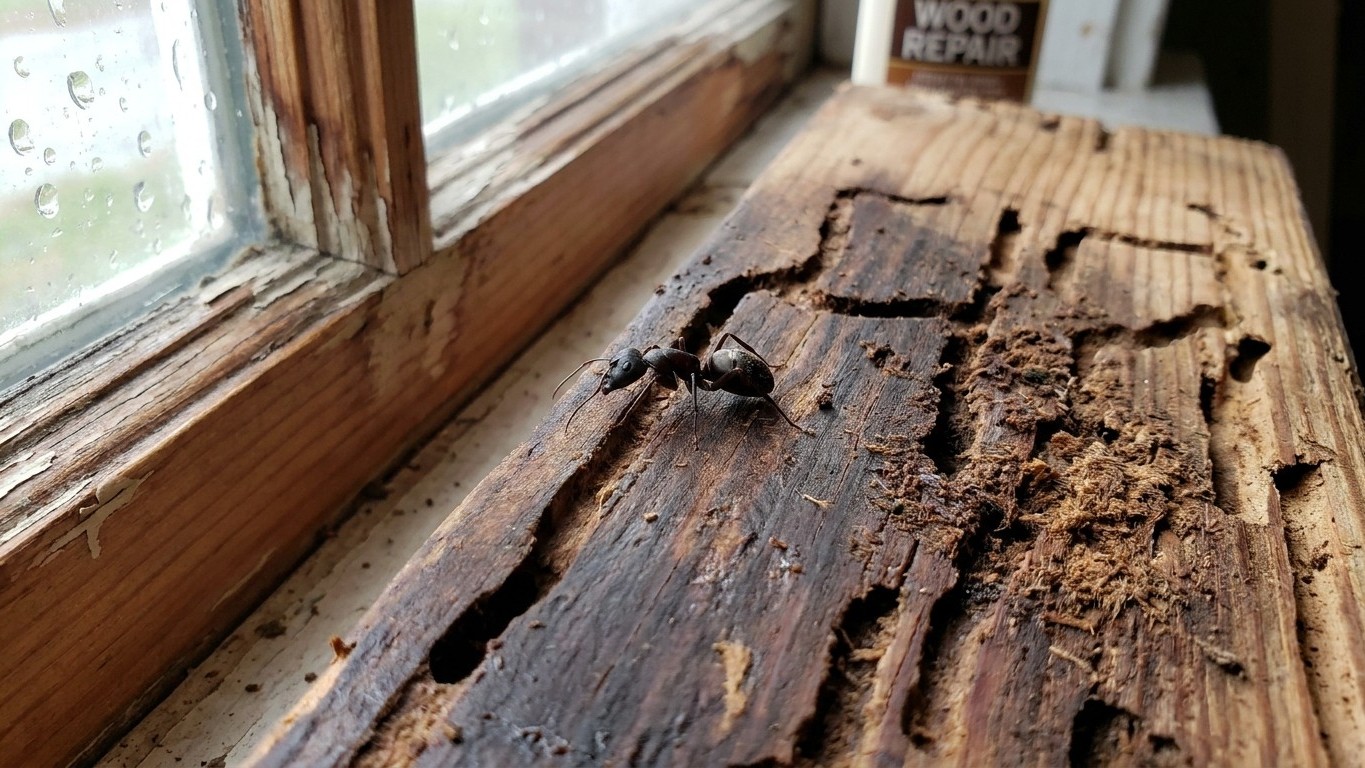

Carpenter ants control succeeds when it follows a sequence: find the nest, cut off what draws it (moisture, wood contact, food), seal entry points, and reach for a pesticide only if the colony survives that pressure. Skipping straight to a spray usually treats the symptom, not the source, and the ants come back within weeks because the wood is still soft and the door frame still leaks.
The order that works

The U.S. Environmental Protection Agency describes this approach under a specific name. “Integrated Pest Management (IPM) is an effective and environmentally sensitive approach to pest management that relies on a combination of common-sense practices.” That phrase, “common-sense,” matters more than it sounds. It means the plan starts with observation, not chemistry.
The first move isn’t treatment at all. “Before taking any pest control action, IPM first sets an action threshold, a point at which pest populations or environmental conditions indicate that pest control action must be taken.” A few scout ants near a windowsill in July is not the same emergency as a steady line marching out of a wall void at dusk. The threshold decides whether you act today or just keep watching.
Once that line is crossed, the next step is confirming what you’re dealing with, not guessing. “IPM programs work to monitor for pests and identify them accurately, so that appropriate control decisions can be made.” Carpenter ants don’t eat wood the way termites do. They excavate it to build galleries, which means the fix targets moisture and structural wood contact, not a food source.
Prevention comes before any product. “As a first line of pest control, IPM programs work to manage the crop, lawn, or indoor space to prevent pests from becoming a threat.” For a house, that’s gutters that drain, firewood stacked away from the foundation, and tree limbs that no longer touch the roofline.
Only after those steps does control enter the picture, and even then, the least aggressive option comes first. “Effective, less risky pest controls are chosen first, including highly targeted chemicals, such as pheromones to disrupt pest mating, or mechanical control, such as trapping or weeding.” Broad spraying sits at the very bottom of that list, treated as an exception rather than a starting point. “Broadcast spraying of non-specific pesticides is a last resort.”
A page, or a homeowner, that opens on a can of spray has inverted this order. Treatment applied to a structure that still offers food, water, and shelter has to be repeated indefinitely, because nothing about the underlying conditions changed. The ants aren’t defeating the product. The house is just still hospitable.
What works without a pesticide
Several tactics require no label and no waiting period, and they carry most of the weight in a carpenter ant situation. None of them is a single fix. Each addresses one piece of why the colony chose your house in the first place.
Exclusion, sanitation, and moisture
Exclusion means sealing the cracks, gaps around utility lines, and rotted trim that give ants a path indoors. It stops new entry but does nothing for a colony already established inside a wall. Sanitation, clearing woodpiles, stumps, and dead branches away from the foundation, removes outdoor satellite nests and food scouting routes, but an indoor parent colony can persist even after the yard is spotless.
Moisture control is often the single most useful step, because carpenter ants favor wood that’s already water-damaged or decaying. Fixing a leaking roof valley, a clogged gutter, or a bathroom vent that dumps into an attic removes the softened wood the colony needs to expand its galleries. It won’t evict an established nest overnight, but it stops the problem from spreading room to room.
Traps and physical removal
Baited traps can draw foraging workers and, over time, give a rough sense of how active a colony is, but store-bought ant traps built for household ants often underperform against carpenter ant colonies, which can be large and split across multiple satellite nests. Physical removal, opening a wall void and vacuuming or scraping out a visible nest, works only when the nest location is confirmed and accessible, which is rarely the case on a first attempt.
The honest limitation across all of these: they lower pressure, they don’t guarantee elimination once a colony is mature. That’s precisely why the EPA’s guidance treats them as the preferred starting point rather than the whole answer. “Effective, less risky pest controls are chosen first, including highly targeted chemicals, such as pheromones to disrupt pest mating, or mechanical control, such as trapping or weeding.” Trapping and exclusion belong at the front of the line, not because they always finish the job, but because they carry the least risk while you find out whether they’re enough.
When a product is warranted
A colony that keeps producing visible workers after moisture is fixed, entry points are sealed, and outdoor nests are cleared has likely moved past what exclusion and sanitation can resolve on their own. That’s the point where a registered pesticide product becomes a reasonable next step, not a first resort.
What that product should be isn’t something a general article can tell you. Registered products differ by state, get reformulated, and get pulled from the market on their own timelines. The label on the container you actually hold is the one document that governs how, where, and how much of it can legally be used in your situation, and it’s written to reflect the current registration in your state. No article can substitute for that.
There’s a reason for that caution beyond legal formality. Pesticides are built to be toxic to the organisms they target, and that same toxicity can affect people when a product is used off-label, in the wrong location, or in larger amounts than the label allows. The EPA specifically flags children, older adults, and people with compromised immune systems as groups facing greater risk from pesticide exposure, which is worth weighing before treating an area near a nursery, a bedroom, or a kitchen counter.
If you’re standing in the aisle looking at two products, or you already have one at home and aren’t sure it’s rated for indoor use, for pets, or for the specific area you’re targeting, that’s a question for people trained to answer it precisely: the National Pesticide Information Center, at 1-800-858-7378. They field exactly this kind of question daily and can speak to your specific situation, your specific state, and your specific label, in a way a general guide never could.
When to stop and call someone
There’s a clear line past which self-treatment stops being a reasonable plan, and it’s worth naming plainly instead of hedging. If you’ve sealed entry points, corrected the moisture problem, cleared outdoor debris, and still see fresh sawdust-like frass or new worker ants after a full treatment cycle, the colony has likely split into satellite nests you haven’t located. That’s a structural search problem, not a product problem, and it usually needs someone with a moisture meter, a stethoscope-style listening device, or the experience to know where colonies tend to hide in your specific type of construction.
Visible structural damage changes the calculation entirely. Carpenter ants excavate galleries through wood over months or years, and by the time damage is visible, whether that’s a soft spot in a windowsill, sagging under a deck ledger, or crumbling wood behind siding, a licensed pest control professional or a structural contractor needs to assess how far it’s spread, not just whether the ants are gone. Structural repair and pest treatment are two separate skill sets, and a homeowner attempting both at once often misses one or the other.
A health question is the third clear boundary. If a household member has a reaction after a pesticide application, whether that’s respiratory irritation, skin contact, or something less obvious, that’s a call to a physician or the National Pesticide Information Center at 1-800-858-7378, not a guessing game with home remedies or a second application. The same applies if you’re unsure whether a product is safe to use around a pregnant household member, an infant, or someone with a compromised immune system; ask before you spray again.
None of these thresholds mean carpenter ants control is beyond a homeowner. Most cases resolve with the sequence described above: threshold, identification, prevention, then the least risky control available. But repeated failure after a genuine attempt, visible damage to structural wood, or a health concern are the three points where handing the job to a licensed professional isn’t giving up, it’s the appropriate next step in the same process the EPA describes.
Common questions
How long does it take to get rid of carpenter ants once treatment starts?
It varies by colony size and how many satellite nests exist, but noticeable improvement usually takes several weeks once moisture sources are fixed and any product used has had time to reach the colony through foraging workers. A single day’s treatment rarely finishes the job on its own.
Do carpenter ants mean my house has termites too?
No. Carpenter ants and termites are unrelated and cause different kinds of damage; carpenter ants excavate smooth galleries in wood without eating it, while termites consume wood fiber. Finding one doesn’t confirm the other, though both are drawn to similarly damp, damaged wood.
Can I use an outdoor ant bait product indoors?
Only if the label specifically allows indoor use. Products are registered for particular sites and uses, and using an outdoor-labeled product inside violates the label and can create unnecessary exposure risk. Check the label or call the National Pesticide Information Center at 1-800-858-7378 if you’re unsure.
Is it normal to see winged carpenter ants indoors?
Winged ants (swarmers) indoors typically signal a mature colony reproducing nearby, often inside a wall or other hidden void, rather than ants that wandered in from outside. That’s a stronger signal to identify the nest location than worker ants alone.