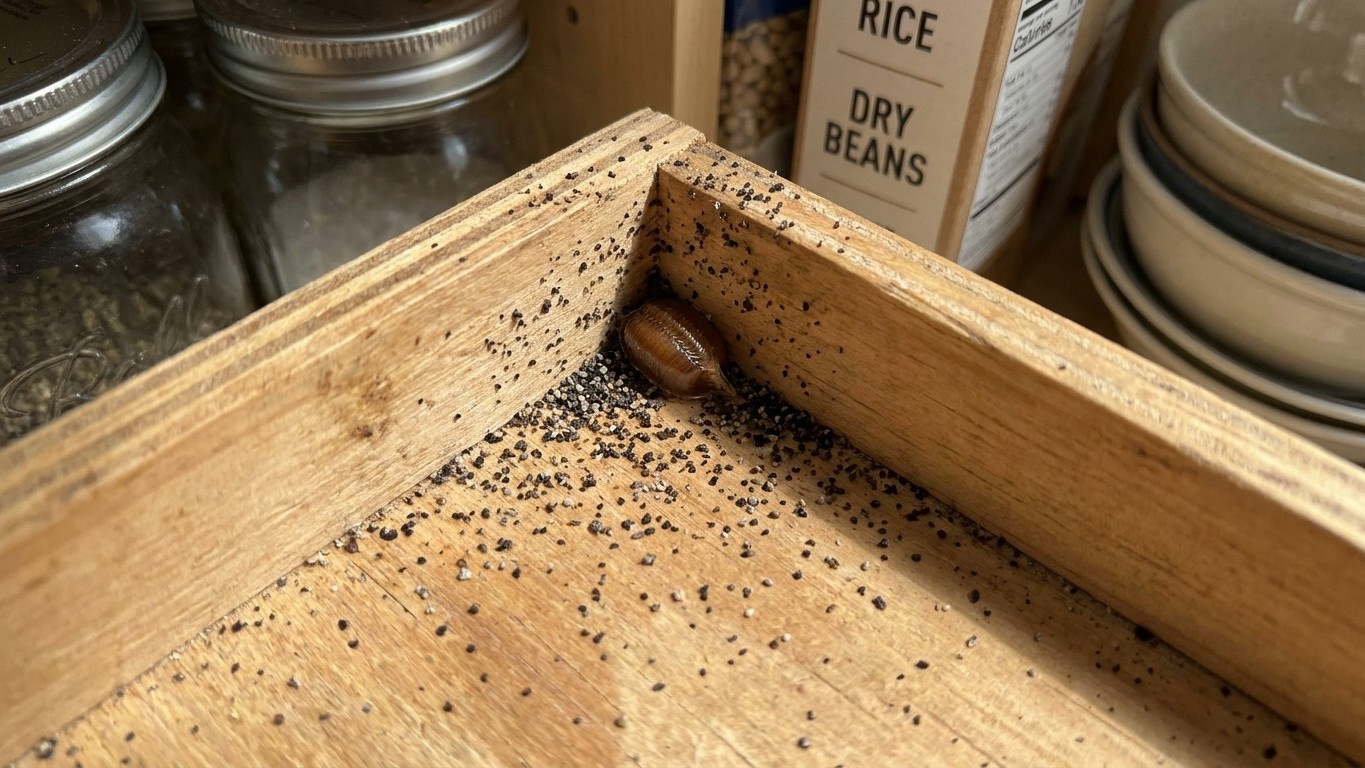

The clearest sign of cockroaches is finding their droppings (tiny dark specks resembling ground coffee or pepper) in cabinet corners, behind appliances, or along baseboards. Egg cases, a musty odor, and shed skins usually show up before you ever see a live roach. If you do spot one crossing the kitchen floor in daylight, the infestation is typically already well established, not just starting.
What you notice first

Most households don’t spot a cockroach first. They spot the evidence, and usually in a specific order. Droppings come first, because roaches produce them constantly and they accumulate faster than the insects themselves show up. Look for them along the underside of cabinet shelves, behind the stove, in drawer tracks, and where pipes enter the wall. German cockroach droppings look like coarse black pepper or coffee grounds; larger species leave larger, ridged pellets that can be mistaken for mouse droppings, a mix-up covered in the next section.
A musty, oily smell is the next clue, and it’s the one people dismiss most often. Roaches release pheromones that build up in enclosed spaces, so a persistent, slightly sweet-and-sour odor coming from a cabinet or behind a refrigerator is worth investigating even without visible insects. Egg cases, called oothecae, are brown or tan capsules about a quarter-inch long, often tucked into corners or glued to cardboard. Finding one intact case suggests recent activity; finding several, plus empty shed casings from nymphs molting, points to a population that’s already reproducing on-site.
The sign people miss
Smear marks, brownish streaks along walls near roach-traveled paths, get overlooked constantly because they look like grime rather than pest evidence. They form when roaches move through damp, dust-covered areas. Combined with any of the signs above, they confirm a travel route, which matters when you’re trying to find the nest rather than just the symptoms.
Seeing a live roach, especially in daylight, is the least common sign but the most alarming one, and for good reason. These insects are nocturnal and avoid light instinctively, so daytime sightings generally mean the population has outgrown its hiding spots. This is precisely why identification has to come before any control decision. As the EPA puts it, “IPM programs work to monitor for pests and identify them accurately, so that appropriate control decisions can be made.” Confirming which signs you’re actually looking at, and which species produced them, decides everything that follows.
What it is confused with
Cockroach signs get misread more often than most pest evidence, largely because droppings, shells, and even the insects themselves overlap visually with several other household nuisances. The mistake matters because it sends people toward treatments, traps, or cleaning routines aimed at the wrong problem, and that’s money and effort spent with nothing to show for it.
| What you found | What it might actually be | How to tell them apart |
|---|---|---|
| Small dark droppings in a drawer or pantry | Mouse droppings | Mouse droppings are slightly larger, tapered at both ends, and often found in a scattered trail rather than a tight cluster; roach droppings are more uniform and gritty to the touch |
| A large brown insect seen outdoors near the foundation | Wood cockroach or “palmetto bug” (an outdoor species) | Wood roaches rarely establish indoor infestations and die off quickly inside; German cockroaches, the common indoor pest, are smaller, tan, and stay near moisture and food |
| Small brown oval shells in a closet | Carpet beetle larvae casings | Carpet beetle shells are fuzzy and found near fabric or wool; cockroach nymph skins are smooth, curved, and found near kitchens or bathrooms |
| A fast-moving insect at night | House cricket | Crickets have long back legs built for jumping and make noise; cockroaches run flat and fast along surfaces and stay silent |
The costliest version of this confusion is treating an outdoor wood roach sighting as if it were a German cockroach infestation. Homeowners sometimes fog or repeatedly bait an entire kitchen for a species that was never going to establish itself indoors in the first place, while a genuine moisture or entry-point issue outside goes unaddressed. Getting the species right isn’t a technicality. It decides whether you’re solving a real problem or chasing one that doesn’t exist.
Telling a sighting from an infestation
One roach is not an infestation. That’s a hard sentence to sit with when you’ve just seen one in your kitchen at midnight, but it’s the judgment call that keeps people from overreacting, and from underreacting when it counts. A single roach that wandered in from a shared wall, a delivery box, or a drain can be a one-off. What turns a sighting into an infestation is a pattern: repeated droppings in the same spots over several days, multiple egg cases in different locations, and insects of different sizes, meaning nymphs alongside adults, which confirms breeding is happening on-site rather than a lone insect passing through.
Where and when matter as much as how many
Location narrows things down fast. Droppings concentrated under the sink, behind the refrigerator, or inside a dishwasher’s base point to an established harborage near water and warmth. Timing matters too: a roach seen scurrying at night when a light flips on is normal behavior for the species. A roach out and moving slowly in daylight, especially more than one, is a sign that the hidden population has grown large enough to push individuals into less favorable spots.
This is where the EPA’s framework becomes genuinely useful rather than abstract. Their guidance is explicit that “before taking any pest control action, IPM first sets an action threshold, a point at which pest populations or environmental conditions indicate that pest control action must be taken.” Treating a home aggressively after one roach sighting skips that threshold entirely, and it’s just as much a mistake as ignoring a dozen droppings and three egg cases because you haven’t personally seen a live insect yet.
A practical way to gauge the threshold without guesswork: place a few sticky monitoring traps in suspected areas (under the sink, behind the stove, near trash storage) and check them after 48 to 72 hours. Zero catches with no droppings or odor suggests a passing sighting. Multiple catches, especially of different sizes, combined with any of the signs from the first section, confirms an established population and moves you past the point where waiting makes sense.
What to do once you are sure
Once the signs add up to a confirmed infestation rather than a stray sighting, two things determine what happens next: what’s drawing them in, and how you actually deal with the population. Cockroaches are pulled indoors by accessible food residue, standing water, and cardboard or paper clutter that gives them shelter, so the conditions that attracted them in the first place need attention alongside any active control. The EPA’s broader framework backs this up directly: “As a first line of pest control, IPM programs work to manage the crop, lawn, or indoor space to prevent pests from becoming a threat,” and only after that does the agency recommend that “effective, less risky pest controls are chosen first, including highly targeted chemicals, such as pheromones to disrupt pest mating, or mechanical control, such as trapping or weeding.” Broad spraying, the EPA notes plainly, “is a last resort,” not a first response.
There’s a documented health dimension here worth stating without exaggeration. Cockroach allergens, from their shed skins, saliva, and droppings, are recognized triggers for asthma and allergic reactions, particularly in children. This is documented by public health authorities, and anyone managing respiratory symptoms alongside a confirmed infestation should raise it with the CDC’s public resources or their local health department rather than treating it as a side detail.
For a heavy or recurring infestation, especially one involving multiple units in an apartment building or a population that’s resisted store-bought baits, a pest control professional is a reasonable first call rather than a last resort. If you have questions about a specific product’s safety or use, the National Pesticide Information Center takes calls at 1-800-858-7378, and your own product’s label, not general advice, is the one that legally applies to your situation.
Common questions
Can cockroach signs appear without any live roaches ever being seen?
Yes. Droppings, egg cases, shed skins, and odor can all be present and accumulating for weeks before anyone in the household spots a live insect, since the species is nocturnal and light-averse by nature.
Do a few droppings always mean an infestation is starting?
Not necessarily. A handful of droppings found once, with no repeat activity, no odor, and no egg cases, may reflect a single insect that entered and didn’t establish. Recurring droppings in the same spot over days is the stronger signal.
Are egg cases dangerous to touch or remove?
They pose no direct danger, but they can hold dozens of nymphs ready to hatch. Removing and disposing of them in a sealed bag, along with cleaning the area, is a reasonable precaution while you assess the extent of the problem.
Is a musty smell alone enough to confirm cockroaches?
No. A musty or oily odor is a supporting clue, not standalone proof, since damp cabinets, mildew, and other pests can produce similar smells. It’s most reliable when paired with droppings, shed skins, or sightings.