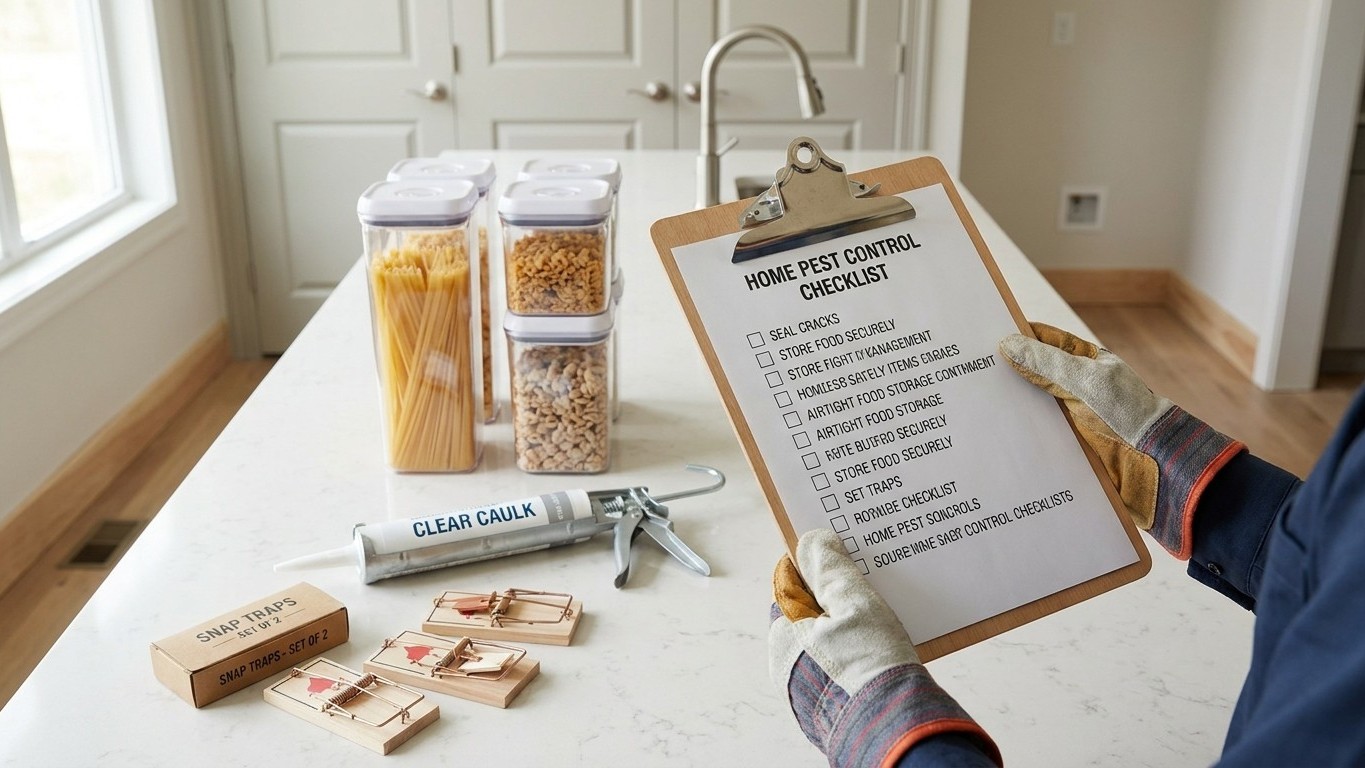

Rat control that actually holds up follows a specific order: shut off their food and water, seal the entry points, then trap. Poison bait is a tool for specific situations, not the default first move. Skip the sequence and you’ll be re-baiting the same corners every few weeks, wondering why the problem never resolves.
The order that works

The EPA didn’t invent Integrated Pest Management for rats specifically, but the framework applies directly. The agency describes IPM as “an effective and environmentally sensitive approach to pest management that relies on a combination of common-sense practices.” The word “combination” matters. No single step, including bait, does the whole job alone.
The sequence starts before any product touches the ground. “Before taking any pest control action, IPM first sets an action threshold, a point at which pest populations or environmental conditions indicate that pest control action must be taken.” For rats, that threshold might be droppings in a pantry, gnaw marks on a baseboard, or a scratching sound in the wall at night, not a vague sense that “there might be mice around.”
Next comes identification. “IPM programs work to monitor for pests and identify them accurately, so that appropriate control decisions can be made.” A Norway rat and a roof rat behave differently, one burrows near foundations, the other climbs into attics, and treating the wrong access point wastes weeks.
Only after that does prevention take the lead. “As a first line of pest control, IPM programs work to manage the crop, lawn, or indoor space to prevent pests from becoming a threat.” For a house, that means food storage, moisture control, and sealing gaps, done before any product decision.
Then comes the choice of method, and here’s where most rushed advice gets it backward: “Effective, less risky pest controls are chosen first, including highly targeted chemicals, such as pheromones to disrupt pest mating, or mechanical control, such as trapping or weeding.” Broadcast pesticide use sits at the bottom of that list on purpose. “Broadcast spraying of non-specific pesticides is a last resort.”
A page, or a homeowner, that opens with bait boxes has inverted this doctrine. Bait applied to a house that still offers rats food, water, and easy shelter treats a symptom. The rats keep coming because the conditions that attracted them haven’t changed, which means the treatment has to be repeated indefinitely, at real cost, with no endpoint in sight.
What works without a pesticide
Exclusion is the physical work of closing gaps. Rats can squeeze through openings as small as a half-inch, so steel wool, hardware cloth, and metal flashing around pipes, vents, and foundation cracks block their entry points. What it doesn’t do: remove rats already inside. Exclusion stops new arrivals; it’s not a treatment for an active infestation on its own.
Sanitation means removing what rats came for in the first place, pet food left in bowls overnight, birdseed spillage, unsecured trash, compost that isn’t rodent-proof. It’s unglamorous and constant, not a weekend project. What it doesn’t do: it won’t dislodge rats that have already established a nest with a stable food source nearby, like a neighbor’s uncovered chicken feed.
Moisture control matters more than most people expect. Rats need water daily, and a leaking outdoor faucet, a clogged gutter, or a damp crawl space can sustain a colony even when food access is limited. Fixing leaks and improving drainage removes that resource. What it doesn’t do: address existing nesting sites, which may be dry and simply close to the food supply.
Traps and physical removal
Snap traps and multiple-catch traps are the mechanical control the EPA lists as a preferred, targeted option, “trapping or weeding” being the literal wording used for this category of low-risk method. Placed along walls, behind appliances, and near confirmed droppings, traps remove individual rats without introducing any chemical into the home. What they don’t do: scale efficiently against a large, established population. A handful of traps in a house with dozens of rats will catch some, but the effort required to keep pace, checking and resetting daily, becomes its own part-time job.
Combined, these four steps form the “common-sense practices” the EPA describes, and they’re also the reason IPM insists prevention comes before any product. A house that’s sealed, dry, and free of accessible food gives rats no reason to stay, which is a very different outcome than a house that’s baited but still leaking water under the sink.
When a product is warranted
There are situations where exclusion, sanitation, and trapping aren’t enough on their own, typically when a population is already established and reproducing faster than traps can remove individuals. In that case, a registered rodenticide product, applied according to its label, becomes a reasonable part of the combination the EPA describes, not a replacement for the earlier steps but an addition to them.
This is also where specifics have to stop. Registered products differ by state, get reformulated, and get pulled from shelves; what’s legally available and appropriately labeled for a given situation changes over time and by location. The label on the product a reader actually holds is the only one that governs its use, not a description in an article. For that reason, no product, brand, active ingredient, or dose belongs in this discussion, and none will be named here.
What matters more than any specific product is understanding the general toxicity involved. Pesticides are built to be toxic to the pest they target, and that same toxicity carries risk to people when a product is used improperly, stored carelessly, or placed where it shouldn’t be. The EPA names three groups as especially vulnerable to pesticide exposure: children, older adults, and people with compromised immune systems. A bait station placed at floor level in a home with a toddler or a pet carries a different risk profile than the same station in a sealed crawl space, and label instructions typically address exactly that kind of placement.
Anyone deciding whether a product is the right next step, or trying to understand what a label actually requires, has a direct resource built for that question. The National Pesticide Information Center takes calls from the public at 1-800-858-7378, and that’s the appropriate place to ask about a specific product’s use, storage, or disposal, rather than relying on general guidance or guesswork. A five-minute call before a purchase, or before placing anything in a home with kids or pets, is a reasonable step, not an overreaction.
Used this way, as one tool within the sequence the EPA lays out, a product fills the gap that traps and exclusion can’t close fast enough on their own. Used as the first and only response, it becomes the repeated, indefinite treatment the earlier section described, expensive, imperfect, and never quite finished.
When to stop and call someone
A rodent infestation inside the structure of a home, walls, attic spaces, crawl spaces with active nesting, is generally past the point where a homeowner’s own efforts resolve it completely. This isn’t a judgment on effort or persistence; it’s a statement about scale. Rats reproduce quickly, nest in spaces that are difficult to access safely, and an infestation established enough to notice by droppings, gnaw marks, or nighttime noise usually means the population is larger than what’s visible.
Pest control professionals bring tools and access that a household setup doesn’t: structural inspection to find every entry point, not just the obvious ones; professional-grade exclusion materials; and the ability to place and monitor treatment in spaces, like deep wall voids or attic insulation, that aren’t practical or safe for a homeowner to enter repeatedly. Saying a home remedy will handle a structural infestation costs more in the long run than the price of a professional call, both in continued damage and in the health exposure of an unresolved rodent presence.
On the health side, what’s documented matters more than what’s feared or downplayed. Rodents are established carriers of disease risks that public health agencies track and describe in detail, including risks tied to droppings, urine, and nesting material, not just bites. The specifics of transmission, symptoms, and risk in a given region are best answered directly by the source built for that purpose. The CDC’s rodent-borne disease resources lay out what’s documented, and a local health department can address regional concerns, like specific disease prevalence in an area, that a national resource can’t cover in detail.
The honest boundary is this: exclusion, sanitation, and traps handle a rat or two that wandered in. A structural infestation, confirmed by sustained noise, multiple droppings sites, or visible nesting, is a professional’s job. Recognizing that line early, rather than after weeks of home remedies that didn’t hold, is what actually saves time, money, and exposure.
Common questions
How do I know if I have one rat or an infestation?
A single sighting, especially outdoors, doesn’t necessarily mean an infestation. Multiple droppings sites, gnaw marks in more than one location, nesting material found in insulation or storage boxes, and sounds at consistent times each night point toward an established population rather than a single visitor.
Do ultrasonic repellent devices work on rats?
The EPA’s framework emphasizes methods with documented effectiveness, like exclusion, sanitation, and trapping, over unverified deterrents. Any device claiming to repel rats without addressing food, water, or entry points isn’t part of the combination approach the EPA describes as effective.
Is it safe to clean up rat droppings myself?
Because rodents are documented carriers of health risks tied to droppings and urine, the CDC provides specific guidance on ventilation, protective equipment, and disinfection before cleanup. Checking the CDC’s guidance before starting is safer than assuming a quick wipe-down is sufficient.
How long does it take to get rid of rats without calling a professional?
There’s no fixed timeline, because it depends on how established the population is and how thoroughly exclusion and sanitation steps are completed. A minor issue caught early, with entry points sealed and food sources removed, can resolve in a couple of weeks with traps. A larger, unaddressed population rarely resolves on a predictable schedule, which is itself a signal to call a professional rather than wait longer.