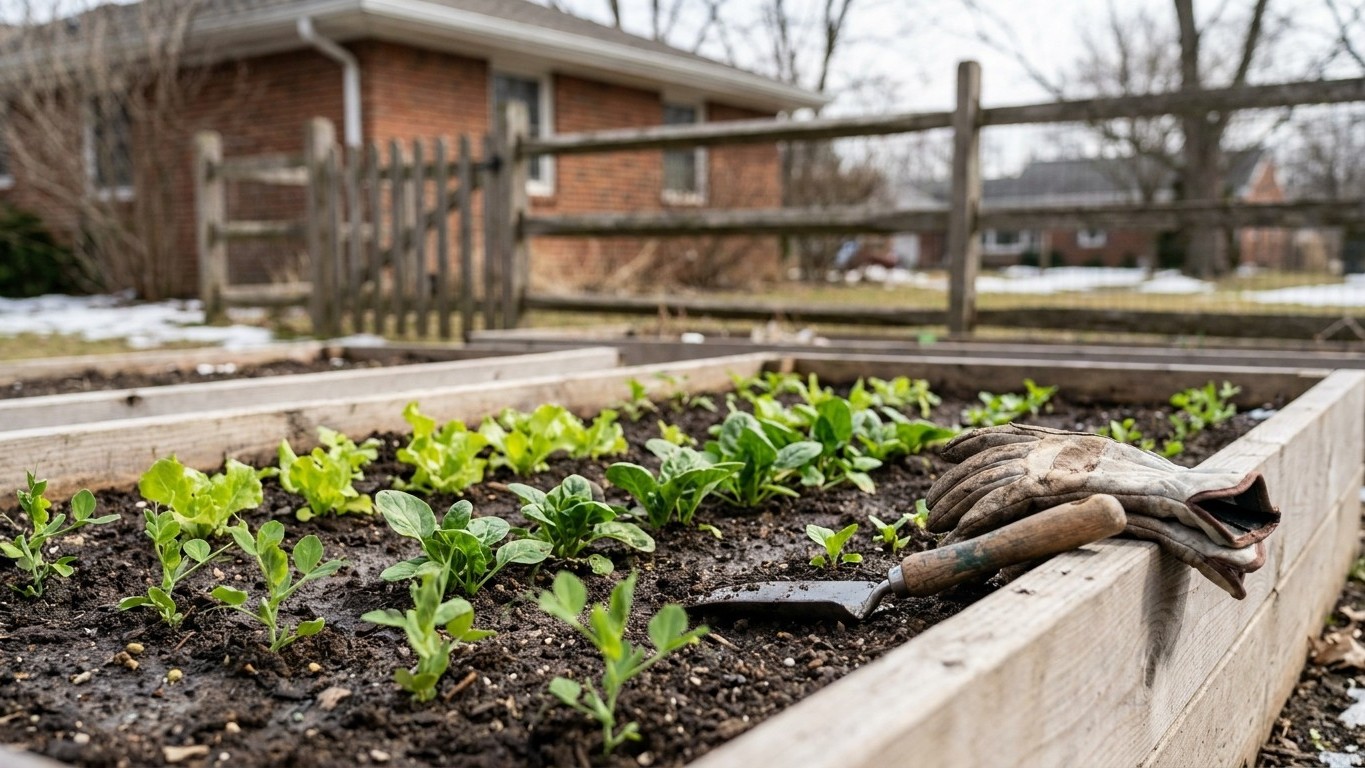

Across most of Quebec, March means the ground is still frozen or buried in snow, so the direct answer is: nothing goes into open soil yet. The month belongs indoors, in cold frames, and in the pruning saw. Seed starting for tomatoes, peppers, and onions begins now, timed backward from an average last frost near May 6.
What goes in the ground in March

The calendar says spring is close. The soil disagrees. Around the Montreal area, the average last spring frost lands near May 6, and that date is a midpoint, not a guarantee: in one year out of two, frost arrives even later. Count backward from there and March sits roughly eight to ten weeks out. Soil at that distance from the frost window is still frozen at depth in most of the province, even on afternoons warm enough to melt the surface crust. That single fact settles the question for open-ground planting: for the large majority of Quebec, nothing goes into bare soil this month.
Say that plainly, then look at what is actually possible. In the mildest, best-drained pockets of the south, mostly in parts of Montérégie and the Monteregian lowlands, gardeners sometimes get a narrow window near the end of the month where the top few inches thaw enough to tuck in garlic or shallot cloves left over from a fall planting that never happened. That is a gamble, not a routine, and it only works where the ground is truly workable, not just soft on top.
Better bets: cold frames and low tunnels set over already-thawed patches, where hardy greens like spinach or mâche can be sown in the last week or two of the month in southern regions. Bare-root fruit trees and cane fruit can go into the ground the moment it is workable, which for most of the province is closer to April, but in the mildest microclimates a late-March planting is not unreasonable if the hole doesn’t fill with meltwater. Indoors, this is prime time for forcing: rhubarb crowns dug and brought into a dark, warm spot will push tender stalks in a few weeks, and chicory roots lifted for Belgian endive (witloof) can be forced the same way. Quebec’s reference hardiness zone, 5b in the Canadian system used by Natural Resources Canada, reflects a province built for patience in early spring, not for planting by the calendar page.
What to start under cover
March earns its keep at the seed-starting bench, and the math runs backward from that same average last frost near May 6. Onions and leeks want the earliest start, roughly ten to twelve weeks before transplanting, which puts their sowing date in late February or the very start of March for anyone aiming to set plants out once the ground is workable. Peppers and eggplant come next, needing eight to ten weeks under lights before they go outside, which lands their seeding squarely in the first half of March. Tomatoes follow close behind at six to eight weeks, meaning mid to late March for most home gardeners.
Cole crops meant for an early transplant, cabbage, broccoli, and their relatives, fit the same six-to-eight-week window and can be started alongside the tomatoes. The arithmetic is simple enough to redo for any county: take the average last frost, subtract the number of weeks a given crop needs before it goes outside, and that is the seeding week. Because May 6 is a mean and not a promise, build in slack rather than shaving it close.
The two ways this goes wrong are mirror images of each other. Start too early, guessing the season will be kind, and tomatoes and peppers end up rootbound and leggy in their trays weeks before the soil is warm enough to take them, stretching toward the light and stressing hard once transplanted. Start too late, and short-season crops run out of daylight before the first fall frost, which averages October 5 at the same reference station, giving a growing window that simply won’t stretch to cover a late start. Neither mistake is fatal on its own, but both cost real yield.
What is ready to pick
Outdoors, the honest answer is close to nothing. Snow cover or frozen ground rules out fresh harvest across nearly all of the province, and even the toughest overwintered kale or leeks are usually locked under a crust rather than available for cutting. What still feeds the table comes from two places: the cold frame and the cellar.
A cold frame or low tunnel set up in the fall, or even a well-insulated raised bed, can hold spinach, mâche, and hardy lettuce in a state gardeners call “standing still,” alive but not growing much, ready to harvest a few leaves at a time whenever the frame is opened on a mild day. Indoors, sprouts and microgreens fill the gap fast, ready in one to two weeks from seed with nothing more than a windowsill and a tray.
The other job this month is inspection, not harvest. Squash, potatoes, and onions held in cold storage since fall should get a hands-on check: soft spots on squash spread quickly and the affected fruit should come out before it touches its neighbors, potatoes that have started to sprout heavily are better used first, and onions gone soft at the neck are the ones to cook now rather than save. Forced rhubarb and chicory, started earlier in the month, come ready to cut around three to four weeks after forcing begins, giving fresh stalks and tender leaves well ahead of anything outdoors.
The jobs that matter this month

March in Quebec is a working month even without a spade touching open soil, and the list is long enough to fill every free weekend before the ground thaws.
Dormant pruning tops it. Apple, pear, and plum trees, along with raspberry and currant canes, should be pruned while they’re still fully dormant and before buds swell, since cuts made after growth starts cost the tree more sap and more stress. This is also the last realistic window to do it before spring work crowds it out.
Seed ordering belongs here too, and it is more time-sensitive than it looks: popular varieties, especially short-season tomatoes and cold-hardy greens bred for northern gardens, sell out from Quebec seed suppliers by early spring most years. Waiting until April routinely means settling for whatever’s left.
Soil work fits the quieter days well. A soil test sent out now comes back with results in time to amend before planting, rather than guessing all season. Compost piles built in fall benefit from a turn as soon as they’ve thawed enough to work, speeding decomposition before it’s needed in the beds. Tools deserve the same attention: pruners cleaned and sharpened, shovels and hoes checked for loose handles, all before the rush when there’s no time to stop.
Round it out with the less glamorous chores: repairing raised bed frames and fencing damaged by frost heave or snow load, planning crop rotation on paper before the beds fill up, and one more pass through the root cellar or storage room checking for anything starting to turn. None of this is filler. Skipped now, every item on this list becomes a scramble in April or May.
What not to do in March
The classic mistake is trusting the air instead of the soil. A mild stretch in March, sometimes reaching well above freezing for a few days, tempts gardeners to treat it as spring. It isn’t. Soil several inches down is still cold, often still frozen, regardless of how warm the afternoon feels, and any warm-season seed or transplant put into it will sit and rot rather than grow.
A close cousin of that mistake is uncovering too soon. Rose cones, mulch piled over perennials, and winter protection on tender shrubs exist precisely for the frost that comes after a false thaw. Pull them off during a mild spell and a return to normal March or April cold, well within the frost window that runs on average to May 6, can undo a whole winter’s protection in one night.
Fertilizer timing trips people up too. Nitrogen applied to dormant lawns or beds this early mostly washes away before roots are active enough to use it, feeding runoff more than the garden. It’s a wasted bag and, in some regions, an avoidable source of nutrient runoff into local waterways. The better move on all three counts is the same: wait for the soil itself, not the thermometer or the calendar, to signal that it’s ready.
Checking this against your own county
Everything above is built on a single reference station near Montreal, and Quebec is far too large a province for one date to fit it all. Elevation, distance from the St. Lawrence, and simple latitude shift these windows by weeks: a garden in the Eastern Townships or Montérégie can be safely ahead of one in Saguenay–Lac-Saint-Jean, the Gaspésie, or Abitibi-Témiscamingue, where frost lingers well past what this page describes.
Treat the dates here as a starting point, then check them against local conditions and against the resources maintained by Quebec’s Ministère de l’Agriculture, des Pêcheries et de l’Alimentation (MAPAQ), which tracks regional planting guidance across the province.
Common questions
Can I plant anything outside in Quebec in March?
For most of the province, no. The ground is typically still frozen or snow-covered. The rare exception is garlic or shallot cloves tucked into already-thawed soil in the mildest southern pockets, and even that is a gamble rather than a routine practice.
When is it safe to start tomato seeds indoors in Quebec?
Counting back six to eight weeks from the average last spring frost near May 6 puts tomato seeding in mid to late March for most home gardeners. Because May 6 is a mean date, not a guarantee, some growers wait to shift closer to the later end of that window rather than risk leggy plants sitting too long indoors.
What hardiness zone is Quebec in?
The reference city used on this page falls in Canadian hardiness zone 5b, based on Natural Resources Canada’s Plant Hardiness Site using 1991-2020 normals. This is the Canadian zone system, built on seven climate variables, and it does not convert directly to the USDA zone system used elsewhere.
When can I expect the first fall frost in Quebec?
Near the Montreal reference station, the average first fall frost falls around October 5. As with the spring date, this is a midpoint rather than a fixed cutoff, and colder or more northern regions of the province see frost arrive noticeably earlier.