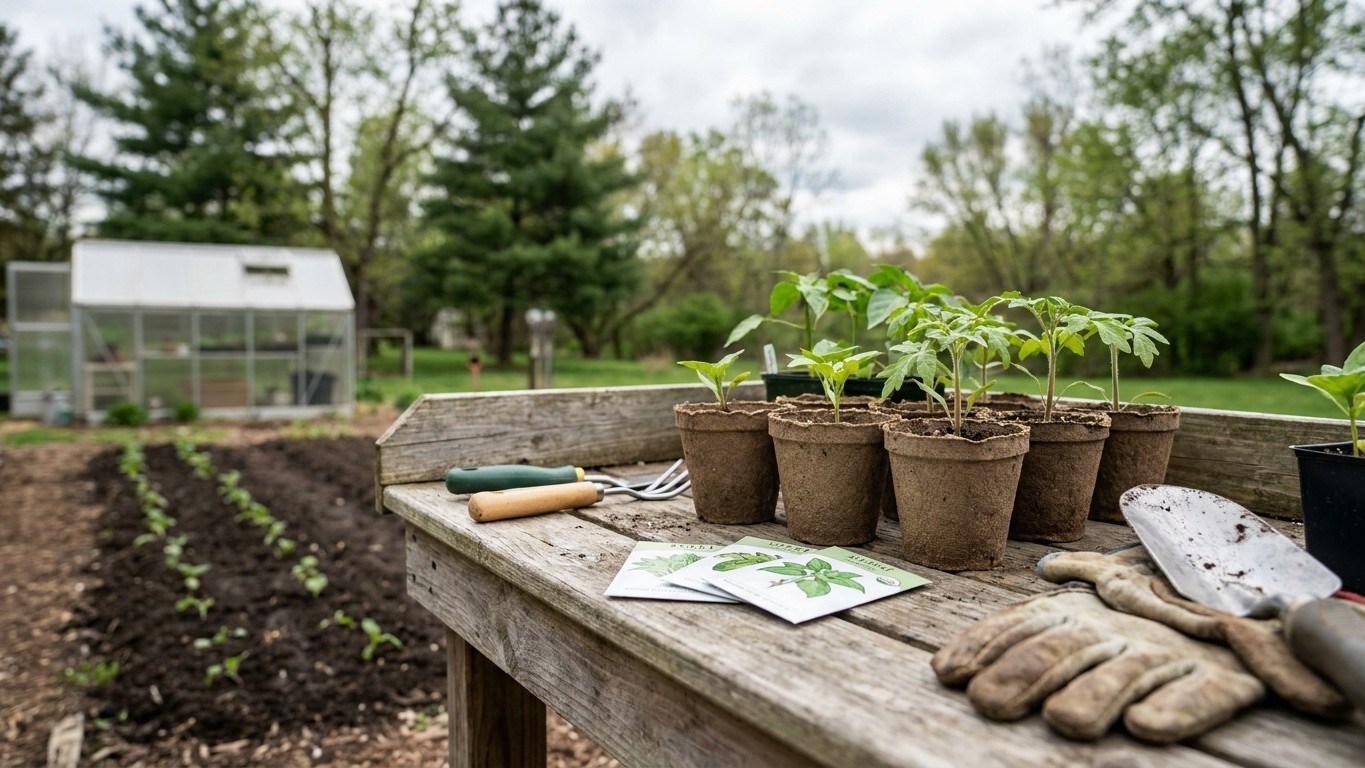

The honest answer for April in Quebec is: soil prep, indoor starts, and a handful of frost-tolerant crops if the ground has thawed enough to dig. The mean last spring frost for the Montreal area sits at May 6, which puts most of April on the cold side of that line. What changes the answer week to week is whether the ground is workable at all, not what the calendar says.
What goes in the ground in April
Soil temperature decides this month, not air temperature. A sunny afternoon in the low 60s can feel like planting weather while six inches down the ground is still near freezing and waterlogged from snowmelt. Since the mean last frost for the region sits at May 6, April sits almost entirely before that window closes, and that date is a midpoint, not a guarantee: in roughly half the years on record, frost arrives later still. Treat anything planted in April as a bet on hardiness, not on luck.
That said, the ground is rarely a total no-go once the frost comes out of it, usually in the second half of the month across southern Quebec and later further north or at elevation. Once a garden bed can be worked without turning into mud, several crops tolerate what April still throws at them:
- Peas, direct-sown as soon as the soil crumbles rather than clumps
- Spinach and arugula, both of which shrug off a light frost
- Onion sets and shallots, pressed in as soon as beds are workable
- Garlic that missed its fall planting window, though fall-planted garlic will always outperform it
- Bare-root fruit trees, canes, and asparagus or rhubarb crowns, planted while they are still dormant
Cold frames and low tunnels stretch this list. Under cover, lettuce, radishes, and hardy greens can go in two to three weeks ahead of open-ground timing, because the plastic or glass buys several degrees of protection on cold nights. Tomatoes, peppers, beans, squash, and anything else that dies at 32°F stay indoors or under grow lights this month, full stop. The soil simply has not caught up to the calendar yet.
What to start under cover
Work backward from that May 6 mean frost date rather than from a fixed date on the wall calendar. Tomatoes generally need six to eight weeks indoors before they are ready to move outside, which puts an early-April sowing on track for a late May or early June transplant, comfortably past the mean frost line with some buffer for a late year. Peppers and eggplant run slower, often eight to ten weeks, so an April start is already tight; if it was not done in March, get it going the first week of April rather than waiting further.
Brassicas move faster and tolerate more cold once they are out of the seed tray. Broccoli, cabbage, and kale started indoors four to six weeks before transplant can go outside while there is still a real chance of frost, since young transplants of these crops shrug off temperatures that would kill a tomato seedling outright. That makes April sowings of brassicas useful for a transplant date in early-to-mid May.
Two mistakes show up every spring. Sowing too early leaves warm-season starts sitting in small pots for weeks longer than they should, and they get rootbound and leggy, stretching toward the light and never quite recovering once they finally go in the ground. Sowing too late does the opposite: the transplant misses its window and spends the rest of the season trying to catch up to a plant that went in on time. Counting backward from the mean frost date, and padding that count by a week or two for a late year, solves both problems at once.
What is ready to pick
Little comes out of an open garden bed in Quebec in April, and there is no point pretending otherwise. What does come out tends to be things that spent the winter in the ground or under cover, quietly waiting for the thaw.
Parsnips and Jerusalem artichokes (sunchokes) left in the soil over winter are often at their sweetest right after the ground softens, since the cold converts their starches to sugar. Kale and leeks that overwintered under snow cover can still be harvestable if they were mulched well and the crowns survived. Cold frames that held lettuce or spinach through the tail end of winter may be giving their first real cuttings of the season by mid-to-late April.
Indoors, sprouts and microgreens fill the gap for households wanting something fresh every week regardless of what the garden is doing. Rhubarb crowns brought indoors and forced in the dark produce tender, pale stalks well ahead of the outdoor harvest, which typically waits until late May or June.
This is also the month to walk the root cellar or storage shelves with a critical eye. Squash with soft spots, potatoes that have started to sprout aggressively or shrivel, and onions gone soft at the neck should come out and get used or composted before they take the rest of the bin down with them. A single rotting potato in a bag of good ones will spread trouble faster than most gardeners expect.
The jobs that matter this month
April rewards gardeners who get ahead of the season rather than waiting for it to arrive. Dormant pruning of fruit trees, grapevines, and cane fruit like raspberries needs to happen before buds swell and break; prune too late and every cut becomes an open wound on actively growing wood, inviting disease and slowing the plant’s spring push. This is close to the last comfortable window for that job in most of the province.
Seed ordering has a deadline too, even if it feels informal. Popular varieties, especially disease-resistant tomatoes and anything sold in limited runs, sell out through March and April, and a gardener who waits until the ground is ready to think about seed often finds the good options already gone.
Soil testing pays off disproportionately when done now, before anything is planted and while there is still time to correct a pH problem or add amendments that need weeks to break down. Compost piles that sat dormant over winter benefit from a turn as soon as they thaw enough to work, which speeds up the breakdown that will feed summer beds.
Beyond that, April is the month to walk the property with a checklist: sharpen and oil pruners and shovels before the rush starts, check fencing and raised bed frames for winter damage, and firm up a rotation plan so tomatoes are not going back into the same bed they occupied last season. None of this is glamorous, but skipping it costs real time in May and June, when there is no slack left in the schedule to catch up.
What not to do in April
The most common mistake is planting warm-season crops because the air finally feels like spring. A run of 65°F afternoons does not mean the soil has warmed to the 60°F or higher that tomatoes, peppers, and squash need to establish; planted into cold, wet ground, their roots stall, and the plants often end up stunted for the rest of the season even if they survive. Wait for the soil itself, not the forecast, before those crops go outside.
Pulling mulch off beds too early after a mild stretch is the second trap. A week of warm days can trick a gardener into stripping winter protection from perennials, garlic, or strawberry beds, right before a cold snap returns and damages the tender new growth that mulch was hiding and protecting. Since the mean frost date sits well into the first week of May, a mild April stretch is not proof the cold is done.
Nitrogen applied at the wrong moment causes its own problems. Feeding fruit trees or perennial beds heavy nitrogen before real growth resumes pushes soft, sappy new growth that is more vulnerable to a late frost, rather than helping the plant establish. Hold off until buds are actively opening and growth is underway.
Finally, working wet soil compacts it, undoing months of good structure in a single afternoon of impatient digging. If a handful of soil forms a tight, sticky ball instead of crumbling, it is too wet to till or dig, no matter how good the weather looks.
Checking this against your own county
A province-wide frost date is a starting point, not an instruction for a specific backyard. Elevation, proximity to the St. Lawrence River, and the long north-south stretch of Quebec all shift these windows by weeks in either direction. A garden near Montreal and a garden two or three hours north or at higher elevation are not working from the same clock, even in the same province. The hardiness zone figure used here, Canadian zone 5b, applies to the reference area near Montreal used throughout this site and does not describe the whole province, let alone convert to a USDA zone.
For local planting windows and frost guidance specific to a county or region, Quebec’s Ministry of Agriculture, Fisheries and Food (MAPAQ) is the extension-equivalent resource worth checking before committing seed to soil.
Common questions
Is it too early to plant tomatoes outdoors in April in Quebec?
Yes, in almost every part of the province. The mean last spring frost sits at May 6, and that date is only a midpoint, meaning frost arrives later in roughly half the years on record. Tomatoes started indoors in April should stay under cover until late May or later.
Can garlic still be planted in April if it was missed in the fall?
It can, and it will still produce, but fall-planted garlic that spends the winter establishing roots almost always outperforms a spring-planted crop in bulb size. Spring garlic is a fallback, not the first choice.
What is the safest crop to direct-sow outdoors in April?
Peas and spinach are the most forgiving options once soil can be worked without clumping. Both tolerate light frost and germinate in cool soil that would rot warm-season seeds.
Why does a cold frame make such a difference this early in the season?
A cold frame or low tunnel traps daytime heat and blocks wind, often raising the effective growing temperature by several degrees on both sides of a cold night. That gap is often enough to let lettuce, radishes, and hardy greens go in two to three weeks ahead of open-ground timing.