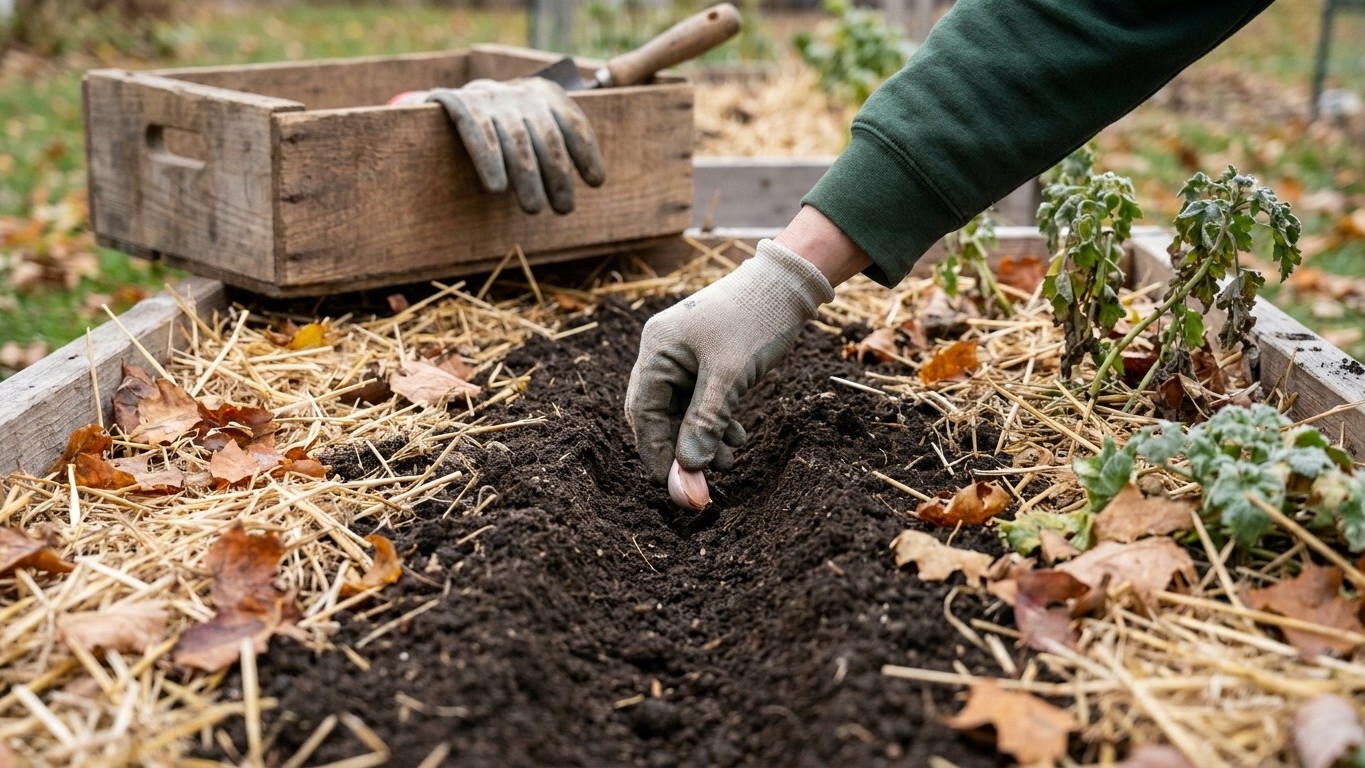

Vermont’s growing season is essentially closed by November. The state’s average first fall frost lands between October 3 and October 13 near Burlington, so by the time November opens, the ground is already cooling and locking up across the higher counties. The honest short answer: garlic and shallots if the soil is still workable, cold frames or low tunnels for a handful of hardy greens, and indoor work such as forcing rhubarb or planting bare-root stock. Open-ground planting is nearly finished for the year.
What goes in the ground in November
The calendar says November, but the soil doesn’t read a calendar. What matters is whether the ground is still workable, meaning not yet frozen solid, and whether there’s enough time left before a hard freeze locks things down for good. Vermont’s first fall frost (October 3-13, NOAA NCEI 1991-2020 normals for the Burlington station) has already come and gone by the time November starts, so the question isn’t “will it frost” anymore. It’s “how much working soil is left before winter takes over.”
The state’s USDA hardiness zones run from 3b in the coldest interior pockets up to 5b along the Lake Champlain shoreline near Burlington, which sits at the mild end of that range while the Green Mountains and the Northeast Kingdom run considerably colder and freeze up sooner. That spread matters more in November than in almost any other month, because it decides whether a gardener still has a week of workable dirt or none at all.
What still fits
For most of the state, tender and warm-season crops are a non-starter this month, full stop. What’s genuinely still possible:
- Garlic and shallots, planted into unfrozen soil, ideally with a few weeks left before the ground locks up so roots can establish before dormancy.
- Cold frames and low tunnels holding already-established hardy greens like spinach, mache, or claytonia through the cold stretch.
- Bare-root and dormant plantings of fruit trees, berry canes, and shrubs, while the soil can still be dug.
- Forced rhubarb or chicory, where roots are dug and brought into a dark, cool indoor space to push tender growth without any outdoor soil involved at all.
Everything else, from lettuce transplants to any warm-season vegetable, is a gamble not worth taking. Once the ground is frozen, none of it matters anyway.
What to start under cover
Counting backward from a frost window only works when the frost window is close. Vermont’s last spring frost falls between April 30 and May 10 near Burlington, which puts that date roughly five to six months away from November. That’s too far out for almost every seed-starting calculation that matters for transplants, and it’s worth saying plainly: starting tomatoes, peppers, or most annual flowers indoors this month is simply too early. Six months indoors under lights produces rootbound, leggy, exhausted seedlings long before the ground is ready for them.
Even alliums, which need one of the longest indoor head starts of any garden crop at 10 to 12 weeks, don’t math out to November. Counting back 10 to 12 weeks from an April 30-May 10 frost window lands in mid-February to early March, not late fall. Anyone starting onions or leeks now is looking at four extra months of pot-bound seedlings before they can go outside, which is the first failure mode: starting too early and ending up with weak, stretched plants that never really recover.
What actually belongs under cover this month runs on a different clock. Seeds that need cold stratification, meaning a sustained period of chill before they’ll germinate, such as many native perennials and some fruit tree seed, can be sown into pots and set into a cold frame or an unheated space now, left to experience winter naturally, and left to sprout on their own timeline come spring. Microgreens and sprouts indoors don’t run on frost math at all; they’re a rolling harvest that can restart every week or two regardless of season, and November is as good a time as any to keep that cycle going while the outdoor garden rests.
What is ready to pick
Outdoors, there isn’t much left standing in a Vermont garden by November, and it’s worth saying that directly rather than stretching the list. Most annual crops are done. What’s still worth checking:
- Overwintered kale and leeks, which can hold in the ground under a layer of mulch or even snow and stay pickable well into the cold months, especially in the milder valleys.
- Cold-frame greens like spinach and mache, which slow down but keep producing small harvests as long as the frame holds some warmth on sunny days.
- Sprouts and microgreens grown indoors, which fill the gap for fresh greens when nothing outdoors is producing.
The bigger job this month is in the root cellar or the pantry, not the garden bed. Stored squash, potatoes, and onions all need a check-in: squash with a soft spot or a sweet smell is starting to break down and should get used first; potatoes that are sprouting or going green need sorting out; onions that feel soft at the neck are on their way to rotting and will spread that rot to their neighbors if left in the pile. A few minutes of sorting now saves a whole bin later.
The jobs that matter this month
A quiet-looking garden still has a full workload attached to it, and November’s list is long. Skipping any of it doesn’t cost the current season, since that’s already closed, but it costs the next one.
Outdoors before the ground locks up
- Dormant pruning of fruit trees and berry canes, done once the plant has fully dropped its leaves and gone dormant, which reduces disease risk and shapes growth for the coming year.
- Mulching perennials, garlic beds, and young trees once the ground has cooled but before it’s frozen solid, to buffer roots against the freeze-thaw cycles that heave plants out of the soil.
- Protecting young trunks from rodents and deer with guards or wrap, since bark damage over winter can girdle and kill a young tree.
- Checking beds, trellises, and fencing for repairs while the ground is still soft enough to reset a post or stake.
Indoors and on paper
- Ordering seed early, since popular varieties of vegetables and flowers routinely sell out before late winter.
- Testing and amending soil, because amendments like lime need months to change soil chemistry, and fall applications have all winter to work in.
- Turning the compost pile one more time before it freezes, and cleaning and sharpening tools before they sit unused for months.
- Planning next season’s rotation, mapping out which beds grew what so the same family of crops isn’t repeated in the same spot.
None of this is filler work. It’s the difference between a garden that starts strong in spring and one that spends its first month catching up.
What not to do in November
The classic November mistake in Vermont is trusting a mild afternoon over the calendar and the soil. A run of 55-degree days can feel like an invitation to plant something tender or to pull covers off a cold frame, but a single overnight freeze afterward will undo all of it. The safer read is the trend over the coming week, not the temperature on any one afternoon.
A second common error is uncovering beds too early after a warm stretch, only to have the next cold snap catch hardy greens or newly mulched crowns with no protection. Once mulch or row cover goes on for the winter, it should generally stay put until there’s a real, sustained warm-up, not just a one-day thaw.
Fertilizing at the wrong point does real damage too. Nitrogen applied late in fall pushes soft new growth right before the plant needs to be hardening off for winter, and that tender growth is exactly what a hard freeze kills first. If soil needs amending, lime and phosphorus-heavy amendments that work slowly over winter make sense now; nitrogen-heavy feeds don’t.
Finally, garlic planted too late is a quiet failure that doesn’t show up until spring. Cloves need a few weeks of unfrozen soil to grow roots before going dormant. Planted right before a freeze, with no rooting time at all, they often come up weak or not at all the following year.
Checking this against your own county
A statewide month is a starting point, not an instruction. Vermont’s terrain moves frost dates and freeze-up by weeks on its own: the Champlain Valley around Burlington runs milder and later into fall than the Green Mountains or the Northeast Kingdom, where elevation and cold-air pooling bring the freeze in sooner. A garden at 1,500 feet in the mountains can have frozen ground while a valley garden thirty miles away is still workable.
Before acting on any date in this article, check it against local conditions through the University of Vermont Extension, which tracks frost and planting timing specific to the state’s counties and elevations.
Common questions
Can I still plant garlic in Vermont in November?
Yes, as long as the soil is still workable and hasn’t frozen. Garlic planted with a few weeks of unfrozen ground ahead of it has time to root before going dormant for winter. Once the ground is frozen solid, it’s too late.
Is it too late to prune fruit trees in November?
No. Dormant pruning is done once the tree has dropped its leaves and gone fully dormant, which for most of Vermont happens well before or during November. Pruning during dormancy reduces disease risk compared to pruning during active growth.
What can I still harvest outdoors in a Vermont garden in November?
Overwintered kale and leeks can hold in the ground under mulch, and cold-frame greens like spinach or mache may still produce small harvests. Beyond that, most fresh food is coming from storage (squash, potatoes, onions) or from indoor sprouts and microgreens.
Why shouldn’t I start seeds indoors this month for spring planting?
Vermont’s last spring frost falls between April 30 and May 10 near Burlington, five to six months away from November. Starting most transplants this early means months of rootbound, leggy seedlings under lights before the ground is ready for them outside.