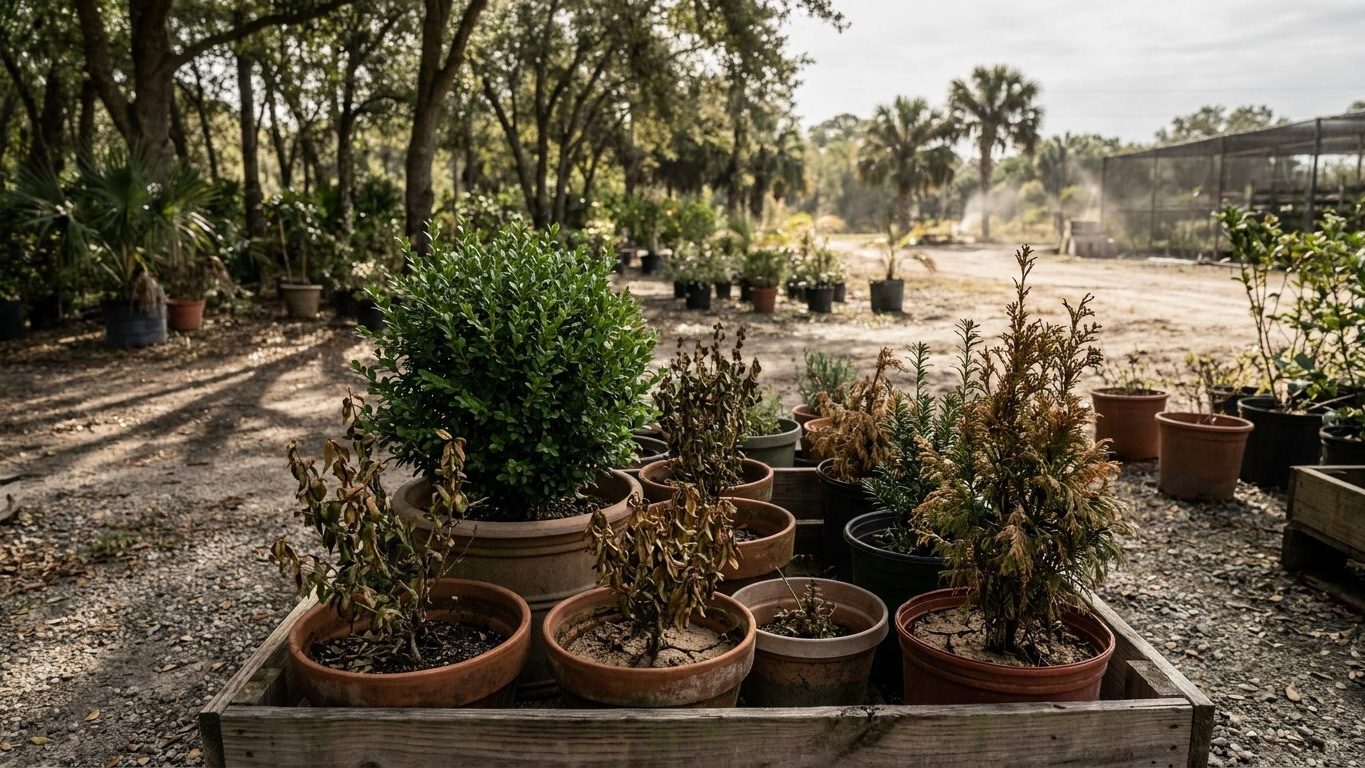

Six hedge plants survive winter anywhere in Vermont: American hornbeam, winterberry holly, eastern red cedar, arborvitae, eastern hemlock and arrowwood viburnum. Four more survive only in the milder zones. Two popular names, Leyland cypress and cherry laurel, do not survive in the state at all. Vermont runs from zone 3b to 5b on the USDA Plant Hardiness Zone Map 2023, so a tag reading “hardy to zone 5” means something different in the Northeast Kingdom than it does near Lake Champlain.
What actually holds in Vermont
Nursery tags use the USDA zone system, which rests on one number: the average annual extreme minimum temperature. Vermont covers 3b, 4a, 4b, 5a and 5b. Of the 12 hedge species in this series, six hold across all of those zones, four hold in part of them, and two hold nowhere. “Holds” here means the plant survives winter. A shrub sitting at the cold edge of its range can live for years and still look battered every April.
Which hedge plants will not survive in Vermont?
Leyland cypress (x Hesperotropsis leylandii) and cherry laurel (Prunus laurocerasus) are not hardy anywhere in the state, the mildest pockets included. Both are sold as quick evergreen screens in catalogs and garden centers, which is how they end up in Vermont yards. A row of either is a loss waiting for the first hard winter. If a neighbor’s photo shows one thriving, it was probably planted somewhere warmer.
Which hedge plants survive in only part of Vermont?
Four plants need your zone named before you buy:
- Boxwood (Buxus sempervirens): zones 5a and 5b only.
- Inkberry holly (Ilex glabra), an evergreen: zones 4a through 5b.
- Privet (Ligustrum vulgare): zones 4a through 5b.
- Yew (Taxus x media): zones 4a through 5b.
None of the four holds in 3b. Boxwood is the pickiest, since it drops out in 4a and 4b as well. Look up your zone by ZIP code on the USDA map before you shop, because a county can contain more than one.
Which hedge plants hold across all of Vermont?
Three conifers and three deciduous shrubs make the list: eastern red cedar, arborvitae and eastern hemlock, plus American hornbeam, winterberry holly and arrowwood viburnum. Winterberry loses its leaves in winter, so it is the one holly here that will not screen a view from November to May. These six are the safe bets in the coldest corners, and they are the only ones to plant if you live in 3b.
The hedges you can never cut back down
Eastern red cedar and arborvitae cannot regrow from old wood. Cut into the brown, leafless interior and the branch stays bare. Neither plant sprouts new growth from those older stems, so a hedge that gets too tall or too wide can only be trimmed within the green growth. Taking it back to a smaller size later is not an option. Of the 12 species in the series, these two are the ones to choose with the final size in mind.
How big will red cedar and arborvitae get as a hedge?
Eastern red cedar grows 12 to 24 inches a year and reaches 8 to 20 feet as a screen. Left alone for three seasons, it can add 3 to 6 feet. The only pruning it takes is light cuts in late winter. It suits a windbreak or a long property line where height is the goal. It is a poor choice for a narrow strip beside a driveway.
Arborvitae (Thuja occidentalis) is slower, at 6 to 9 inches a year, and reaches 4 to 15 feet as a hedge. You can prune it in late winter before growth starts, or in midsummer. A small trim every year keeps it where you set it. Skip a few years and it stays as tall as it grew, with no way to reduce it.
Which Vermont hedges can be cut back hard?
The rest of the list forgives mistakes. American hornbeam, winterberry holly, arrowwood viburnum, inkberry holly, privet, yew and boxwood all regrow from old wood. A neglected hedge of any of them can be cut hard and will fill in again. Hornbeam grows about 12 inches a year and takes its trim in midsummer after the first flush. Arrowwood is pruned right after flowering. Winterberry and inkberry go in late winter while dormant. Yew is pruned in late spring after the new growth hardens, and privet twice a season, in spring and again in midsummer.
Eastern hemlock sits in between. It regrows from old wood, but it is pruned in late spring with light cuts only. Treat it as forgiving rather than invincible. It grows 12 to 24 inches a year and reaches 10 to 20 feet as a hedge, so it needs room.
If you inherit a cedar or arborvitae hedge that has gone too tall, the choices are living with it or replacing it. Hard pruning will not rescue it.
Matching the plant to the job
Here is every hedge plant that survives in some part of Vermont, side by side.
| Plant | Where it holds | Height as a hedge | Growth a year | When to prune | Regrows from old wood |
|---|---|---|---|---|---|
| American hornbeam | 3b to 5b | 6 to 15 feet | 12 inches | Midsummer, after the first flush | Yes |
| Winterberry holly | 3b to 5b | 5 to 15 feet | 6 to 12 inches | Late winter, dormant | Yes |
| Eastern red cedar | 3b to 5b | 8 to 20 feet | 12 to 24 inches | Late winter, light cuts | No |
| Arborvitae | 3b to 5b | 4 to 15 feet | 6 to 9 inches | Late winter, or midsummer | No |
| Eastern hemlock | 3b to 5b | 10 to 20 feet | 12 to 24 inches | Late spring, light cuts | Yes |
| Arrowwood viburnum | 3b to 5b | 6 to 10 feet | 12 to 24 inches | Right after flowering | Yes |
| Inkberry holly | 4a to 5b | 5 to 15 feet | 6 to 12 inches | Late winter, dormant | Yes |
| Privet | 4a to 5b | 4 to 12 feet | 2 to 3 feet | Spring and midsummer | Yes |
| Yew | 4a to 5b | 3 to 8 feet | 6 to 12 inches | Late spring, after new growth hardens | Yes |
| Boxwood | 5a and 5b | 2 to 6 feet | 3 to 6 inches | Late spring, after the last frost | Yes |
For a fast privacy screen, the growth column decides. Hemlock and red cedar add 12 to 24 inches a year, and privet adds 2 to 3 feet where it holds. Hemlock keeps its needles all winter and takes light cuts only, as does cedar. Privet is the quickest of the three, but it needs two trims a season to stay neat.
For a low, formal edge along a walk or garden, yew reaches 3 to 8 feet and holds in 4a and warmer. Boxwood is the classic choice, staying at 2 to 6 feet and growing only 3 to 6 inches a year. It is slow to fill and limited to 5a and 5b, so it only fits the milder valleys.
For a mixed, informal hedge, hornbeam, arrowwood and winterberry all grow in every zone and regrow after hard pruning. Inkberry is the evergreen option for 4a and warmer. Gardeners in neighboring states face similar choices, and the guides for Hedge Plants for New Hampshire: What Holds, and What Only Looks Hardy and Hedge Plants for Massachusetts: What Holds, and What Only Looks Hardy show where the lists overlap. Readers in the cold north can compare with Hedge Plants for Minnesota: What Holds, and What Only Looks Hardy. Hedge Plants for Maryland: What Holds, and What Only Looks Hardy shows how far the list shifts in a warmer climate. The wider Hedges section covers planting and care.
Timing matters too. At Burlington, on Lake Champlain, the last spring frost falls between April 30 and May 10, and the first fall frost between October 3 and October 13. The Green Mountains and the Northeast Kingdom run substantially shorter, so a “late spring” trim comes later there. Nothing on the table calls for pruning in late October. The next windows open in late winter.
The ground you are planting into
What is Vermont’s state soil like?
Vermont law named the Tunbridge series the official state soil in 1985. It is a Spodosol, a sandy, acid, strongly leached soil that typically forms under conifers. The USDA records a surface pH of about 3.5, which is strongly acid, with 79 percent sand and 21 percent clay and well-drained conditions. Organic matter is about 75.0 percent. That figure describes the natural forest litter on top of the mapped soil, and a cultivated garden bed will have far less.
Those numbers describe what this soil does across the Vermont hills: it sheds water quickly and runs acid. They do not describe your yard. The values come from the surface layer of 442 mapped components of the series, and the state has hundreds of other soil series. River bottoms, valley clay and any lot a builder has scraped or filled can behave completely differently.
How do you check the soil where the hedge will go?
Test it. A soil test gives your own pH, and the report will say whether lime is needed. University of Vermont Extension can point you to testing and explain how to read the results. Take samples from the actual hedge line, since soil can change across a few yards of slope.
A simple check helps before you dig. Fill a planting hole with water and watch it. If it drains in a few hours, the ground is free-draining like the Tunbridge series, and a new hedge will need regular watering through its first season. If water sits in the hole overnight, you are on heavy or compacted ground, and a mound or a different spot is worth considering. Plant evergreens while the ground is still unfrozen, and check with your local extension office for timing in your area. Keep them watered until it freezes.
Common questions
Can I grow boxwood in northern Vermont?
Only in zones 5a and 5b. It does not hold in 3b, 4a or 4b, which covers most of the hill country and the Northeast Kingdom. In those zones, yew (4a and warmer) or arborvitae (all zones) give a similar formal look.
Is it worth trying Leyland cypress or cherry laurel?
No. Neither is hardy in any part of Vermont. Choose eastern hemlock or arborvitae for an evergreen screen that survives every zone in the state.
Which hedge can I cut back if it outgrows its space?
Hornbeam, winterberry, arrowwood, inkberry, privet, yew and boxwood all regrow from old wood. Hemlock does too, though it only wants light cuts. Eastern red cedar and arborvitae do not regrow from old wood, so trim them lightly every year.
Should I prune my hedge this month?
Not in late October. The schedules run from late winter to midsummer, depending on the plant. Wait until late winter for holly, cedar and arborvitae, and until after flowering or the first flush for arrowwood and hornbeam.