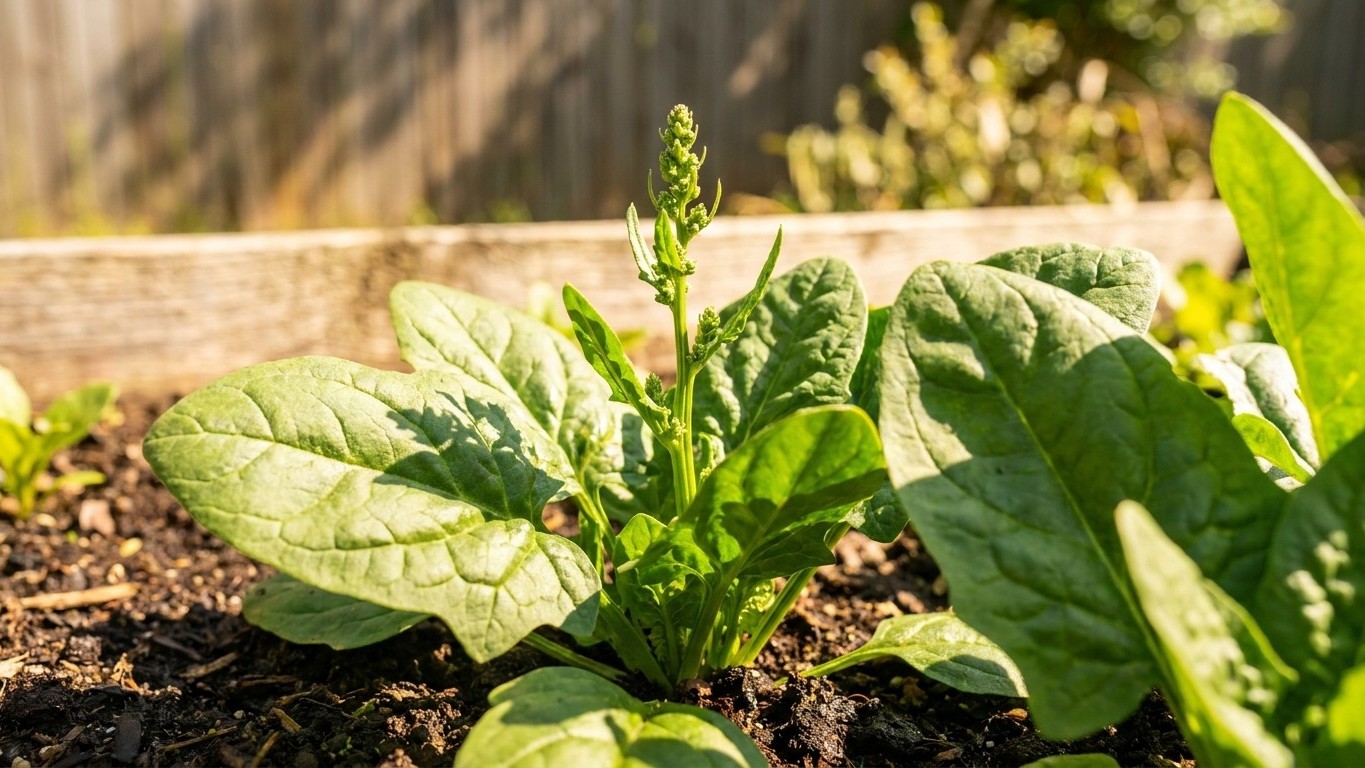

Cut spinach when the plant holds a full rosette of leaves about as long as your palm, and before the center begins to rise. In Vermont that means roughly late May to mid-June for a spring sowing, and late September into the first hard freezes for a fall one. Once cut, the leaves keep two weeks at most, and only at 32°F. A household fridge shortens that. Here is how to time it all, as covered more broadly in Growing Spinach in Vermont.
When spinach is ready in Vermont
Start cutting outer leaves once the plant has six or more leaves of eating size. Keep cutting until the center stem lengthens and the new leaves turn narrow and pointed. Those two signs bracket the harvest, and they hold in any year, whatever the calendar says.
The calendar still helps. Around Burlington, on Lake Champlain, the NOAA NCEI climate normals put the last spring frost between April 30 and May 10, and the first fall frost between October 3 and October 13. That is the mildest corner of the state. The Green Mountains and the Northeast Kingdom run substantially shorter, so shift your dates accordingly. Spinach shrugs off frost, so sow it as soon as the soil can be worked, well before the last-frost window closes. An early April sowing gives a cutting window that opens in late May and closes in mid-June.
Why does the spring window close so fast?
Two things end it. Heat comes first. Utah State University Extension says spinach grows best where temperatures do not exceed 75 F. That same number is where leaves turn bitter, so a warm spell can spoil the flavor before the plant gives any other sign. Burlington averages only 5.4 days a year at 90 F or higher, which sounds mild. Spinach quits long before 90 F, so that low count does not rescue it.
Day length is the second cause, and it surprises people. Spinach bolts during long days as well as warm temperatures. The longest day at Burlington carries 15 h 22 of daylight, and the days are already long by late spring. A cool northern summer does not buy extra weeks. If the plants sit in the row too long, they flower no matter how mild the weather feels. Will Spinach Bolt Early in Vermont? goes through what that looks like in the row.
Fall runs on a different clock. The Extension advice is to plant early enough that the crop matures before the heat arrives. If you want leaves in hand around the first fall frost window, that means sowing between late July and late August. The catch is the soil. Seed germination drops once the soil climbs above 80 F, and late-summer ground can stay that warm. Sow in shade, water the row, or wait a week or two for the soil to cool. Fall plants grow into shortening days and falling temperatures, so they don’t bolt the way spring plants do.
When you cut, take the outer leaves about an inch above the crown and leave the center growing. A cool spell will give you several more cuttings from the same plants. Once the center stem starts to stretch, cut the whole plant at the base and eat it that week. Leaf-eaters can shorten the window too, and What Eats Spinach in Vermont, and When covers the usual culprits.
Keeping it, and for how long
The UC Davis Postharvest Technology Center, in its Produce Facts Sheets for spinach (postharvest.ucdavis.edu), gives the optimum as 0°C (32°F) with 95-98% relative humidity. It calls spinach highly perishable and says it will not maintain good quality for more than 2 weeks. That is the ceiling under ideal conditions. It is not a schedule for your kitchen.
The same fact sheet is blunter about what happens along the way. Wilting, yellowing of leaves, and decay are likely to increase once storage runs past 10 to 14 days. At common distribution conditions of 5 to 10°C (41 to 50°F), the decline comes faster. A home fridge sits in or near that range, so a bag of garden spinach that looks fine on day three may be sliming by day seven.
Can you really hold spinach for two weeks?
Only if everything goes right. Thirty-two degrees is the freezing point of water, so the optimum sits right at the edge of frozen leaves. Humidity of 95-98% is close to the air in a bathroom after a hot shower. Few kitchens offer both at once. Plan on eating cut spinach within a few days, and treat anything older as a bonus.
That short shelf life changes how you harvest. In cool weather, the garden row is the best storage you have. Leave the plants standing and cut only what you will eat in the next day or two. This works in spring until the bolting signs appear, and in fall until a hard freeze. Cut in the cool of the morning, and get the leaves into the cold quickly, because leaves warmed by the sun start aging before they reach the fridge.
When the bolting signs force your hand and you cut the whole row at once, you have a storage problem. Part of the crop can go into the freezer or the cooking pot that day. The rest goes into the coldest, dampest corner of the kitchen, which is where the next section picks up.
Where in the house that actually is
A domestic fridge runs warmer than 32°F, and the door runs warmer still because it swings open and sits next to room air. A door shelf can land in the 41 to 50°F range where spinach yellows in days. The closest match to the optimum is the back of the bottom shelf, where cold air settles. A crisper drawer at the bottom can serve too if you keep the humidity vent closed.
Keep leaves off the back wall itself. Where the cooling element sits behind it, leaves touching the wall can freeze at the edges. A fridge thermometer is a few dollars and tells you what the shelf is actually doing. If it reads well above the low 30s, that is why the spinach is not lasting.
How do you keep spinach moist without making it slimy?
High humidity in a home fridge comes from the packaging. Put dry, unwashed leaves in a plastic bag, press out most of the air, and leave the top loose. Or wrap the leaves in a barely damp towel and slide the bundle into the bag. If you cut whole plants at the base, stand the cut ends in an inch of water in a jar and drape a bag loosely over the top. Each method gives the leaves a humid pocket without soaking them.
Wet leaves rot, so wash only when you are about to eat. Standing water around the cut ends is fine, because the stems drink it. Water pooled on the leaves is a different matter. It speeds the yellowing and decay that the postharvest sheet warns about. If leaves feel limp but still look green, a few minutes in cold water can revive them. Yellow, slick, or foul-smelling leaves go in the compost.
Put the bag on the back of the bottom shelf, never in the door. Skipping that one move can cost you most of the shelf life, since the door’s warmer air brings the fast decline that begins in days rather than weeks.
Common questions
Can I cut spinach more than once?
Yes, while the weather stays cool. Take the outer leaves and leave the center intact. The plant keeps producing new leaves from the middle for several cuttings. Once the center stem starts to stretch, or the new leaves narrow and turn bitter, cut the whole plant and pull the row.
When is the last safe sowing date for fall spinach?
Around Burlington, that puts a sowing in late July to late August for harvest near the first fall frost window of October 3 to 13. In the Green Mountains and the Northeast Kingdom, where frost arrives earlier, count back from an earlier date. Warm soil is the real obstacle, because germination drops above 80 F.
Which spinach varieties should I grow?
Your county extension office can tell you which of them, or which others, do best in your elevation and soil. Buy fresh seed each year, and sow a small row every couple of weeks in spring so the cutting window stretches out.
How long does cut spinach last in the fridge?
UC Davis Postharvest says spinach will not hold good quality beyond 2 weeks even at 32°F with 95-98% humidity, and that decline speeds up past 10 to 14 days. A household fridge is warmer than that, so use cut spinach within a few days. Keep it in a loose bag on the back of the bottom shelf, and check it daily.