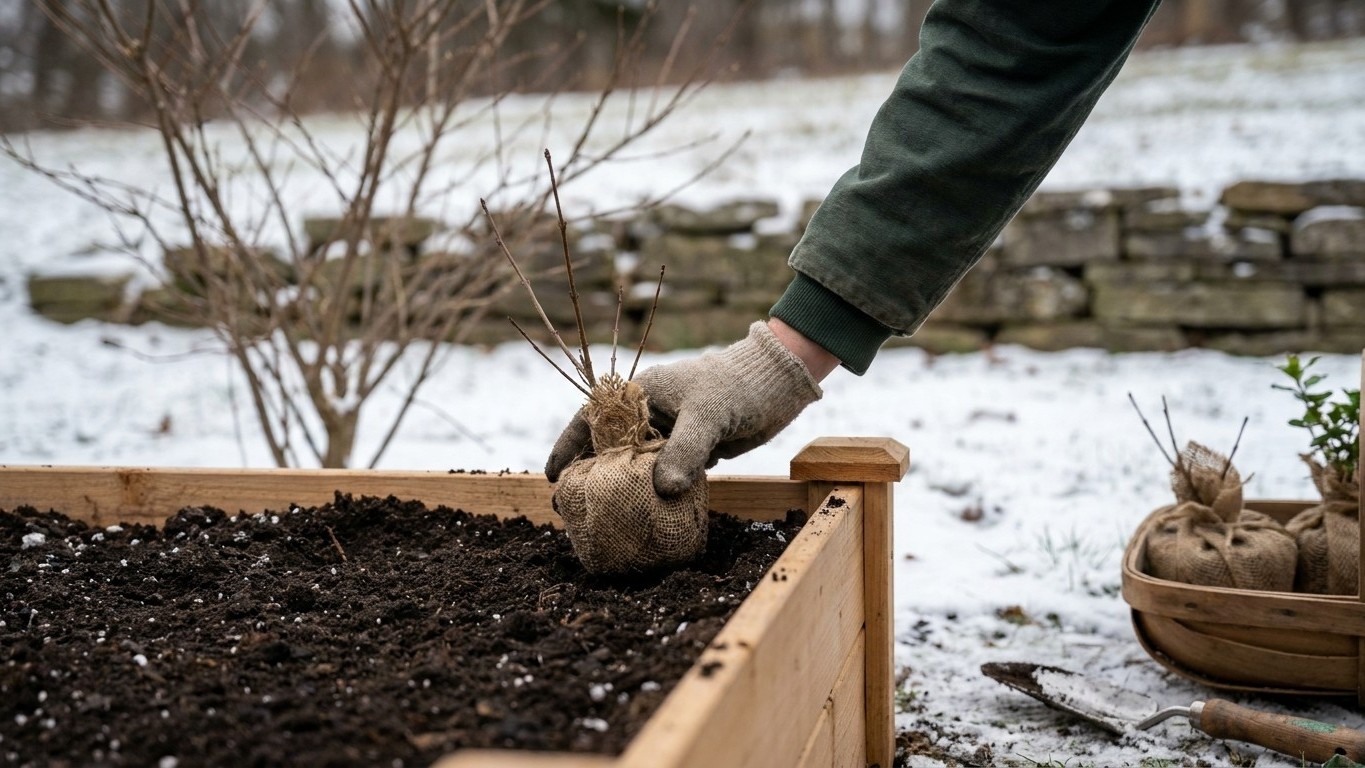

December offers almost nothing for open ground in West Virginia: garlic and shallots still working into unfrozen soil, cold frames holding hardy greens, and dormant bare-root planting for fruit trees and shrubs. Everything else waits. The state spans USDA zones 5a to 7a, and Charleston’s growing season closed between October 18 and November 1.
What goes in the ground in December

Charleston’s growing season, per NOAA’s 1991-2020 climate normals, closed somewhere between October 18 and November 1. The next one doesn’t open until April 9 to April 23. December sits almost exactly in the middle of that gap, the deepest point of the dormant stretch. Soil temperature, not the reading on a thermometer nailed to the porch, decides what a seed or root can do underground, and by December most West Virginia soil has dropped well below the threshold where roots build new tissue.
That’s the honest starting point: for the vast majority of crops, nothing goes into open ground this month. A short list still works, and none of it depends on warmth.
Garlic and shallots carry the widest margin. Cloves pushed into loosened, unfrozen soil will sit through winter and root slowly even at low soil temperatures, breaking dormancy on their own schedule once spring arrives. In valley locations, where ground often stays workable into early December, there’s still a window to get cloves in, mulch heavily, and walk away. Bare-root fruit trees, brambles, and some perennial crowns can also go in wherever the site drains well and isn’t frozen solid, since dormant roots are only trying to establish before the ground locks up hard, not trying to grow.
Cold frames and low tunnels change the math by raising soil and air temperature a few degrees, often enough to keep already-established spinach, mache, and claytonia alive rather than dead. That’s maintenance on plants already in place, not new planting, but it counts. Indoors, forcing rhubarb crowns or chicory roots in a dark, cool space produces tender stalks or chicons within weeks, drawing on stored energy from last season rather than anything the plant pulls from December light.
How elevation shifts the answer
| Location type | Typical December soil | What’s still possible |
|---|---|---|
| River valley (near Charleston) | Workable most of the month unless a hard freeze sets in | Garlic, shallots, bare-root planting |
| Mid-elevation slopes | Frozen at the surface most mornings, thaws by afternoon on mild days | Cold frame maintenance only |
| Ridge tops and higher counties | Frozen solid for extended stretches | Indoor forcing and dormant pruning only |
What to start under cover
Work backward from the frost window instead of the calendar, and December looks different depending on what’s being counted.
Take onions or leeks started from seed, a crop that typically needs eight to twelve weeks indoors before it goes out as a transplant after the last frost. Counting back from the April 9-23 window puts the seed-starting date somewhere in late January to mid-February, not December. Start onions now and they’ll be leggy, rootbound, and stressed long before the ground is ready for them, the classic too-early failure.
Long-season peppers and some artichoke varieties sit at the other edge of that math. Peppers needing ten to fourteen weeks of indoor growth before transplanting push their start date back into February for most gardens, but a few extra-long or slow-germinating varieties, paired with a plan to pot up twice under grow lights, can reasonably begin in late December without outrunning the plant’s own pace.
The safer December work under cover is less about the outdoor transplant date and more about extending what already exists. Cold frames and unheated hoop houses holding spinach, arugula, mache, and other cold-hardy greens can be reseeded in mild pockets, since these crops germinate at soil temperatures far lower than tomatoes or squash ever will, and they finish in weeks rather than months.
Microgreens and sprouts sidestep the frost-window math completely. Grown on a counter or windowsill, they’re ready in one to three weeks regardless of what the soil outside is doing, making them the most reliable indoor project on the calendar. The failure mode to watch for either way is the same one: start too early against April’s window and end up with stretched, weak transplants; start too late and the plant never catches up to the season it needs.
What is ready to pick
Outdoors, the honest answer is close to nothing. Whatever wasn’t harvested before the ground locked up is either finished or waiting under cover, and December’s job is checking on it rather than planting anything new.
Kale, collards, and other hardy brassicas left standing often keep producing usable leaves through repeated freezes, sometimes tasting sweeter for the cold since frost converts stored starches to sugars. Leeks behave the same way, sitting under mulch or even snow and pulling fine whenever the soil isn’t frozen solid enough to fight. Cold frames carrying spinach, mache, arugula, or claytonia can be harvested a few leaves at a time all month, as long as the frame is opened during the warmer part of the day rather than left sealed and humid.
Indoors, sprouts and microgreens fill the gap other crops leave. A tray started on the counter in early December is ready before the month ends, and a second tray started a week later keeps the supply steady.
Stored crops need a hands-on check now, not a glance. Squash should be firm with no soft spots or sunken patches near the stem. Potatoes that have sprouted, wrinkled, or turned green at the surface should come out and get used first, since green skin signals solanine buildup and shouldn’t be eaten. Onions gone soft at the neck or starting to sprout are on borrowed time and belong in the next meal, not back in storage. Going through the root cellar or pantry shelf once this month, pulling anything questionable before it spreads rot to its neighbors, saves more of the harvest than any storage setup managed earlier in the season.
The jobs that matter this month

December’s real work happens above ground, in the shed and the orchard rather than in freshly turned beds, and skipping it costs real ground in spring.
Dormant pruning of fruit trees and brambles carries the tightest deadline. Apple, pear, and stone fruit trees prune most safely while fully dormant and the wood is hard, before sap starts moving with the first warm stretch. Cutting now, while the tree’s structure is visible without leaves, also makes it far easier to spot crossing branches, disease, and damage that summer foliage would have hidden.
Seed ordering belongs on this list too, not as an afterthought. Popular varieties, especially disease-resistant tomatoes and anything sold by a small regional supplier, sell out before the ground thaws, and ordering in December beats competing for the last packet in March.
Soil testing works better in the cold months than most assume, since a lab result now gives enough lead time to source and apply lime or amendments before spring planting, rather than trying to correct pH in the same week seeds go in. Compost piles built up over fall benefit from a turn now too, keeping the pile from going anaerobic through the wet, cold months so it’s ready by spring.
Tools deserve the attention they rarely get during the growing season. Cleaning soil and sap off blades, sharpening pruners and hoes, and oiling wooden handles before they crack in a cold shed all take an afternoon and pay back in tools that actually work when spring arrives. Raised beds, fencing, and trellis structures are easier to repair now, without a live crop in the way, and a sagging post or rotted bed corner found in December is one less emergency in April. Planning next season’s rotation on paper while last season is still fresh keeps the same crop family from landing in the same bed two years running, a habit that heads off a lot of soil-borne disease before it starts.
What not to do in December
A stretch of fifty-degree days in the middle of December convinces plenty of gardeners that spring has arrived early. It hasn’t. Air temperature swings fast; soil temperature moves slowly, and a warm afternoon does nothing to the frozen or near-frozen ground a few inches down. Planting anything tender based on how the air feels is the month’s most common and most avoidable mistake.
Uncovering cold frames or removing winter mulch after one of those mild spells is a close second. Pulling protection off hardy greens or newly planted garlic because the weather turned pleasant leaves them exposed for whatever cold follows, and cold snaps after a warm stretch are common through the whole winter in this state.
Feeding nitrogen now works against the plant rather than for it. Nitrogen pushes soft, leafy growth, and any new growth encouraged in December has no chance to harden off before the next hard freeze, leaving weak tissue that dies back and stresses the plant more than doing nothing at all would have.
Working the soil while it’s wet or frozen causes damage that lasts well past winter. Walking on or digging into saturated or half-frozen ground compacts it, squeezing out the pore space roots and soil life depend on, and that compaction doesn’t fix itself until it’s mechanically broken up again, often not until well into the next growing season.
Leaving stored crops unchecked for weeks at a time is the quiet mistake. One soft potato or moldy onion left in a bin spreads rot to everything touching it, and a five-minute check every week or two catches the problem while it’s still just one vegetable, not a whole bin.
Checking this against your own county
A garden a few hundred feet higher, or tucked into a north-facing hollow, can lag weeks behind these dates, and West Virginia’s terrain moves from river valley to ridge top over surprisingly short distances.
A state-wide month is a starting point, not an instruction. The West Virginia University Extension Service tracks conditions and planting guidance at the county level, and a call or visit to the local office is the fastest way to find out how far these dates shift for a specific address, elevation, and slope.
Gardeners who plant by the Moon can check the December 2026 moon planting calendar, a tradition rather than a proven method.
Common questions
Can I still plant garlic in West Virginia in December?
In many spots, yes, especially in valley locations where soil hasn’t frozen solid. Fall planting in October or November gives cloves a head start, but workable December ground still allows planting with a heavy mulch layer afterward.
What vegetables can survive winter in a West Virginia garden without cover?
Kale, collards, and other hardy brassicas, along with leeks, routinely handle repeated freezes standing in the open garden. Their flavor often improves as cold converts stored starches to sugar.
Is it too late to start seeds indoors in December?
It depends on the crop. Onions and most peppers meant for an April transplant are started too early in December and will end up stressed and rootbound. Microgreens and sprouts have no such constraint and can be started any week of the month.
Should I prune fruit trees in West Virginia in December?
Yes. Dormant-season pruning, done while trees are fully leafless and sap hasn’t started moving, is the safest window for apples, pears, and stone fruit, and it makes structural problems far easier to spot than during the growing season.