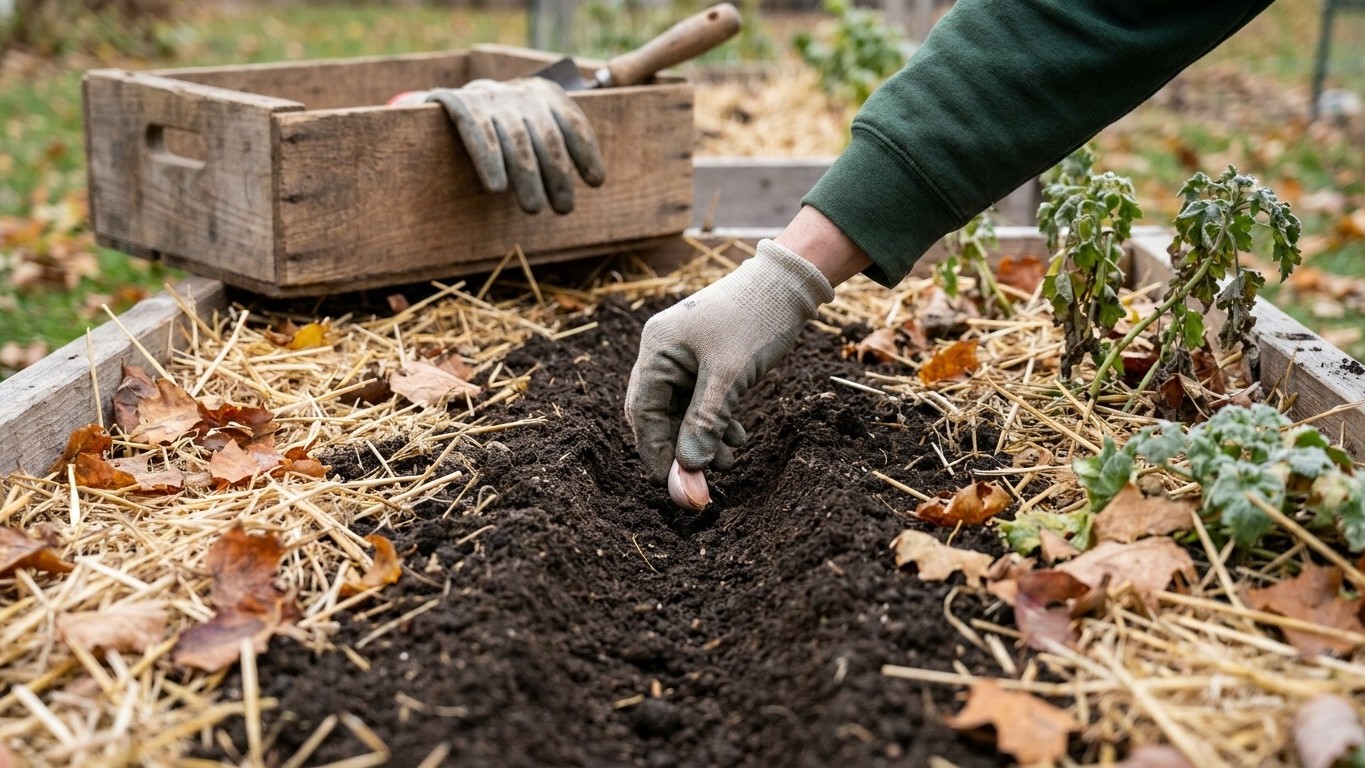

By November, the ground in West Virginia has already had its first hard frost almost everywhere in the state, so the honest answer is that very little goes into open soil this month. Garlic and shallots are the exception, and they still go in as long as the ground is workable. Everything else moves under cover, into cold frames, or onto the pruning and planning list.
What goes in the ground in November

The reference station in Charleston puts the first fall frost between October 18 and November 1, based on NOAA’s 1991-2020 climate normals. That means by the time November opens, most of the state, including higher ground that freezes earlier than the river valley where that station sits, has already crossed into the season where tender and even semi-hardy crops are done. This isn’t a guess about the calendar. It’s a threshold that’s already passed for the month you’re standing in.
What that leaves is narrow, but real. Garlic cloves and shallot sets still go into the ground through November wherever the soil hasn’t frozen solid or turned to mud. Push cloves root-down about two inches deep, space them a hand’s width apart, and mulch heavily with straw once the ground has had its first freeze. That mulch layer is what protects the developing roots through the coldest stretch and what you’ll pull back in spring.
Cold frames and low tunnels extend what’s possible. A cold frame built over a bed of spinach, mache, or hardy lettuce sown a few weeks earlier can keep those plants alive and slowly growing through most of the winter, even in the higher zone 5a pockets of the state. Low tunnels made from hoops and row cover do the same job on a bigger bed, buying several degrees of frost protection.
Bare-root fruit trees, roses, and berry canes are typically shipped and planted from late fall into early spring while they’re dormant, and November is within that window for much of West Virginia, provided the ground isn’t frozen at planting time. Rhubarb and chicory can also be dug and brought indoors now for forcing, a way to pull fresh, pale stalks or leaves out of a dark basement or cellar corner when nothing else is coming out of the yard.
What to start under cover
Almost nothing gets started indoors in November with an eye toward this season. What does make sense is sowing hardy greens under a cold frame or low tunnel for a slow winter harvest and an early spring one. Spinach, mache, and cold-tolerant lettuce varieties sown now will barely grow through the coldest weeks, but they’ll be rooted and ready to take off the moment day length and soil temperature turn back in their favor.
The arithmetic here runs backward from the first fall frost window of October 18 to November 1 rather than forward from a fixed date. Anything meant to reach a harvestable size before that window closed needed six to eight weeks in the ground before frost. Since that window has passed, sowing hardy greens now is a bet on winter survival and early spring growth, not on beating the frost.
Two mistakes show up every year with cover sowing this late. The first is sowing too thickly and too early relative to the frost window, so seedlings get soft and leggy trying to grow in low light before cold really sets in, and they don’t have the root structure to survive. The second is waiting too long, past the point where seeds can germinate at all in cooling soil, and losing the whole planting to a stretch of hard freezes before anything sprouts. A soil thermometer, more than the air temperature, tells you whether there’s still a window.
What is ready to pick
Outdoors, the picking list is short by November across most of the state. Kale, collards, and Brussels sprouts that were planted in summer are often still standing, and a light frost actually improves their flavor by converting some of the starches to sugars. Leeks left in the ground, especially hilled with soil or mulch, can be dug through much of the winter as long as the ground isn’t frozen solid, which makes them one of the more reliable late-season harvests in this climate.
Cold frames sown earlier in fall may already be yielding small pickings of spinach or lettuce, cut sparingly to let the plants keep some leaf area for photosynthesis through the dark months. Indoors, sprouts and microgreens fill the gap for households wanting something fresh and fast; a jar of sprouting seeds or a tray of microgreens on a windowsill goes from seed to harvest in one to two weeks, no outdoor season required.
The other job this month is checking what’s already in storage. Winter squash, potatoes, and onions put up earlier in fall need a look-over now. A squash with a soft spot or a sweet smell at the stem end is starting to break down and should be used first, not left to spread rot to its neighbors. Potatoes that have sprouted or gone green need to be pulled from the pile, and onions that have gone soft at the neck are past holding. Ten minutes sorting a storage bin saves the rest of the batch.
The jobs that matter this month

November is when dormant pruning starts to make sense on fruit trees and bramble canes, once the leaves are down and the plant’s structure is visible. Cutting out dead, crossing, or diseased wood now, while the tree is not actively growing, reduces stress on the plant and makes next year’s growth easier to shape. Wait too long into a warm stretch in late winter and you risk cutting into wood that’s already trying to break dormancy.
Ordering, testing, and turning
Seed catalogs for the coming season start circulating in fall, and the popular varieties, especially disease-resistant tomatoes and open-pollinated favorites, sell out well before spring planting time. Ordering now, while the choices are still full, beats settling for whatever’s left in February. This is also a good month to pull a soil sample from vegetable beds and send it to a lab or the local extension office; results that come back over winter give plenty of time to work in lime or amendments before spring planting.
Compost piles built up over the growing season benefit from a turn now, mixing green kitchen scraps and fall leaves so the pile keeps working through the cold months instead of sitting inert. Tools, meanwhile, are easy to neglect until the moment you need them. Cleaning soil off blades, sharpening pruners and hoes, and oiling wooden handles now means they’re ready when the ground opens back up, rather than rusted or dull at the exact moment there’s no time to fix them.
Raised beds, fencing, and trellises that took a beating over summer are also worth repairing while the garden is quiet. A loose fence post or a rotting bed corner is a five-minute fix in November and a bigger project in spring when there’s a planting schedule competing for the same afternoon.
What not to do in November
The most common mistake this month is trusting a warm afternoon over the soil itself. A stretch of 60-degree days can feel like an invitation to get something in the ground, but air temperature and soil temperature don’t move together, especially as nights lengthen. Soil that feels workable on the surface can still be too cold a few inches down for anything but the toughest crops like garlic. Check with a soil thermometer rather than a jacket.
Pulling row covers or cold frame lids off during a mild spell is another habit that backfires. Plants that have hardened off under protection lose some of that cold tolerance if they’re exposed and then hit with another freeze right after. Covers can be vented on a warm day to prevent overheating, but the practice of removing them entirely until the next cold snap creates more stress than it relieves.
Feeding nitrogen-rich fertilizer to perennials, fruit trees, or overwintering greens this late is also a mistake. Nitrogen pushes soft new growth, and soft growth is exactly what a hard freeze damages most. Anything getting fed at this point in the season should be a slow-release, low-nitrogen amendment aimed at root development, not top growth, or better yet, held off until real spring growth resumes.
Checking this against your own county
A statewide frost window is a starting point, not an instruction for your particular garden. West Virginia’s terrain runs from river valleys to ridge tops within a few miles in places, and elevation alone can shift a frost date by weeks. A garden at 3,000 feet in the eastern highlands will see its first hard freeze well before one in a sheltered valley near the Ohio River, even though both fall under the same statewide zone range of 5a to 7a.
The West Virginia University Extension Service tracks these local variations county by county and is the best next stop for a planting window specific to your address.
Common questions
Is it too late to plant garlic in November in West Virginia?
No. Garlic and shallots are typically planted from fall into early winter as long as the ground can still be worked, and November falls squarely in that window for most of the state.
Can I still start a fall vegetable garden in November?
Not outdoors in open soil, since the first fall frost window of October 18 to November 1 has already passed statewide. Cold frames and low tunnels are the realistic path for hardy greens this late.
Why did my cold frame greens stop growing but not die?
That’s normal. Cold-tolerant greens like spinach and mache slow to a near standstill in low light and cold soil but stay alive, then resume growth once days lengthen in late winter.
Should I prune my fruit trees before or after the first hard freeze?
After. Dormant pruning is meant for a tree that has already dropped its leaves and stopped active growth, which typically follows the first hard freeze in most of the state.
Gardeners who plant by the Moon can check the November 2026 moon planting calendar, a tradition rather than a proven method.
Related guides
- the West Virginia planting calendar
- What to Plant in West Virginia in October
- What to Plant in West Virginia in December
Elsewhere? See what to plant in November in every state and province.