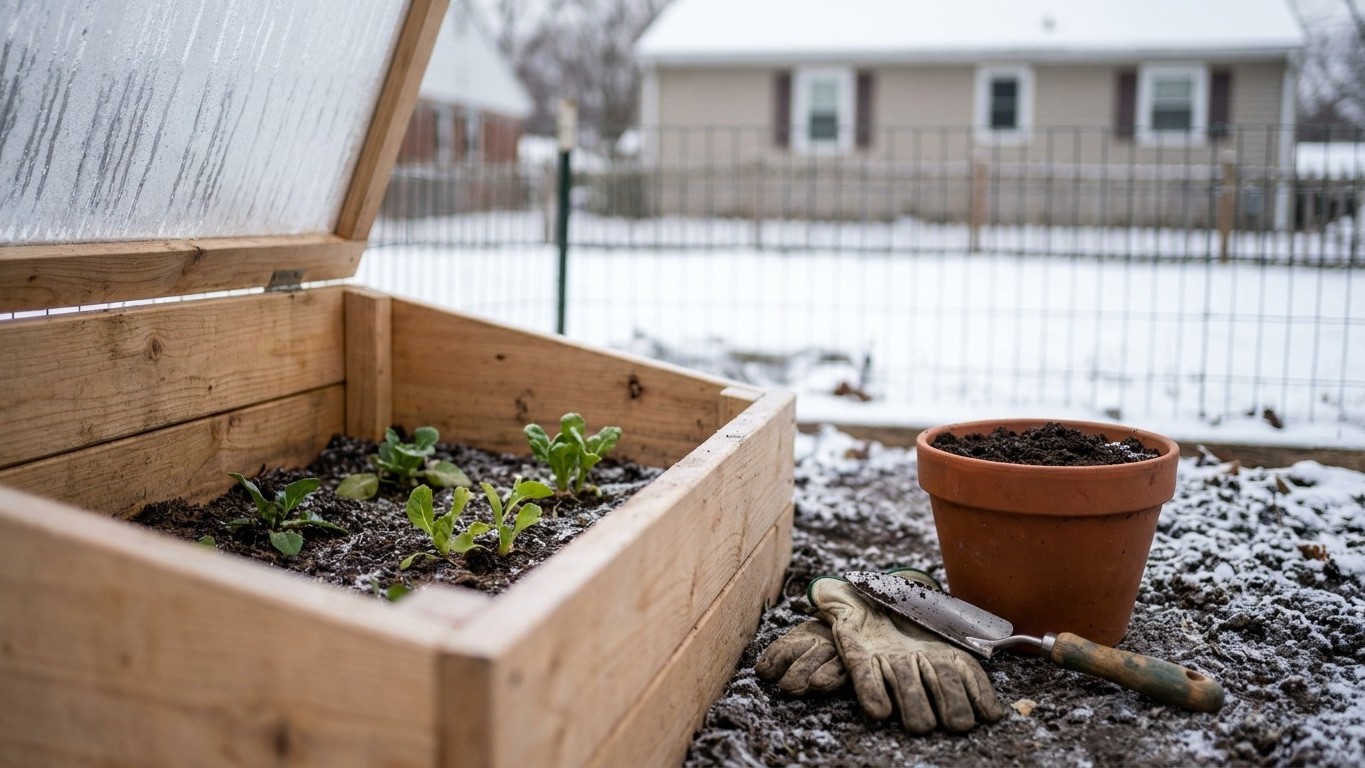

January in West Virginia is not a planting month for open ground in most of the state. What you can do: tuck garlic or shallots into workable soil, shelter greens already growing under cold frames, plant bare-root stock while it’s dormant, and start long-season seeds like onions and leeks indoors under lights.
What goes in the ground in January

The calendar says January. The soil doesn’t care what the calendar says. What decides whether anything goes into the ground is soil temperature and how far you sit from the last spring frost, and in West Virginia that frost lands anywhere from April 9 to April 23 depending on where you are relative to Charleston’s river valley (NOAA NCEI 1991-2020 Climate Normals, station USW00013866). That’s ten to twelve weeks out. For direct-sown crops, that’s simply too early. The ground is frozen solid across much of the state for stretches of the month, and even where it thaws, a warm afternoon doesn’t mean the root zone six inches down has followed along.
So the honest answer for most West Virginia gardens is that nothing new gets direct-sown outdoors this month. That’s not a gap in the calendar, it’s a different kind of work. A few things do still move into soil or shelter now, and they’re worth naming precisely instead of padding the list with crops that would rot or freeze.
Garlic and shallots can still go into the ground where soil remains workable, meaning unfrozen and not waterlogged. Fall planting is the standard practice for these in West Virginia, but a mild stretch in a milder pocket of the state, closer to zone 7a than 5a, can still accept cloves if the ground hasn’t locked up. Cold frames and low tunnels are doing real work right now too, holding greens that were established in fall through the coldest stretch of the year without adding anything new. Bare-root fruit trees, brambles, and dormant perennials can be planted in late January in the milder parts of the state, provided the ground isn’t frozen and the plant is fully dormant, no swelling buds. And indoors, this is a good month to force rhubarb crowns or chicory roots in a dark, cool space for an early harvest of something fresh while the garden itself sits idle.
What to start under cover
Seed starting in January is an exercise in counting backward, not forward. Take the earlier end of West Virginia’s frost window, April 9, and work back from it. Onions and leeks are the classic January starts because they’re slow: grown from seed, they typically need ten to twelve weeks of indoor growth before they’re sturdy enough to harden off and move outside, which puts their sowing date squarely in this month for anyone aiming at an early-April transplant. Peppers are the other candidate. They germinate slowly in cool conditions and grow unhurried even under lights, so an eight-to-ten-week head start under cover means starting them now rather than waiting for February.
The arithmetic matters more than the date on a seed packet. If your local frost typically falls near the later end of the state’s range, closer to April 23, you can afford to wait another week or two before sowing. If you’re in a valley or lower elevation that tends to run mild, you might be closer to the April 9 end, and starting now keeps you on schedule.
Two mistakes bookend this window. Start too early, and by the time the ground is actually ready in April, the transplants are leggy, rootbound in their cell trays, and stressed before they even go outside, a plant that spent six extra weeks fighting for light under a grow lamp rarely catches up. Start too late, and short-season crops especially get squeezed, running out of warm days before they mature. The fix for both is the same discipline: count weeks from your real frost window, not from habit or from what a neighbor is doing.
What is ready to pick
Outdoors, January gives back very little. That’s simply the season. But “little” isn’t “nothing,” and what does come out of a West Virginia garden this month tends to be the crops that were planned for exactly this stretch. Kale, planted in late summer and left standing, often improves after hard frost, the cold converts starches to sugars and the leaves taste sweeter than they did in October. Leeks left in the ground under a heavy mulch or a blanket of snow can still be dug when the soil isn’t frozen solid, and Brussels sprouts, if the stalks were left standing, often hold their sprouts through cold snaps far better than most people expect.
Cold frames extend this further. Spinach, mache, and arugula sown in fall and sheltered under glass or plastic keep growing slowly through winter, giving small but real harvests on any day the frame isn’t buried in snow. Indoors, sprouts and microgreens fill the gap entirely on your own schedule, a jar of sprouting seeds or a tray of microgreens under a window can go from seed to harvest in one to two weeks regardless of what’s happening outside.
This is also the month to walk the root cellar or pantry shelf with a critical eye. Squash with a soft spot near the stem, potatoes that have started to sprout or shrivel, onions gone soft at the neck: catch these now and use them before they take neighboring produce down with them. A single rotting squash in a bin of stored produce spreads faster than most people expect.
The jobs that matter this month

A quiet-looking garden in January is still carrying a full list of deadlines, and missing them costs more than it looks like it would.
Pruning, ordering, and planning
Dormant pruning of fruit trees and cane fruits is best done now, while the plant’s structure is visible without leaves and before sap starts moving. Cutting back apple, pear, and stone fruit trees in January, when they’re fully dormant, reduces disease spread and stress compared to pruning once growth resumes. Seed ordering belongs on this month’s list too, popular varieties, especially open-pollinated and heirloom types, sell out from suppliers well before spring planting windows open. Waiting until March to order often means settling for whatever’s left.
This is also the natural planning month: sketching out crop rotation for the coming season so the same family of vegetables doesn’t land in the same bed two years running, a habit that keeps soil-borne pests and diseases from building up.
Soil, tools, and storage
Soil testing done now gives results back in time to amend before spring planting, rather than scrambling in March. Turning a compost pile, even a slow, cold one, keeps decomposition moving and prevents it from going anaerobic and sour over winter. Tools deserve the same attention: cleaning rust off blades, sharpening pruners and hoes, and oiling wooden handles now means starting the working season with equipment that’s ready instead of discovering a cracked handle mid-job in April.
Raised beds, fencing, and trellising that took a beating over the growing season are easier to repair now, before frozen ground or spring mud makes the work harder. And circle back to that root cellar or pantry check regularly, not just once, since rot spreads and a weekly look catches problems before they spread to the whole bin.
What not to do in January
The classic January mistake in West Virginia is trusting the air instead of the soil. A stretch of 55-degree afternoons can feel like spring, but the ground several inches down is still cold, sometimes still frozen at night, and warm-season transplants set out now, or seeds direct-sown in a moment of enthusiasm, simply sit and rot rather than grow. Air temperature is the least reliable signal a gardener has this time of year.
The second mistake is uncovering too soon. A mild week tempts people to pull mulch off garlic beds or open up cold frames to “let some air in,” and then a hard freeze follows and damages growth that had started to wake up under the insulation. Mulch and row covers exist specifically to smooth out these swings; removing them because of one warm afternoon defeats the purpose. Leave winter protection in place until you’re past the point where a hard freeze is a realistic risk, not just until the weather feels nice for a few days.
The third mistake is feeding nitrogen at the wrong point in the cycle. Fertilizing dormant fruit trees, garlic, or overwintering greens with a nitrogen-heavy feed in January can push soft, tender new growth right before a cold snap, and that new growth is exactly what winter kills first. Save nitrogen applications for when active growth is actually underway, not for the depth of dormancy.
A quieter error is skipping the soil test because “nothing’s growing anyway.” Winter is precisely when a test is easiest to schedule and act on, since there’s no crop in the ground to disturb while you amend.
Checking this against your own county
Everything above is built around Charleston’s frost data, and Charleston sits in a river valley, which runs milder than much of the surrounding state. West Virginia spans USDA hardiness zones 5a to 7a, and elevation alone can shift a frost window by weeks: a garden in the Eastern Panhandle’s lower valleys behaves very differently from one on a ridge in the high country of Pocahontas or Randolph County. A statewide month is a starting point, not an instruction specific to your yard.
For a planting calendar and frost guidance tuned to your county, check the West Virginia University Extension Service, which tracks local variation that a single statewide frost range can’t capture.
Common questions
Can I plant garlic in West Virginia in January?
Fall is the standard window, but if soil remains unfrozen and workable in a milder part of the state, cloves can still go in this month. Once the ground freezes solid, wait for spring.
Is it too early to start tomato seeds indoors in January?
For most of West Virginia, yes. With the last frost falling between April 9 and April 23, tomatoes started in January risk becoming leggy and rootbound long before it’s safe to transplant them outside. Peppers and onions, being slower growers, are better suited to a January start.
Should I remove mulch from my beds during a warm spell in January?
No. A mild stretch doesn’t mean winter is over, and pulling mulch or row covers now exposes plants and soil to the hard freeze that often follows. Leave protection in place until the frost risk has genuinely passed.
What’s the single most useful job to do in a West Virginia garden in January?
Order seed and prune dormant fruit trees. Popular varieties sell out early, and pruning is easiest and safest to do while trees are fully dormant, well before buds swell.
Gardeners who plant by the Moon can check the January 2027 moon planting calendar, a tradition rather than a proven method.