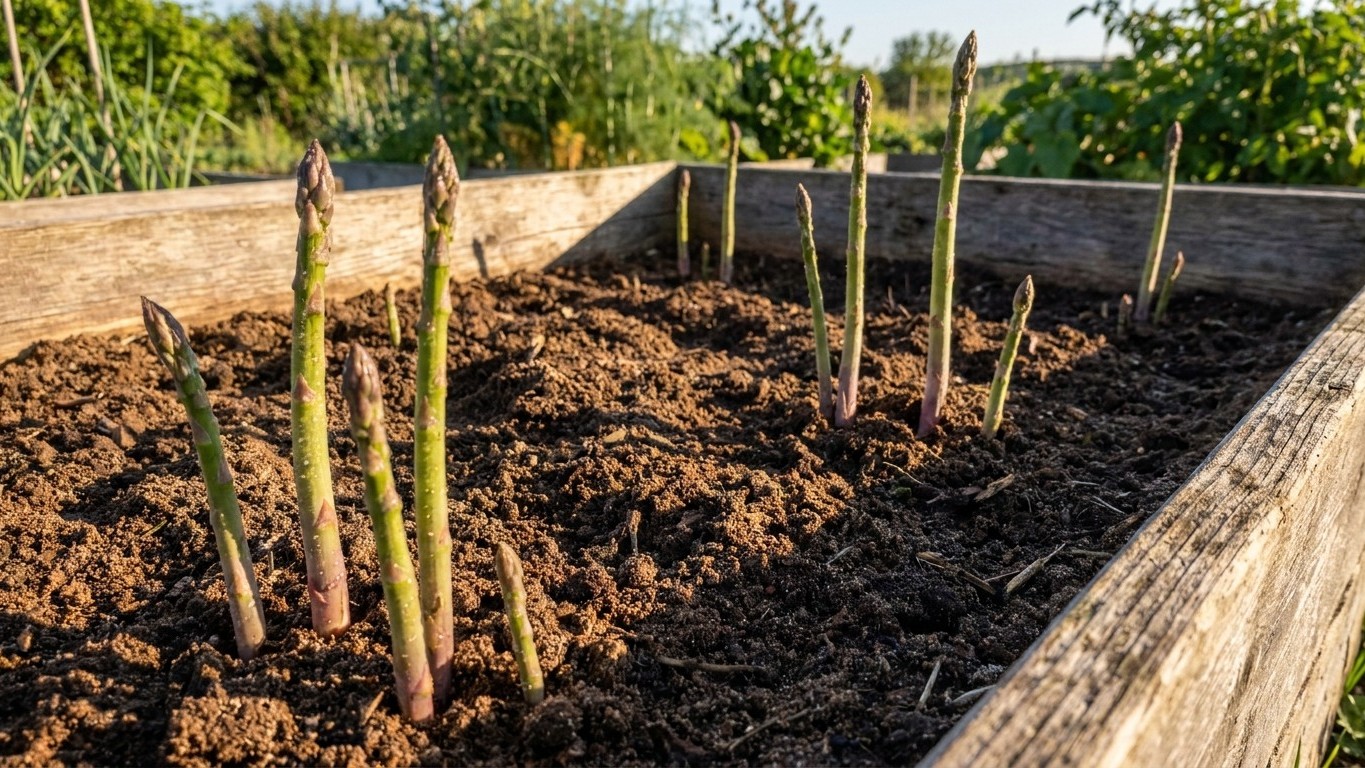

Few asparagus pests are documented for Northwest Territories, so most of the trouble in a northern bed comes down to timing and diagnosis. Spears are exposed first, when the soil thaws and they break the surface. Ferns are exposed through the rest of a short season. Frost, dry soil and wet crowns can all mimic insect damage, so confirm the cause before you treat anything.
Which pests attack asparagus in Northwest Territories
The territory’s agriculture and extension services record few asparagus pests, so there is no long roster to work from. Build your picture from symptoms and from the kind of damage you see.
The sorting is easy. Insects tracked for northern forests, such as the defoliators of spruce and poplar, feed on tree needles and leaves and have no reason to visit an asparagus bed. Anything that bores into wood is out for the same reason. What remains is three kinds of damage: something chewing or scarring the spears, something feeding on the ferns, and something working on the crown below ground.
Asparagus gives pests a long window to settle in. Crowns go into 8-inch furrows in early spring and are not harvested until year 3, then produce for 10 to 15 years. For two full seasons the ferns simply grow, and any insect that likes them has the bed to itself.
The ground matters too. The dominant soil across the territory’s mapped surface is a Cryosol, which has permafrost within the profile and thaws only to a shallow active layer each summer. The surface horizons run loam to silt (55 percent sand, 6 percent clay, 39 percent silt), with about 2.4 percent organic matter, and they drain well. That survey covers the agricultural regions, so the far north is not represented, and river bottoms, muskeg and scraped or filled ground will behave differently. If your bed sits on ground that stays cold and wet, soil-dwelling problems become more likely than leaf-feeding ones, and the soil guide, Will Northwest Territories Soil Hold an Asparagus Bed for Fifteen Years?, covers drainage in detail.
The territorial agriculture and extension offices know what is registered locally and what has been seen in nearby gardens.
When each one shows up, and what it does first
Count from your own planting date and from the frost, because both move from one garden to the next. The mean last spring frost at the Yellowknife A reference station is May 25, according to Environment and Climate Change Canada’s 1981-2010 normals. That is the midpoint of a window. In one year out of two the last frost falls later, and northern or upland districts run weeks behind this station. A bed set up using When to Plant Asparagus Crowns in Northwest Territories will have its own clock, and every timing below runs from it.
Spears: the first weeks after the soil thaws
The first thing you see on an emerging spear is surface scarring, a rough or silvery patch, or a chewed tip. Spears that came up straight and arrive bent or tattered point to a feeder working at the soil line. Damage like this appears within days of emergence, because a spear is soft and unprotected only for a short time.
Ferns: from leaf-out through the rest of the season
Once spears open into ferns, look for ragged edges, stripped sections or bare stems. Sap-feeders show up differently, as distorted or sticky tops, or a general loss of colour with nothing obviously chewing. Ferns feed the crown for next year’s spears, so a hit here has a delayed cost. The effect shows the following spring as thinner spears.
Crown: slow and easy to confuse
Damage below ground gives no early signal. You see weak, thin or missing spears in spring, and the crown itself, when lifted, may be soft, hollowed or discoloured. By then the damage has been building for a season.
Telling the damage apart from everything else
Many asparagus problems look like insect work and are not. Dry soil, a late frost or a waterlogged crown can all produce the same yellow, thin or bent growth. The signs below separate them, and the territory’s extension service can confirm what you are looking at.
| What you see | Possible cause | What helps tell them apart |
|---|---|---|
| Spear tips water-soaked, then limp or darkened | Frost after emergence | The same pattern across the whole row, soon after a cold night; no insects or droppings |
| Scarred or chewed spears | Chewing insect | Uneven damage on some spears and not others; insects or their droppings on the surface |
| Ferns yellowing from the base | Dry soil, or wet roots | Check moisture a hand-width down; sample the soil where the crown sits |
| Orange or rusty powder on ferns | A fungal disease | Powder rubs off on your fingers; the pattern spreads leaf to leaf |
| Thin spears across the whole bed | Young or overworked crowns | Bed age, harvest history, and whether the ferns grew well last year |
| Soft, collapsed crowns | Waterlogged or poorly drained ground | Water standing in the furrow after rain; crowns that feel mushy when lifted |
Drought is the look-alike most likely to fool a northern gardener. Summer rain at the reference station is about 109 mm (4.3 inches) across June, July and August, out of 290 mm (11.4 inches) for the year, and June is the driest month at 29 mm (1.14 inches). These are 1981-2010 normals from Environment and Climate Change Canada for Yellowknife A, so they describe what the region can usually expect and not your plot. A rain gauge in the bed tells you what actually fell.
If yellowing tracks the dry weeks and eases after rain, the cause is more likely water than insects. When you cannot tell, bring a fresh stem and a photo to the extension office rather than guessing.
What actually works here, and what is a waste of time
A short season rewards timing over product. A physical barrier does more than a spray, because it stops damage before it starts. Floating row cover or a similar fabric, laid over the row before the first spears break the surface, keeps flying and crawling insects off the most exposed stage. It also takes the edge off a late frost, and where the mean last frost is May 25 and half of all years run later, that second job matters.
Three habits help every season. Check the bed on a regular walk so that you catch damage in its first week. Keep the planting well drained so crowns never sit wet. And backfill the furrow gradually rather than all at once, because a bed filled in one pass buries the crowns too fast.
Several common reactions waste time. Spraying on a calendar before you know what is eating the bed treats a guess. Spraying during harvest puts anything you apply on food you are about to cut. Buying a variety for pest resistance rests on a claim nobody has published: the varieties named by Utah State University Extension are listed with their sex only, and no pest advantage comes with them. Harvesting early in year 1 or 2 weakens the crown that has to carry the bed for 10 to 15 years.
The harvest schedule is also a plant-health rule. Take nothing in years 1 and 2. After that the harvest continues and ends when most spears are thinner than a pencil. Stopping there lets ferns grow and feed the crown, which is the plant’s best defence against feeding damage. For anything beyond that, ask the extension office what is registered and approved before you buy a product.
Where to check this for your own county
Pest presence changes from one garden to the next inside the territory. The territory has no counties, so the practical contact is the office covering your community, whether that is the territorial agriculture office or the extension service serving your region. Staff there know what has been seen nearby this season, what is registered for use locally, and how recent weather has affected local gardens.
Local differences are real. The mean last frost date of May 25 and the rainfall normals come from a single station, and a river valley, a slope or an exposed lot can run weeks behind or ahead of it. Your own ground may also be muskeg, fill or a scraped building lot. A soil test gives your number, and a local office can tell you how it relates to nearby beds.
Take a few things with you: a clear photo of the damage beside a coin, the date you first saw it, how old the bed is, and whether you have cut spears yet. A fresh stem sealed in a bag, if the office accepts samples, is better still. For the background on the planting itself, the overview is Growing Asparagus in Northwest Territories.
Common questions
Can I cut asparagus in the first two years?
No. Do not harvest until year 3. Then the harvest continues and stops when most spears are thinner than a pencil.
When is the last spring frost in Northwest Territories?
The mean last spring frost at the Yellowknife A reference station is May 25 (1981-2010 normals, Environment and Climate Change Canada). In one year out of two the last frost falls later, and northern or upland districts run weeks behind.
Does summer rain affect asparagus problems?
Yes. Rain at the reference station averages 109 mm (4.3 inches) across June to August, and June is the driest month at 29 mm (1.14 inches). Dry weeks can look like pest damage, and standing water can rot crowns. A rain gauge in your bed shows what your own plot received.
Is any asparagus variety known to resist pests?
Utah State University Extension names its varieties by sex only. No pest resistance is attached to any of them, so pick for how your site drains and ask the extension office what has done well locally.