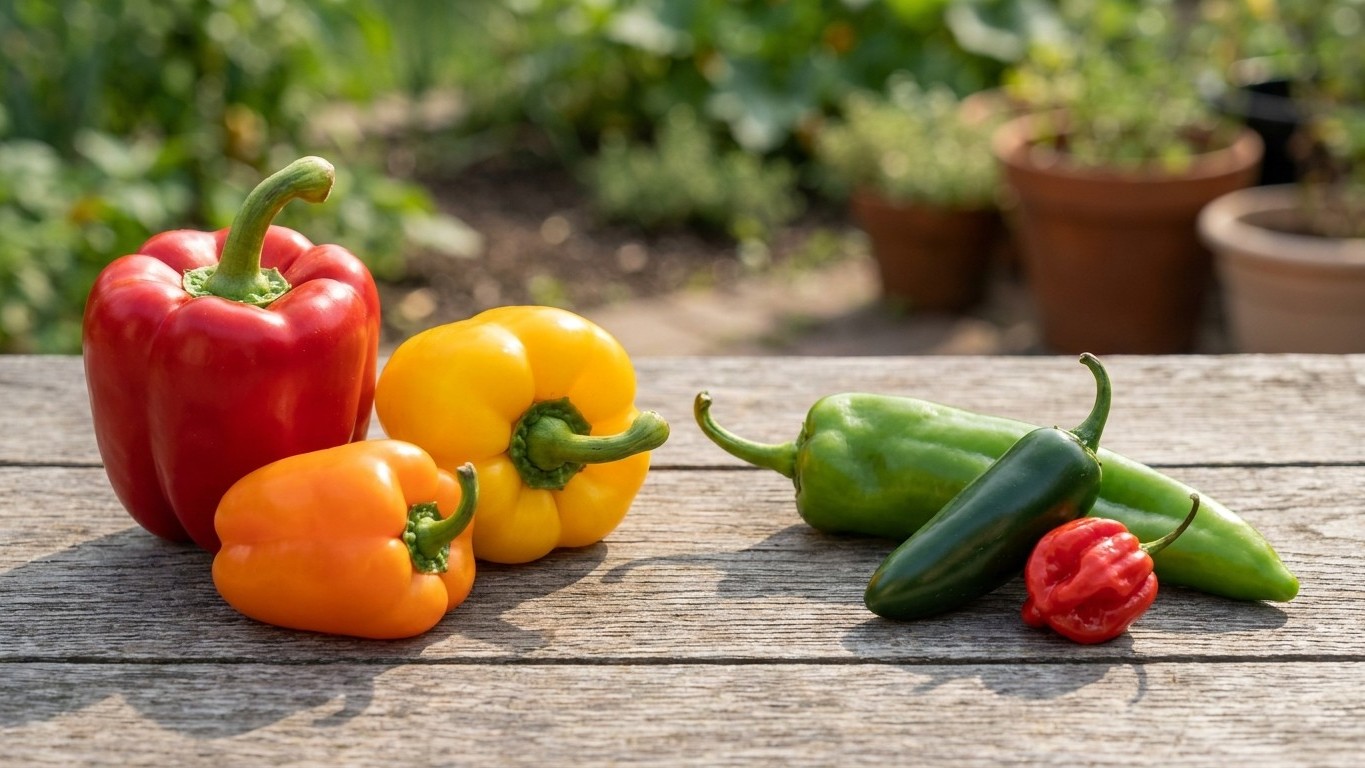

Utah State University Extension’s “Peppers in the Garden” names six pepper varieties for home gardeners: three sweet types (Ace, Big Bertha, California Wonder) and three hot types (Anaheim, Jalapeno, Habanero). That’s the full list. What the publication does not give you, for any of the six, is a heat rating, a days-to-maturity figure, or a fruit size. Those details simply aren’t in that source.
The short answer
Split it in half and the pattern is easy to see. On the sweet side, Utah State University Extension names Ace, Big Bertha, and California Wonder. On the hot side, it names Anaheim, Jalapeno, and Habanero. Three and three, a clean division that tells a gardener which shelf to reach for, sweet for stuffing and slicing, hot for salsa and heat, without telling them anything more granular than that.
What’s missing is the part most catalog shoppers actually want. There’s no Scoville figure attached to Anaheim, Jalapeno, or Habanero in this source, even though those three names cover an enormous heat range in the wider pepper world. There’s no days-to-maturity number for any of the six, sweet or hot. There’s no fruit size, so a gardener can’t tell from this list alone whether Big Bertha produces something pocket-sized or a pepper that fills a dinner plate. The publication does the job of naming reliable garden varieties. It doesn’t do the job of rating them.
This matters because a lot of gardeners assume a university extension list is a complete spec sheet. It isn’t, not this one. Think of it the way you’d think of a hardware store clerk who tells you “we carry three brands of hinges” without mentioning weight capacity or finish. The names are the starting point, not the whole answer. If a plant tag or seed packet for one of these six names does carry a heat rating or a maturity window, that number came from the seed company, not from Utah State University Extension’s plant list.
The practical result is that a gardener working only from this source has to treat all six names as a shopping list of proven varieties, then go elsewhere for the numbers that decide whether a given variety actually fits their kitchen or their garden bed. That “elsewhere” might be the seed packet in hand, but it is not this Extension document, and conflating the two is where a lot of confusion starts.
What actually decides it
Even without published ratings, three separate mechanisms determine what a pepper plant delivers once it’s in the ground. Each one operates independently, and collapsing them into a single “it depends on the variety” answer hides more than it reveals.
Genetics sets the ceiling, but the source doesn’t publish it
Every one of the six named varieties carries its own genetic potential for heat, size, and flavor. That ceiling is real, but Utah State University Extension’s list doesn’t quantify it for Ace, Big Bertha, California Wonder, Anaheim, Jalapeno, or Habanero. A gardener who wants that number has to look past this particular publication.
Temperature decides whether any fruit forms at all
Separate from genetics entirely, fruit set can fail at both ends of the thermometer. Nights below 55 F and days above 90 F both interfere with a pepper plant’s ability to set fruit, and this is true regardless of which of the six varieties is in the ground. A Habanero and a California Wonder both stall out under the same conditions. This site tracks how many days per year climb above 90 F for different territories, but it does not track summer night minima, so a gardener has to watch their own overnight lows directly rather than assume anything based on daytime heat data or on how cold a typical winter runs.
The flowering-to-harvest window is a separate clock
The 35 to 45 days that typically separate flowering from a ready pepper start counting from the first open flower, not from the day seed went into a tray or the day a transplant went into the garden. That distinction changes the math for every one of the six named varieties. A plant that flowers late because of a cool spring will still need its own 35 to 45 days from that flowering point, regardless of when it was originally sown or transplanted.
How to do it
- Decide sweet or hot first. Use Utah State University Extension’s list as the sorting step: Ace, Big Bertha, and California Wonder for sweet; Anaheim, Jalapeno, and Habanero for hot.
- Go beyond this source for heat rating, size, and days-to-maturity. Those figures aren’t published in “Peppers in the Garden,” so a seed packet or catalog listing for the specific variety is where that detail actually lives.
- Check how many days per year your territory climbs above 90 F, since that’s the daytime threshold that can stop fruit set regardless of which of the six varieties is planted.
- Track your own overnight low temperatures through the growing season. Nights under 55 F carry the same fruit-set risk as the heat, and that figure isn’t part of the day-based data this site carries.
- Time transplanting so flowering is likely to land in a stretch that avoids both extremes, based on your own local pattern rather than a fixed calendar date.
- Mark the date of first open flower on each plant. That date, not the sowing or transplant date, is the starting point for the 35 to 45 day countdown to harvest.
- Count forward 35 to 45 days from that flowering date to estimate when fruit will be ready, adjusting slightly for how the plant is actually developing rather than the calendar alone.
- Harvest sweet varieties at the color or firmness you prefer and hot varieties at the ripeness stage you want, since heat level and ideal picking stage aren’t specified in this source and depend on the actual variety and your own taste.
What goes wrong
- Assuming a name tells you the heat level. Jalapeno and Habanero sit at very different points on any heat scale, but Utah State University Extension’s list doesn’t rate either one. Check the seed packet or a dedicated variety resource before assuming.
- Counting maturity days from the wrong starting point. Counting from sowing or transplanting instead of from flowering throws off harvest timing for every one of the six named varieties. Mark the first open flower and count from there instead.
- No fruit during a heat spell. Days above 90 F can stall fruit set on any of the six varieties. Check your territory’s days-above-90-F pattern and consider timing plantings so flowering avoids the worst stretch.
- No fruit during a cool snap. Nights under 55 F cause the same stall from the other direction, and this site’s territory data doesn’t cover summer night lows. Track your own overnight temperatures directly rather than assuming from daytime data.
- Guessing at fruit size or plant spacing. Big Bertha, Ace, and California Wonder aren’t sized in this source, so planning a bed around an assumed size can leave plants crowded or oddly spaced. Plan for typical pepper plant spacing and adjust once fruit size becomes visible, rather than relying on a figure that isn’t published here.
Common questions
Does Utah State University Extension give a heat rating for Anaheim, Jalapeno, or Habanero? No. The publication names all three as hot varieties but doesn’t attach a Scoville figure or any other heat measurement to any of them.
Are California Wonder and Big Bertha the same type of pepper? Both are named as sweet varieties in the same list, but the source gives no size or maturity figures that would distinguish one from the other. Any such comparison would have to come from elsewhere.
Why does a healthy-looking pepper plant sometimes produce no fruit? Fruit set can fail at both temperature extremes, nights under 55 F and days over 90 F, regardless of how healthy the plant otherwise looks or which named variety it is.
When does the 35 to 45 day countdown to harvest actually start? From flowering, not from the day of sowing or the day of transplanting. Marking the first open flower is the only reliable way to time the countdown correctly.