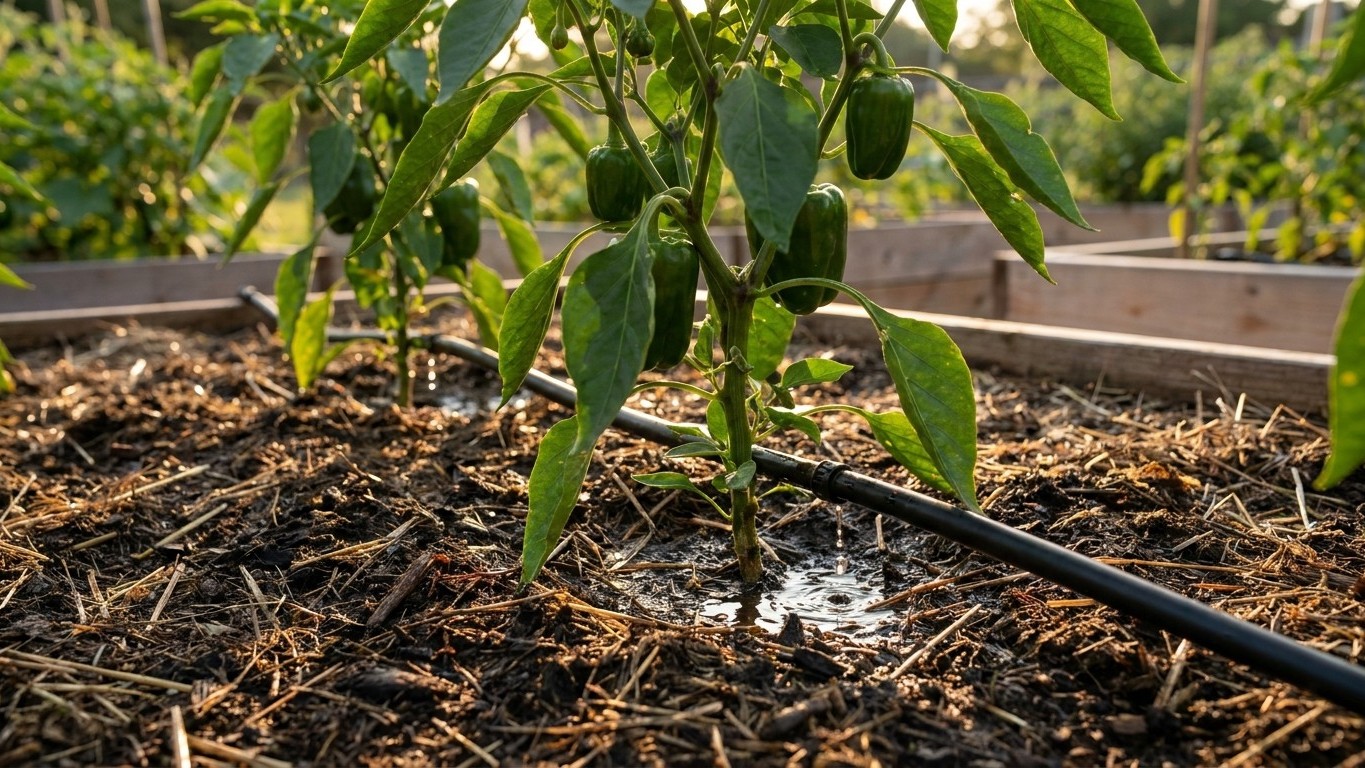

One to two inches of water per week, applied deep and infrequent rather than in daily sips, is what Utah State University Extension recommends for pepper plants. Drip irrigation is the method the extension office points to, because it puts water at the root zone instead of on the leaves. That’s the number. What changes the answer is the weather on either side of it, and that’s where most home gardens run into trouble.
The short answer
Utah State University Extension sets the target at 1-2 inches of water per week, delivered deep and infrequent. Deep means the water should reach past the surface roots into the zone where the plant actually pulls moisture during a hot afternoon. Infrequent means you’re not running a sprinkler for ten minutes every evening. A pepper plant watered that way develops shallow roots that dry out fast and stress the plant right when it’s trying to set fruit.
Drip irrigation is the delivery method the extension office recommends, and the reasoning is straightforward. A drip line or emitter puts water directly at the soil surface near the stem, where roots can use it, instead of wetting the whole leaf canopy the way an overhead sprinkler does. Wet foliage sitting overnight is an invitation for fungal disease, and pepper leaves are not particularly forgiving about that. Drip also makes the “deep and infrequent” part easier to manage, because you can leave a line running for an hour and know the moisture is going down, not just wetting the top inch of soil that evaporates by noon.
None of this is a daily chore. A once or twice-weekly deep soak, timed to the 1-2 inch weekly figure, does more for root development than a quick daily splash ever will. Gardeners who water lightly every day are often trying to compensate for hot weather stress, but the fix for heat stress isn’t more frequent watering. It’s deeper watering, spaced out, so the root system has a reason to grow down instead of staying near the surface where it’s exposed to every swing in temperature.
Row spacing plays into this too, even though it seems unrelated at first. Utah State University Extension recommends plants set 18 inches apart in the row, with rows spaced 18 to 24 inches apart. That spacing matters for watering because it determines how much root competition exists underground. Crowd plants closer than that and you’re effectively asking each root system to compete for the same 1-2 inches of water, which can mean the deep soak you’re delivering doesn’t stretch as far as you’d expect.
What actually decides it
The 1-2 inch weekly figure is a baseline, not a fixed rule that ignores what’s happening in the garden. Three separate mechanisms determine whether that watering schedule actually produces fruit, and conflating them is where a lot of pepper-growing advice goes wrong.
Fruit set fails at both temperature extremes
Peppers drop blossoms or fail to set fruit when nights fall below 55 F and when days climb above 90 F. Both ends matter, and neither one is a watering problem you can irrigate your way out of. A plant sitting in perfectly moist soil will still abort blossoms if the daytime temperature is pushing past 90 F for several days running, because the plant is redirecting energy toward survival rather than fruit development. The same plant will do the same thing if overnight temperatures drop under 55 F, even with ideal soil moisture. This site doesn’t carry summer night minimum data for any particular area, so if the cool end of that range is a concern where you garden, that’s something to track yourself with an outdoor thermometer rather than assume from the season or the calendar.
Root depth determines how “deep” needs to be interpreted
A newly transplanted pepper doesn’t have the same root reach as one that’s been in the ground for two months. Early in the season, “deep” watering for a young plant means something different than it does for an established one with roots six inches or more down. Watering on a fixed schedule without accounting for how far the roots have actually grown means young plants can be both overwatered at the surface and underwatered at depth simultaneously.
Soil texture changes how far an inch of water travels
An inch of water applied to sandy soil moves down fast and doesn’t hold. The same inch applied to heavy clay barely moves and can pool. Neither situation matches the “deep and infrequent” ideal without some adjustment: sandy soil often needs the weekly total split across two applications so it doesn’t drain past the root zone before the plant can use it, while clay soil needs slower delivery, which is another reason drip irrigation is the recommended method.
How to do it
- Set plants 18 inches apart in the row, with rows spaced 18 to 24 inches apart, so root systems aren’t competing for the same water before you even start irrigating.
- Install drip line or individual emitters at the base of each plant rather than relying on an overhead sprinkler, since drip is the method Utah State University Extension recommends for delivering water to the root zone without wetting foliage.
- Calculate the weekly target of 1-2 inches and run the drip system long enough to deliver that amount in one or two sessions rather than daily light watering.
- Check soil moisture a few inches down before watering again, confirming the previous application actually soaked in deep rather than evaporating off the surface.
- Watch daytime highs during flowering. If temperatures are pushing past 90 F for extended stretches, know that fruit set may stall regardless of how consistent the watering has been, since that’s a temperature effect, not a moisture one.
- Track your own overnight lows during the same period, since nights under 55 F carry the same fruit-set risk from the other direction and this isn’t data available for every location.
- Once fruit is set, expect 35 to 45 days from flowering to full color. That window starts at flowering, not at transplanting, so don’t count backward from planting date to guess a harvest window.
- Continue the deep, infrequent watering routine through fruit development, since inconsistent moisture during this stretch is a common cause of misshapen or cracked fruit.
- After harvest, store peppers 1 to 2 weeks at 50-55 F. Avoid prolonged refrigeration, which causes chilling injury and shortens usable storage life rather than extending it.
What goes wrong
- Daily light watering instead of deep, infrequent soaking. This trains roots to stay shallow, making the plant more sensitive to heat swings. Switch to a schedule that delivers the full 1-2 inch weekly total in one or two deep sessions instead of small daily amounts.
- Overhead watering that wets the foliage. Wet leaves sitting overnight invite fungal disease. Move to drip irrigation at the base of the plant, which is the delivery method recommended for peppers.
- Blaming watering for blossom drop during a heat wave. If daytime highs are over 90 F, no amount of irrigation adjustment will restore fruit set on its own. Recognize the temperature-driven cause and expect a pause in fruit set until conditions moderate.
- Ignoring cool nights as a factor. Fruit set also fails when nights drop under 55 F, a threshold that’s easy to overlook because attention tends to go to heat stress alone. Track overnight lows directly, since this isn’t something you can infer from the date or from daytime conditions.
- Crowding plants closer than recommended spacing. Setting plants tighter than 18 inches apart in the row, or rows closer than 18 to 24 inches, forces root systems to compete for the same water. Reset spacing at transplant time rather than trying to fix it mid-season.
- Refrigerating harvested peppers for extended periods. Prolonged refrigeration causes chilling injury. Store harvested fruit at 50-55 F and plan to use it within 1 to 2 weeks rather than treating the refrigerator as long-term storage.
- Counting harvest date from transplanting instead of flowering. The 35-45 day window to full color starts when the flower is present, not when the seedling went into the ground. Track bloom dates on individual plants if you want an accurate harvest estimate.
Common questions
Does 1-2 inches per week include rainfall?
The figure represents total water the plant needs weekly, so natural rainfall counts toward it. The practical approach is to track rainfall and only supplement with drip irrigation to make up the difference toward the 1-2 inch total.
Why did my peppers stop setting fruit even though I’m watering correctly?
Fruit set fails at both temperature extremes, not just from underwatering. Daytime highs over 90 F and nighttime lows under 55 F can both stall fruit set independent of soil moisture. Check your own overnight temperatures, since that data isn’t something available for every location.
How long after flowering should I expect ripe peppers?
Utah State University Extension puts that window at 35 to 45 days from flowering to full color. That count starts at the flower, not at the transplant date, so plants that bloom later in the season will simply ripen later, not faster.
Can I store harvested peppers in the refrigerator long-term?
No. Peppers should be stored 1 to 2 weeks at 50-55 F. Prolonged refrigeration causes chilling injury, which degrades quality rather than preserving it, so the standard refrigerator crisper isn’t the right long-term solution.