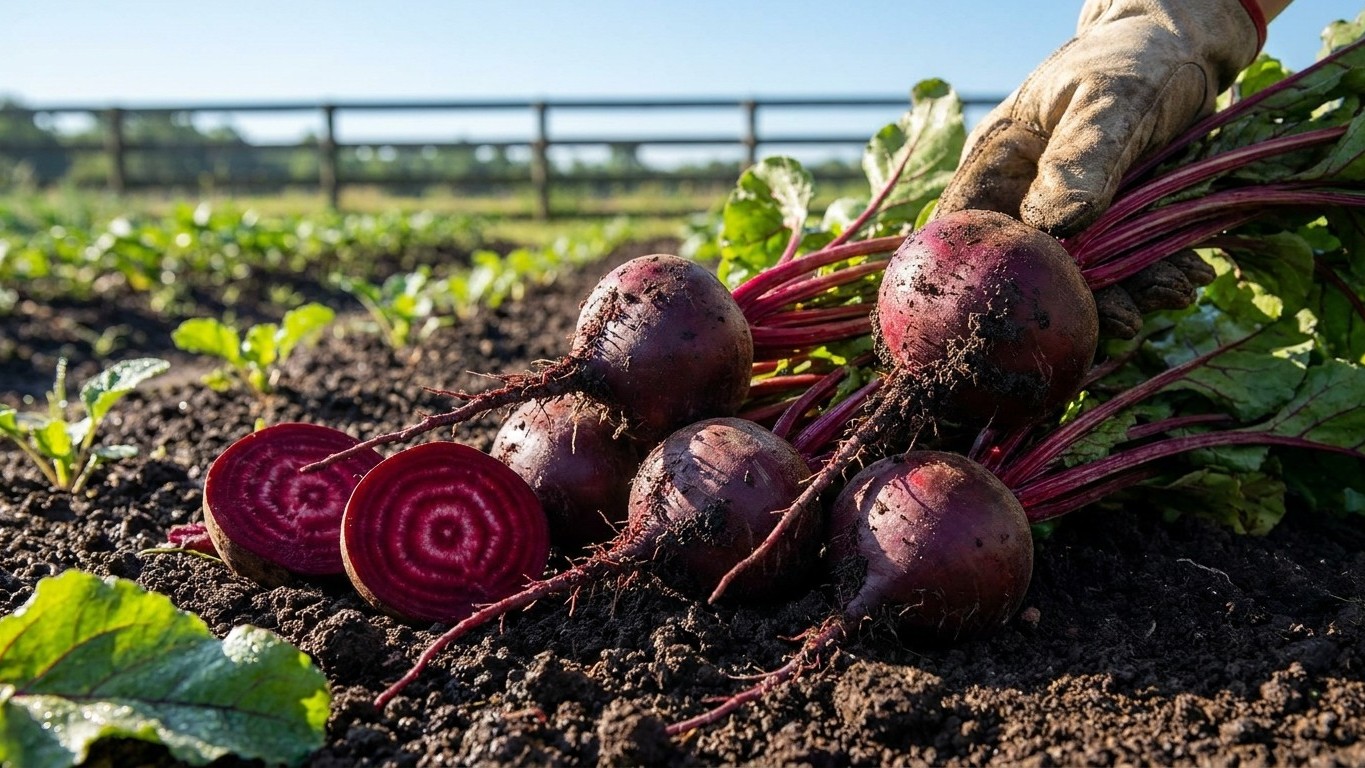

Mississippi’s official soil, the Natchez series, is a well-drained silty loam that beets can grow in reasonably well. But texture alone won’t tell you whether your roots turn woody or bolt before they size up. That comes down to two six-week windows: the one right after sowing, and the one when summer heat arrives, both shaped by the realities of Beet Soil in Mississippi.
The short answer
Mississippi’s state soil, named by state law, is the Natchez series, a young Inceptisol that hasn’t had time to develop the strong layered horizons older soils show. USDA’s representative figures for its surface put it at 5 percent sand, 13 percent clay and 82 percent silt, with a surface pH around 6.2 and organic matter near 1.8 percent. It’s classified well drained. For a beet, that’s a mixed report card. Utah State University Extension notes that beets want deep, sandy, well-drained soil rich in organic matter, and the Natchez series checks the drainage box but falls short on both sand content and organic matter. Silt-heavy ground like this can crust after a hard rain and compact if it’s worked while wet, both of which make it harder for a beet’s taproot to push straight down.
On the heat side, the figure most gardeners want, how many days a year the local air passes 90 F, isn’t published as part of this dataset, so it won’t be guessed at here. What is documented is the threshold that matters most for beets specifically: temperatures above 85 F combined with water stress make the root woody. Mississippi summers push well past that mark for long stretches, which means the second half of a beet’s life here is spent flirting with the exact conditions that ruin texture.
None of this is a verdict on any one garden. A state spans hundreds of soil series, and the Natchez series describes what USDA mapped as a major component across the state, not what’s sitting under a particular raised bed or hillside plot. River-bottom ground, hill country clay, and anything a builder has cut, filled or graded will behave differently, sometimes completely differently. Treat the numbers above as a starting point for guessing at drainage and acidity, then confirm both with an actual soil test before amending anything.
The six weeks that decide it here
Beets are direct-sown, never transplanted, and the standard advice is to get seed in the ground 2 to 3 weeks ahead of the last expected frost. For the reference weather station used in NOAA’s 1991-2020 climate normals, that last spring freeze falls somewhere between March 6 and March 22, details worth checking against a fuller guide on When to Sow Beets in Mississippi. Sow on that timeline and a beet’s critical first six weeks, the window when the plant is deciding whether to bolt, land squarely in Mississippi’s late-winter-into-early-spring stretch.
That stretch is not a calm one. Mississippi spring weather tends to swing hard between wet fronts pushing through and drier, sun-warmed spells that dry out topsoil fast, especially soil this heavy in silt, which can look moist on the surface while the root zone underneath has already gone dry. Utah State’s research is specific on the mechanism at stake here: water stress during those first six weeks after sowing is what causes premature flowering, the bolting that turns a beet planting into seed stalks instead of roots. A single week of neglected watering during a dry snap in March or April can undo weeks of otherwise good growth.
Gardeners further north or at higher elevation within the state should expect their own last frost later than the reference dates above, often by one to two weeks, and their first fall frost earlier by a similar margin. Airport weather stations sit in open, often urban-adjacent locations that warm up faster in spring than a shaded suburban yard or a low-lying rural field. That gap matters for sowing dates: use the March 6 to March 22 window as a reference point, not a rule, and shift it later if your own ground and canopy suggest a colder microclimate.
The practical takeaway is that the bolting risk here sits almost entirely in that early sowing window, before summer heat is even a factor. Get water right in the first six weeks, and the rest of the season is mostly about managing heat, not moisture panic.
What goes wrong here
- Seed sown into cold, wet silt rots before it sprouts. The Natchez series’ heavy silt fraction holds water and can stay cold and soggy well past the calendar date when air temperatures look fine. Wait until the top few inches of soil have actually dried and warmed before sowing, or work in raised rows that drain faster than flat ground.
- An early dry spell during the first six weeks triggers bolting. This is the single biggest risk tied to Mississippi’s swing-prone spring pattern. Water stress in that window, per Utah State University Extension, is what pushes beets to flower early instead of forming a root. Keep soil evenly moist from the day of sowing through at least the sixth week, and don’t let a warm, dry stretch go unwatered just because it’s still technically early spring.
- Low organic matter leaves roots stunted or misshapen. At roughly 1.8 percent organic matter, the state soil sits below what beets prefer. Utah State’s guidance caps amendment at no more than 1 inch of composted organic matter per 100 square feet; more than that can do more harm than good in a silt-heavy bed, so measure rather than eyeball it.
- Late-season heat above 85 F combined with dry soil turns roots woody. This is a separate failure from bolting, tied to the plant’s later life rather than its first six weeks. Once summer heat sets in, consistent watering and a layer of mulch to buffer soil temperature become the priority, and harvesting on the earlier side of the 60-to-80-day window from seeding helps roots avoid the worst of the heat.
- Surface crusting after heavy rain blocks emerging seedlings. Silt-dominant soils like the Natchez series are prone to capping over after a hard rain, which can trap small beet seedlings underneath. A light scratch of the surface or a thin mulch layer at sowing time reduces how hard that crust sets.
Checking this against your own county
Everything above describes the soil mapped as representative for Mississippi as a whole and the frost timing recorded at one reference station. Neither is a substitute for what’s actually under your feet or above your garden this particular spring. The Mississippi State University Extension Service, the state’s land-grant extension office, is the right place to confirm both: a county office can point to a soil test lab, interpret your results against beet needs specifically, and give a locally adjusted planting window that accounts for your elevation and microclimate rather than an airport’s. Find your county’s contact through extension.msstate.edu before finalizing a sowing date.
Common questions
How many days does it take to grow beets from seed in Mississippi?
Beets typically reach harvest 60 to 80 days after seeding, counted from the day seed goes into the ground, not from any transplant date, since beets are always direct-sown.
Is Mississippi’s state soil good for beets?
The Natchez series is well drained and mildly acidic at a surface pH near 6.2, which suits beets fine, but its heavy silt content and organic matter around 1.8 percent fall short of the deep, sandy, organic-rich soil beets prefer, so amendment and careful watering matter more here than in sandier ground.
Why do my beets bolt instead of forming roots?
Bolting is triggered by water stress during the first six weeks after sowing, according to Utah State University Extension. In Mississippi, that window often falls in a spring known for swinging between wet and dry spells, so consistent watering right from sowing is the main defense.
Why are my beet roots woody instead of tender?
Woodiness is a separate problem from bolting, caused by temperatures above 85 F combined with water stress later in the growing season. It’s a summer-heat issue rather than an early-spring one, so mulching and steady watering as temperatures climb matter more than anything done at sowing time.