
Missouri’s benchmark soil, the Menfro series, is a well-drained silt loam that gives carrots decent structure to grow in, but it is not the sandy, stone-free ground the crop actually wants. That gap matters more than the soil name does, and it changes when you sow, how you sow, and whether you need a raised bed before you put a seed in the ground.
The short answer
Missouri’s official state soil is the Menfro series, an Alfisol, the kind of forest soil that formed under trees and holds nutrients reasonably well without being especially rich. Its surface horizon runs slightly acid, with a pH around 6.2, and the texture leans heavily toward silt: about 4 percent sand, 19 percent clay, and 77 percent silt. Organic matter sits around 2.0 percent, and drainage is classed as well drained. These are the representative values USDA NRCS records for the surface horizon of the major components of this series, not a number pulled from any one backyard.
What that texture does to a carrot root
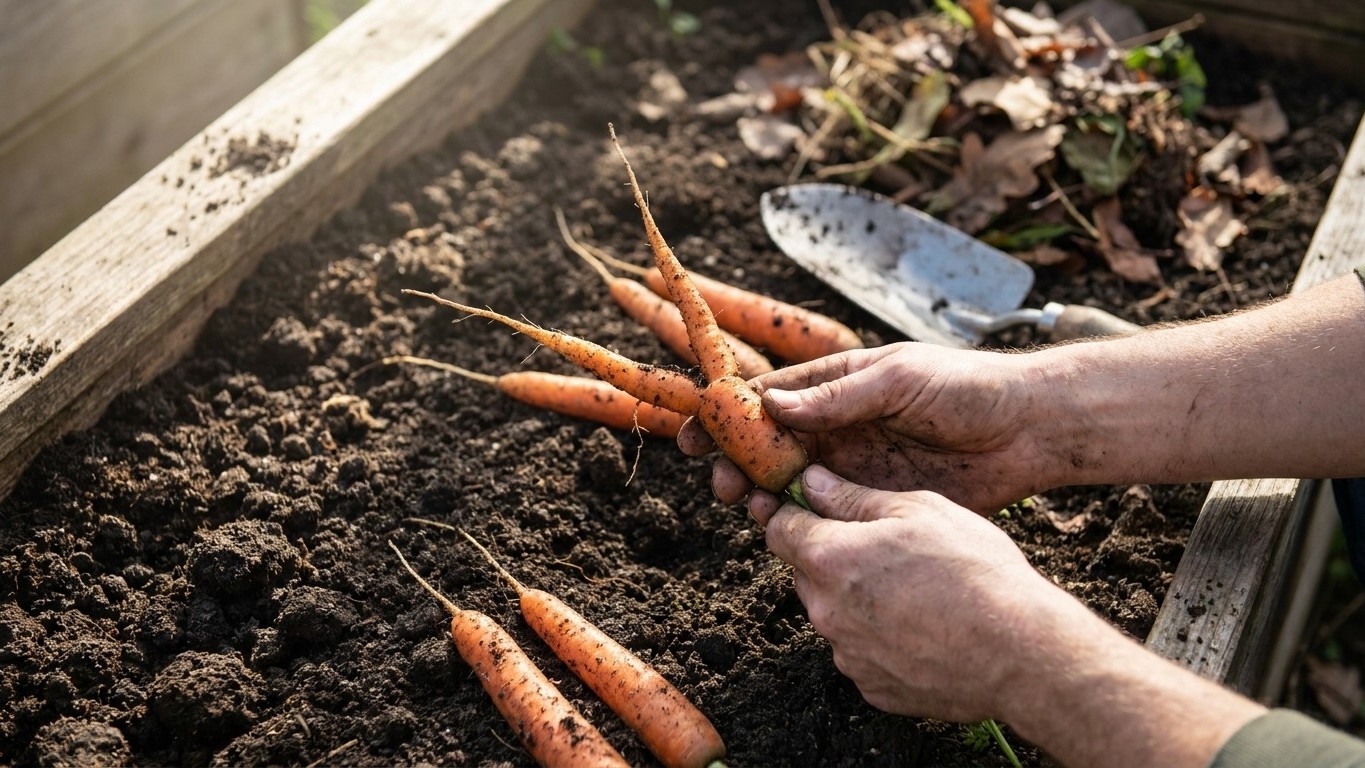
A carrot pushing through 77 percent silt is not fighting sand’s looseness or clay’s density exactly, but silt has its own habit: it compacts and crusts easily, especially after a hard rain followed by sun. Utah State University Extension is blunt about what carrots need to grow straight, deep, sandy, well-drained soil loaded with organic matter, and it says just as plainly that heavy or rocky soil makes the root fork. Menfro’s 19 percent clay isn’t extreme, but paired with a silt-dominant texture that can seal over, a carrot taproot can still hit resistance a few inches down and split into two or three legs instead of growing straight, which raises the practical question of Will Carrots Fork in Missouri Soil? for a given backyard.
The fix Utah State names is not a different variety. It’s soil preparation: work in plenty of compost, and double dig the bed so the loosened, organic-rich layer runs deeper than the root will grow, typically a foot or more. Where the ground stays compacted no matter how much is dug in, whether from a hardpan layer, construction fill, or a naturally dense subsoil, a raised bed filled with a lighter, sifted mix sidesteps the problem entirely rather than fighting it every season. Getting the timing right matters just as much as the bed prep, which is why it’s worth checking When to Sow Carrots in Missouri before you plant.
None of this should be read as a verdict on your particular garden. Missouri spans hundreds of soil series, from river-bottom alluvium in the Bootheel to thin, rocky ground in the Ozark hill country, and a lot of suburban lots sit on soil a builder has scraped, graded, or filled with material trucked in from somewhere else entirely. Menfro is what USDA lists as representative of the state as a whole. It’s a starting point for guessing what your ground tends to do, not a diagnosis of the bed you’re about to plant.
The test that settles it in your own garden
State-level soil data tells you what’s common, not what’s under your feet. The only way to know if your bed will fork carrots is to check it directly, and none of this requires lab equipment.
- Dig a hole where you plan to sow. Go down at least a foot, since that’s roughly how deep a mature carrot root needs clear passage. Note whether the soil stays loose the whole way or turns hard, dense, or rocky partway down.
- Look for what a root would hit. Pull out any stones, clumps of hard clay, or old construction debris as you dig. A taproot forks around the first obstacle it meets, so anything you find in the top foot is a candidate for causing exactly that.
- Feel the texture between your fingers. Take a handful of moist soil and rub it. Gritty means sand, slick and sticky means clay, and a smooth, flour-like feel that holds a shape without much stickiness points to silt, the texture Menfro leans toward.
- Watch how water moves through it. Dig a small hole, fill it with water, let it drain once, then fill it again and time how long the second fill takes to disappear. Water that lingers for hours signals poor drainage and a soil more likely to compact around a growing root; water that vanishes in minutes suggests a looser, sandier profile.
When to sow here
Carrots are sown directly into the ground as seed. There’s no transplanting step to count from, so every date here works backward from the seed going into soil, not from a seedling going into a bed.
- Start with the frost window. NOAA’s 1991-2020 climate normals put Missouri’s last spring frost, the date with a 30 to 70 percent chance of a 32 F freeze, somewhere between April 6 and April 20 depending on where in the state you garden. That range itself moves: NOAA notes the reference station sits north of Kansas City, with downtown running about five days earlier in spring, and southern Missouri milder again.
- Check the soil, not just the calendar. Carrot seed needs soil at a minimum of 40 F to germinate at all. A thermometer pushed a couple inches into the bed on a dry morning gives a real answer faster than guessing from air temperature.
- Sow 2 to 3 weeks before that last frost date. Carrots tolerate cool soil better than many vegetables, so working backward from an April 6 to April 20 window puts sowing anywhere from roughly mid-March in the earliest parts of the state to early April further north, adjusted again for how local your station runs relative to the NOAA reference point.
- Aim for the germination sweet spot. Seeds come up fastest and most evenly between 55 F and 65 F. Soil that’s merely thawed and legal at 40 F will still germinate, just slower and less predictably, so a gardener chasing a fuller stand often waits for that warmer band rather than sowing at the earliest legal moment.
What goes wrong here
- Forked roots in compacted or clay-heavy ground. Menfro’s silt-and-clay surface can seal over after rain, and a carrot root splits when it meets that resistance a few inches down. Compost worked in generously and a double-dug bed, or a raised bed filled with a lighter mix, solves this before the seed ever goes in.
- Spotty or absent germination during a hot stretch. Carrot seed slows down badly above the 55 to 65 F sweet spot, and a sudden warm spell right after sowing can leave big gaps in the row. Keeping the seedbed consistently moist with light watering, or shading it briefly with a board or row cover until seedlings show, keeps the surface from drying and overheating between waterings.
- Split roots from uneven watering. A dry stretch followed by a heavy soak makes the root swell faster than its skin can stretch, cracking it open. Watering on a steady schedule, rather than letting the bed dry hard and then flooding it, keeps growth even through the season.
Checking this against your own county
Everything above is built from statewide figures: one representative soil series, one set of frost-probability dates from a single climate station. Missouri’s actual growing conditions shift by county, sometimes sharply, between the river bottoms, the northern plains, and the Ozark hills. The University of Missouri Extension service, extension.missouri.edu, keeps local frost data, soil test recommendations, and planting guidance tuned to specific counties rather than the state average. A local extension office can also point you toward a soil test lab, which will give an actual pH and texture reading for your bed instead of the statewide estimate used here.
Common questions
Does Missouri’s clay content mean carrots will always fork?
No. At 19 percent clay, Menfro isn’t in true heavy-clay territory, and the series is classed well drained. Forking is a real risk where the surface compacts or where stones and hardpan sit close to the surface, not a guaranteed outcome across the whole state.
Can I sow carrots as soon as the soil hits 40 F?
Yes, the seed will germinate at that minimum, but slowly and unevenly. Waiting for soil closer to the 55 to 65 F range usually produces a fuller, more consistent stand, even though it means sowing a bit later than the earliest legal date.
How deep does my bed need to be to avoid forking?
Utah State University Extension’s guidance points to double digging as the fix for heavy or rocky ground, which generally means loosening and enriching the soil to a depth well beyond where the root will grow, often a foot or more, so the taproot never meets undisturbed, compacted soil.
Is the April 6 to April 20 frost window the same everywhere in Missouri?
No. That range comes from a single NOAA reference station, and NOAA itself notes the surrounding area runs earlier in spring than the station, with southern Missouri milder still. Local extension data will narrow that window for your specific county.