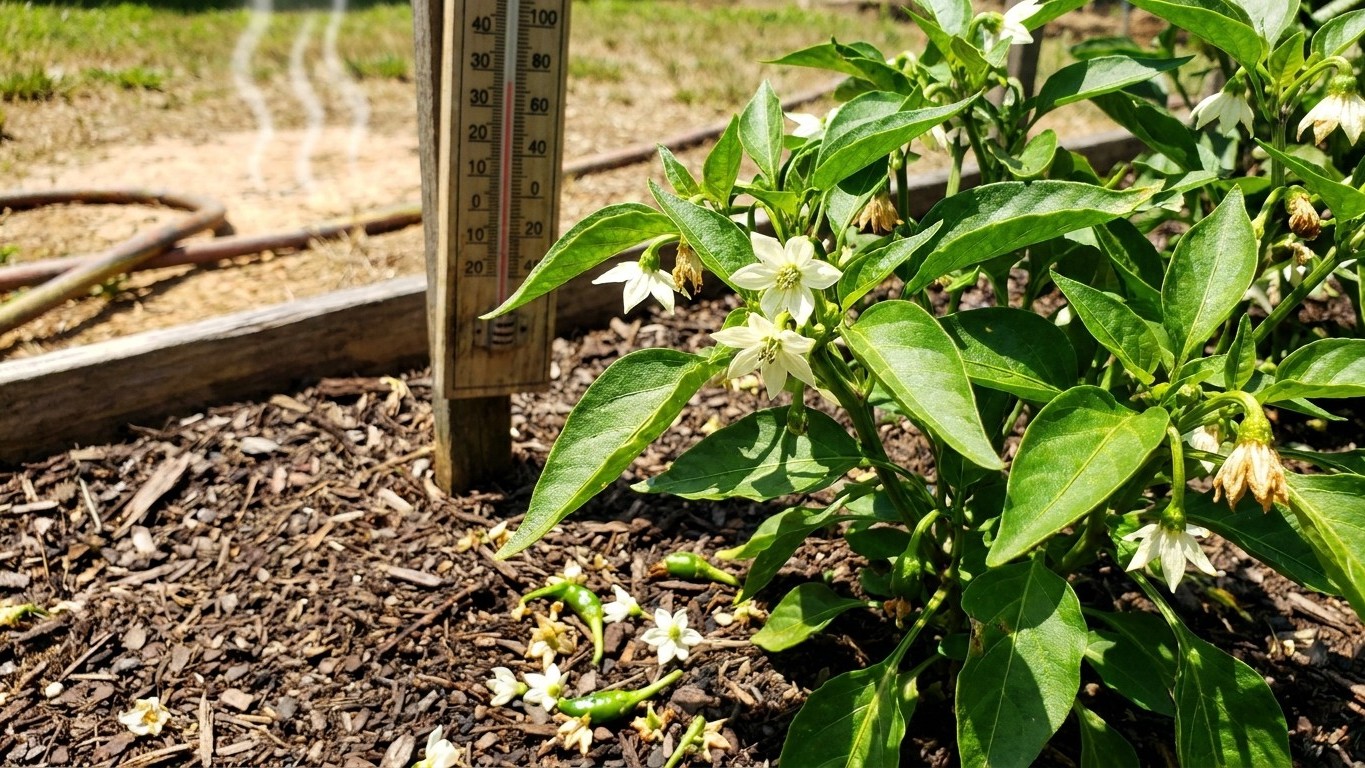

Minnesota gardeners lose pepper fruit for one of two reasons: the plant sat through a stretch of 90-degree days when pollen turned sterile, or a summer night dropped cold enough to stop flower development. The state’s official climate data confirms the hot end is a real, measurable risk here, the cold end depends on your own backyard, not on any published average.
The short answer
Minneapolis, the reference station for Minnesota’s climate normals, averages 10.6 days a year at or above 90 F, according to NOAA NCEI Climate Normals covering 1991-2020. That’s not a brutal number compared to the Deep South, but it’s not zero, either. Pepper flowers are picky: pollen viability collapses in sustained heat, and a pepper plant that looks healthy and green can drop blossom after blossom during a hot spell without setting a single fruit. Ten or eleven days scattered across a Minnesota summer is enough to wipe out a batch of blooms if they happen to open during that window.
The heat threshold
Utah State University Extension’s guidance on peppers puts the ceiling plainly: fruit set fails once daytime highs climb above 90 F. That threshold doesn’t care what variety you planted or how well you watered. It’s a pollen physiology limit, not a soil-fertility problem, which is why growers sometimes dump nitrogen on a non-fruiting plant and get nothing but taller stems for their trouble. In a Minnesota summer, that failure window shows up in short bursts, usually mid-July through early August, rather than as a season-long grind the way it might in Arizona or Texas.
The cold threshold
The other end of the same rule matters just as much: nights below 55 F also stop fruit set, according to the same Utah State University Extension source. This is where Minnesota gardeners need to do their own homework. This site tracks the state’s days above 90 F because that figure is published in the NOAA climate normals, but summer night minimums aren’t part of that same dataset, and nobody should guess at them from latitude, from how far north a garden sits, or from how cold January gets. A river valley, a low spot that pools cold air, or an open field a few miles from a lake can all report different overnight lows on the same night. If your peppers are blooming and not setting fruit in a summer that never hit 90, check your own thermometer before blaming the plant.
When to start seed here
Getting pepper timing right in Minnesota is a matter of counting backward from two fixed points: your last spring frost and the day your soil hits 60 F. Utah State University Extension recommends starting pepper seed 8 to 10 weeks before transplanting outdoors, and transplanting only after frost has passed and the soil has warmed to that 60-degree mark.
- Find your frost window. NOAA NCEI’s 1991-2020 climate normals put the last spring frost for the Twin Cities area between April 17 and April 30. That’s the mild south of the state, northern Minnesota runs two to three weeks tighter at both ends of the season, so a grower near Duluth or International Falls should push transplant dates later and pull seed-starting dates earlier by that same margin.
- Wait for 60 F soil, not just a frost-free calendar date. Air temperature can feel like spring while the ground is still cold. Pepper roots stall in cold soil regardless of what the forecast says, so a soil thermometer pushed a few inches down is worth more than the date on the seed packet.
- Count back 8 to 10 weeks from that transplant date. If soil in the Twin Cities area typically reaches 60 F in mid to late May, seed started indoors 8 to 10 weeks earlier lands in the second half of March. Gardeners farther north, working with a later frost date, should shift their seed-starting date correspondingly earlier in the calendar to still hit that same 8-to-10-week transplant window.
- Track flowering separately from transplanting. Once a transplant is in the ground and growing, the plant still needs time to flower and then to actually set fruit. Utah State University Extension notes that fruit development runs 35 to 45 days from flowering, not from the date you moved the seedling outside. That distinction matters for anyone trying to predict a harvest date: the clock starts when the first bloom opens, not when the plant goes into the garden.
Redo this arithmetic for your own county rather than borrowing a date from a neighbor two towns over. A few days of difference in frost timing, multiplied across a short growing season, can be the gap between a pepper plant that sets three flushes of fruit and one that barely manages one.
What goes wrong here
Minnesota’s climate doesn’t just delay pepper harvests, it produces a specific set of failures tied directly to that swing between hot afternoons and cool nights.
Three failure points to watch
- Blossom drop from a hot spell. When daytime highs push past 90 F, even for a day or two during the state’s average 10.6 annual days at that mark, open flowers can abort and fall off without setting fruit. There’s no fix once pollen is damaged; the remedy is prevention, shading plants briefly with row cover or shade cloth during a forecast heat spike so fewer blooms are exposed during the worst hours of the afternoon.
- Blossom drop from a cool night. The same failure shows up at the opposite extreme, when overnight temperatures fall low enough to stop pollen from functioning. Because this site doesn’t track summer night minimums, the fix starts with observation: keep a simple min-max thermometer near the plants during bloom season, and if flowers are dropping on a night you know ran cold, consider row cover overnight during any stretch of unseasonably cool weather, rather than assuming a stable “safe” low based on the calendar.
- Sunscald on exposed fruit. Strong summer sun on fruit that isn’t shielded by foliage leads to pale, sunken patches on the fruit’s shoulder, especially after a plant loses leaves to wind, pruning, or disease. The remedy is simple: leave the plant’s natural leaf cover intact rather than pruning it back hard, and use shade cloth if a plant has already lost significant foliage during a stretch of intense sun.
- Blossom-end rot. Fruit that develops a dark, leathery patch on the bottom end is showing a calcium-uptake problem, almost always triggered by inconsistent watering rather than a lack of calcium in the soil itself. The remedy is even, regular moisture: a consistent watering schedule and a layer of mulch to buffer soil moisture swings during hot, dry stretches will do more than any calcium spray.
Common questions
Do all pepper varieties fail at the same temperatures in Minnesota?
Utah State University Extension names several pepper varieties suited to home gardens but does not publish a heat rating, days-to-maturity figure, or fruit size for any of them. Without that data, no variety can be claimed to tolerate more heat or cold than another based on this source.
Can I just plant earlier to avoid the hot stretch in July?
You can move your transplant date earlier once soil reaches 60 F, but the frost date and soil temperature set a hard floor on how early that can happen safely. Planting into cold soil before frost risk has passed stalls the plant and won’t move your bloom period out of the hot stretch reliably.
How do I know if my garden’s summer nights are running below 55 F?
Watch your own site with a thermometer rather than estimating from the region’s latitude or winter cold. Microclimates, low spots, and proximity to water can all shift overnight lows independently of what the surrounding area typically sees.
Is northern Minnesota worse for pepper fruit set than the Twin Cities?
The frost-date data confirms northern Minnesota runs two to three weeks tighter than the Twin Cities on both ends of the season, which shortens the window for flowering and fruit set. That’s a season-length disadvantage; it doesn’t by itself confirm colder summer nights, which aren’t part of the published data used here.