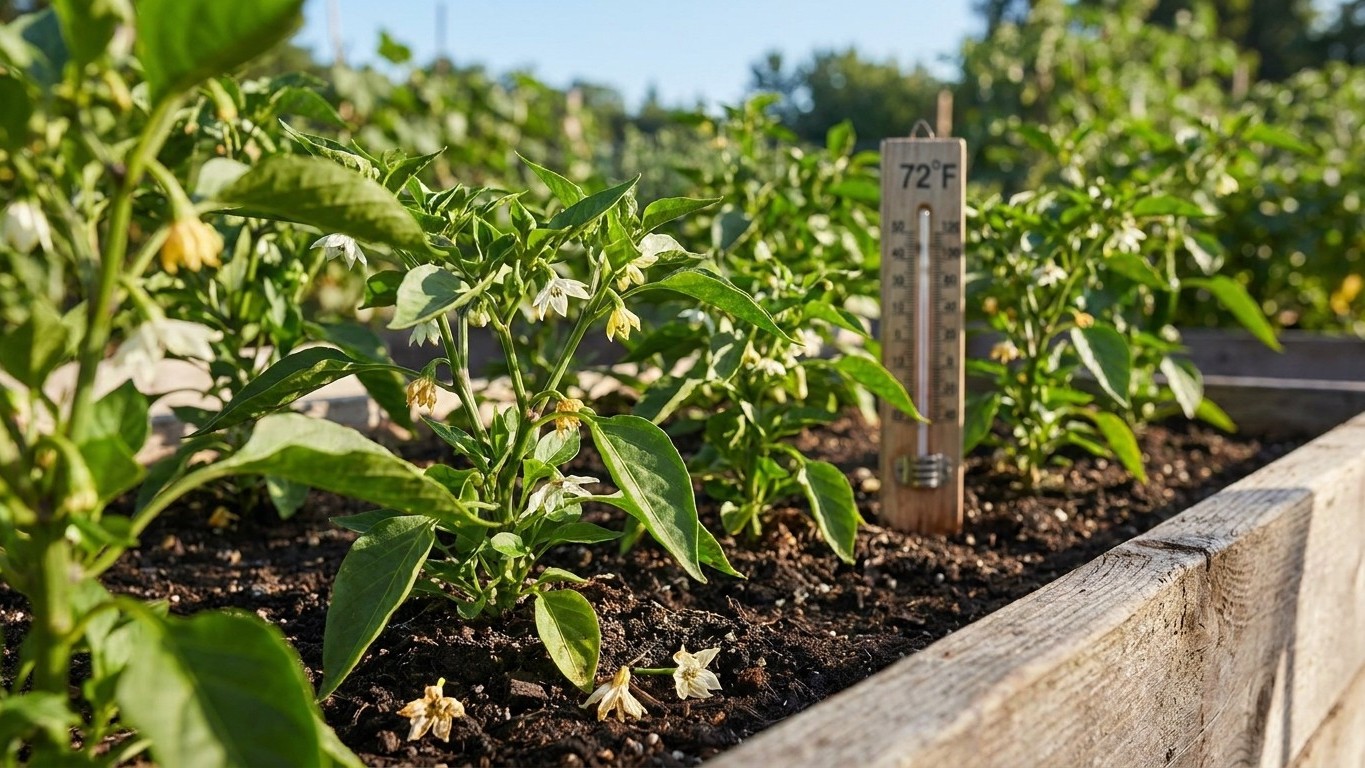

Start pepper seed indoors roughly 8 to 10 weeks before you plan to move transplants outside, which for most of West Virginia lands seed-starting in mid-to-late February through early March. Transplant only after the last frost has passed and soil has warmed to 60 F. Charleston’s last spring frost falls between April 9 and April 23, but higher ground across the state runs colder and later.
The short answer
Charleston averages 16.0 days a year at or above 90 F, based on NOAA NCEI Climate Normals for 1991-2020. That’s not a heat wave here and there. It’s a stretch of days, spread across a typical summer, when pepper flowers can abort before they ever set fruit. Utah State University Extension is blunt about the mechanism: pepper fruit set fails at both ends, and days above 90 F is one of those ends. Sixteen days a year isn’t extreme by national standards, but it’s enough that a grower who ignores it and plants a heat-sensitive variety in full afternoon sun on a west-facing slope can watch blossoms drop for a week at a stretch during the hottest run of July or August.
The other end of that failure window is nights below 55 F, and this is where a lot of West Virginia gardening advice goes wrong. It’s tempting to guess at night temperatures from where you sit on the map, on the theory that southern counties run warmer after dark than the Eastern Panhandle or the high ridges near Pocahontas or Randolph County. But this site does not carry summer night minimum data for any West Virginia location, and neither latitude nor the coldest month of the year is a reliable stand-in for what a thermometer reads at 4 a.m. in July. Elevation, valley cold-air drainage, and local terrain all move nighttime lows in ways a state map can’t show.
What this means in practice: track your own overnight lows during flowering, whether with a min-max thermometer on the porch or a weather station a few miles off. If you’re seeing repeated nights under 55 F while plants are blooming, that’s the likely cause of poor set, not the plant, not the soil, not a lack of pollinators. If daytime highs are pushing past 90 F for several days running during flowering, that’s the other cause, and it’s the one this state’s climate data actually confirms happens here on a predictable basis, 16 days a year on average at the Charleston station.
When to start seed here
Utah State University Extension’s guidance is straightforward: start pepper seed 8 to 10 weeks before transplanting, and don’t transplant until frost danger has passed and soil has reached 60 F. West Virginia’s frost timing does the rest of the math for you, though it varies enough across the state that every grower needs to run the numbers for their own county rather than copy a neighbor’s calendar.
- Find your last frost window. At the Charleston reference station, the 32 F freeze probability data from NOAA NCEI’s 1991-2020 Climate Normals puts the last spring frost between April 9 and April 23. That’s a river valley reading. Higher elevations across West Virginia, including much of the eastern mountains, typically freeze later in spring and earlier in fall than a valley station like Charleston, so treat that window as a starting reference, not a statewide guarantee.
- Confirm soil temperature, not just the calendar date. Frost passing doesn’t mean the soil is ready. Peppers need soil at 60 F before transplant, and cold spring soil in West Virginia’s clay-heavy ground can lag behind air temperature by a couple of weeks, especially in shaded or poorly drained beds. A soil thermometer pushed a few inches down is the only way to know for certain.
- Count backward 8 to 10 weeks from your realistic transplant date. If your target transplant window sits in the back half of April into early May, once frost has cleared and soil has warmed, that puts seed-starting indoors somewhere in mid-February to early March for most of the state. Growers at higher elevations, where both frost and soil warming run later, should shift that seed-starting window later by a week or two to match.
- Adjust for your own microclimate every year. A cold, wet spring pushes soil warming back regardless of the calendar; a mild one can let you transplant early. The 8-to-10-week rule from seed to transplant stays fixed. What moves is the transplant date itself, and that has to be judged fresh each season against actual frost and soil readings, not last year’s dates.
What goes wrong here
- Blossom drop during a hot spell. When daytime highs climb past 90 F, which Charleston’s climate data shows happens on 16.0 days a year on average, pepper flowers can drop before setting fruit. The remedy is shade cloth over plants during the hottest stretch of the day, and choosing planting sites that get some afternoon relief rather than full, unbroken west sun.
- Blossom drop during a cool night. The opposite failure hits when nights fall below 55 F during flowering. Because this site doesn’t track summer night minimums for West Virginia locations, the only way to catch this is to monitor your own garden’s overnight lows with a thermometer, rather than assuming your area is warm enough after dark because it’s warm during the day. If cool nights are the pattern, delaying transplant by a week or two, or using row cover on cool evenings, can help flowers hold.
- Sunscald on exposed fruit. Strong summer sun, paired with the kind of heat load reflected in Charleston’s 90-degree-day count, can scorch pepper fruit left without leaf cover, especially after pruning has stripped foliage or after a storm has knocked leaves down. Leaving natural foliage in place to shade developing fruit, rather than aggressively pruning for airflow, cuts this risk.
- Blossom-end rot. This shows up as a sunken, leathery patch on the fruit’s bottom end and traces back to inconsistent water delivery rather than a soil calcium shortage in most cases. West Virginia’s mix of clay soils and uneven summer rainfall, sometimes dry stretches broken by heavy downpours, makes consistent watering harder than it sounds. Mulching to hold soil moisture steady and watering on a regular schedule, rather than letting soil swing between bone dry and soaked, is the practical fix.
Common questions
How many weeks before the last frost should I Start Pepper Seed in West Virginia?
Utah State University Extension recommends starting pepper seed 8 to 10 weeks before transplanting outdoors. Since Charleston’s last spring frost typically falls between April 9 and April 23, and transplant should wait until after that frost and until soil reaches 60 F, most West Virginia gardeners land on a mid-February to early March start date indoors, adjusted later for higher elevations.
Does West Virginia get hot enough to stop pepper fruit set?
Charleston averages 16.0 days a year at or above 90 F, and days that hot can cause pepper blossoms to drop rather than set fruit, according to Utah State University Extension. It’s not a daily occurrence across a whole summer, but it happens often enough in a typical year that growers in the hottest stretches of the state should plan for some shade during peak afternoon heat.
Can I tell if my nights are too cool for peppers by checking West Virginia’s climate averages?
Not from this data. This site tracks days above 90 F for West Virginia but does not carry summer night minimum temperatures, and night lows shouldn’t be guessed from latitude or from how cold the winter runs. The only reliable way to know if nights are dropping below the 55 F threshold that Utah State University Extension flags as a fruit-set problem is to measure your own garden’s overnight temperatures during flowering.
Why did my peppers flower but never produce fruit?
Utah State University Extension points to two climate triggers: nights below 55 F or days above 90 F during flowering. Since flowering to fruit typically runs 35 to 45 days after the flower opens, a bad stretch of weather during that flowering window, whether a heat spike matching Charleston’s 90-degree pattern or an unusually cool night you tracked yourself, can explain blossoms that never turned into peppers.