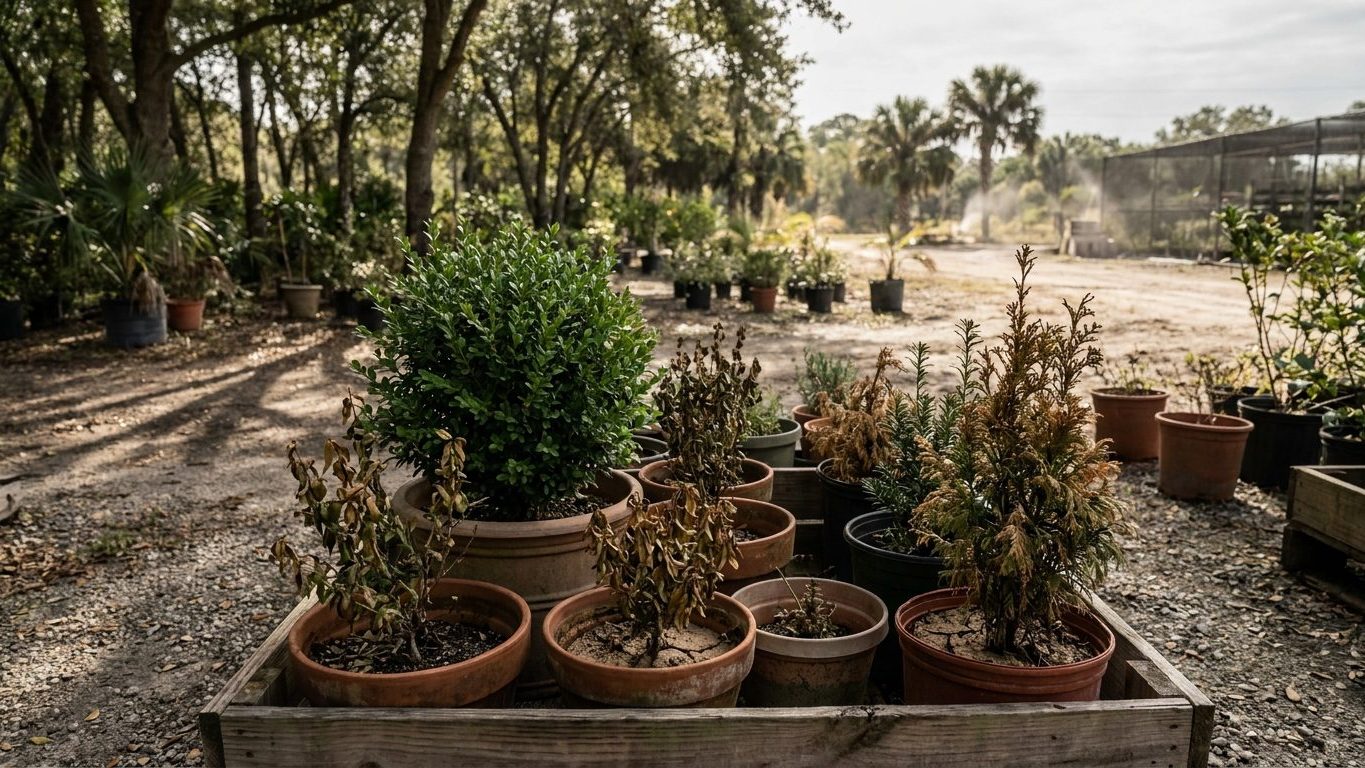

Two popular hedge plants will not survive everywhere in West Virginia. Leyland cypress and cherry laurel are listed only for USDA zones 6a, 6b and 7a, which leaves out the coldest ground in the state. The other ten common hedge plants survive from zone 5a to 7a. What decides regrets later is a different question: which of them can never be cut back to size once they outgrow the spot.
What actually holds in West Virginia
West Virginia runs from zone 5a to zone 7a on the USDA Plant Hardiness Zone Map 2023. That system rests on a single number, the average annual extreme minimum temperature. Because it is an average, any single winter can dip below the zone number. A hedge list written for the whole state hides that spread of two full zones, and the high country and the river valleys are on opposite ends of it.
Which hedge plants fail in the colder zones?
Leyland cypress (x Hesperotropsis leylandii) grows 3 to 4 feet a year and reaches 15 to 25 feet as a screen. Cherry laurel (Prunus laurocerasus) is slower, at 1 to 2 feet a year, and settles at 6 to 15 feet as a hedge. Both are hardy in 6a, 6b and 7a only. On zone 5 ground, which means the higher elevations, they are a gamble. Even in 6a a hard winter can test them, so the safest sites are the warmer valleys. Look up your ZIP code on the zone map before you buy, because a ridge and a river bottom a few miles apart can fall in different zones.
Which ones hold across the whole state?
Boxwood, yew, American hornbeam, inkberry holly, winterberry holly, arrowwood viburnum, privet, arborvitae, Eastern red cedar and Eastern hemlock all survive from 5a through 7a. That is ten of the twelve species gardeners most often plant as hedges, and it leaves plenty of choice.
Surviving is a lower bar than thriving. A hardiness range tells you the plant lives through the cold. It says little about whether the plant looks good at the edge of that range. The upper end of a range is often a heat limit, and the warm valleys of zone 7a are where summer stress shows up first. A plant can be rated for your zone and still look tired every August, so watch the first two or three seasons before you commit to a long run of them.
Frost timing shifts with elevation too. In the Charleston river valley, the last spring frost falls between April 9 and April 23, and the first fall frost between October 18 and November 1 (NOAA NCEI 1991-2020 Climate Normals). Higher ground freezes noticeably earlier in fall, and its last spring frost comes later. Treat those valley dates as a starting point and push them around for your own hill.
The hedges you can never cut back down
Two of the plants that hold across the state share a trait that matters more than hardiness. They do not regrow from old wood. Cut into the bare, leafless interior and the branch stays bare for good. A hedge like that can be trimmed, but it can never be rescued.
Which hedge plants never grow back after a hard cut?
Leyland cypress is the sharpest case. It grows 3 to 4 feet a year, can top 25 feet, and will not regrow from old wood. It is pruned from late spring to midsummer. A row planted too close to a property line cannot be cut back later, so the only fix is removal.
Arborvitae (Thuja occidentalis) grows more slowly, at 6 to 9 inches a year, and reaches 4 to 15 feet as a hedge. It does not regrow from old wood either. Prune it in late winter before growth starts, or in midsummer. Eastern red cedar grows 12 to 24 inches a year and reaches 8 to 20 feet as a screen. It takes light cuts in late winter only, and it too will not sprout from bare wood.
The practical rule is to buy for the height you want in ten years and space the plants for it. Then trim a little every year so you never have to cut deep. A hedge that you shape lightly each season stays full to the ground. One left for three years and then cut hard leaves brown holes that never fill.
Which ones forgive a hard cut?
Boxwood, yew, American hornbeam, inkberry and winterberry holly, arrowwood viburnum, privet and cherry laurel all regrow from old wood. If one gets away from you, a hard cut is a reasonable fix. Do it at the right time of year, and expect the hedge to look rough for a season or two before it fills back in.
Eastern hemlock also regrows from old wood, but it is pruned in late spring with light cuts only. It is a graceful tall hedge at 10 to 20 feet. It also has a serious insect problem in this region, so ask your county extension office about local conditions before you plant a long row.
Matching the plant to the job
Height decides most of the choice. A plant meant for a 4-foot front hedge fights you for the rest of its life if it wants to reach 20 feet. This table sets each plant’s pruning window beside its size and whether it forgives a hard cut.
| Plant | Growth a year | Height as hedge | Prune | Regrows from old wood |
|---|---|---|---|---|
| Boxwood | 3 to 6 inches | 2 to 6 feet | Late spring, after last frost | Yes |
| Yew | 6 to 12 inches | 3 to 8 feet | Late spring, after new growth hardens | Yes |
| Inkberry holly (evergreen) | 6 to 12 inches | 5 to 15 feet | Late winter | Yes |
| Winterberry holly (loses leaves) | 6 to 12 inches | 5 to 15 feet | Late winter | Yes |
| Arrowwood viburnum | 12 to 24 inches | 6 to 10 feet | Right after flowering | Yes |
| American hornbeam | 12 inches | 6 to 15 feet | Midsummer, after first flush | Yes |
| Privet | 2 to 3 feet | 4 to 12 feet | Spring and midsummer | Yes |
| Arborvitae | 6 to 9 inches | 4 to 15 feet | Late winter or midsummer | No |
| Eastern red cedar | 12 to 24 inches | 8 to 20 feet | Late winter, light cuts | No |
| Eastern hemlock | 12 to 24 inches | 10 to 20 feet | Late spring, light cuts | Yes |
| Cherry laurel (6a to 7a only) | 1 to 2 feet | 6 to 15 feet | Late spring, after flowering | Yes |
| Leyland cypress (6a to 7a only) | 3 to 4 feet | 15 to 25 feet | Late spring to midsummer | No |
For a low, formal edge, boxwood and yew are the slow, tidy choices. Boxwood adds only 3 to 6 inches a year, so it takes patience and rarely needs more than one trim. For a tall privacy screen on any ground in the state, hemlock and Eastern red cedar are the broad-range options. Arborvitae suits narrower spots, as long as you accept that it will not regrow if cut hard.
Privet answers a different need. At 2 to 3 feet a year it fills in fast, but it wants two trims a season, one in spring and one in midsummer. Winterberry, hornbeam and arrowwood viburnum suit a looser, less formal line, and the hollies and viburnum give you something besides a green wall. Neighbouring states face a different mix, and you can compare notes with Hedge Plants for Maryland: What Holds, and What Only Looks Hardy or Hedge Plants for Kentucky: What Holds, and What Only Looks Hardy. Colder winters change the list again, as Hedge Plants for Minnesota: What Holds, and What Only Looks Hardy shows. The broader Hedges section covers planting and care.
The ground you are planting into
West Virginia’s official state soil, named by law in 1997, is the Monongahela series. It is an Ultisol, an old, heavily weathered and leached soil that is naturally acid and low in nutrients. USDA’s recorded surface values for it are a pH of about 5.0, which is strongly acid. The texture is loam to silt, at 27 percent sand, 18 percent clay and 54 percent silt, with organic matter around 3.0 percent. It is moderately well drained.
What does that mean for a hedge?
Those numbers describe the soil that represents the state, not the soil in your yard. A state this hilly holds hundreds of soil series. River bottoms, steep hillsides and any lot a builder has scraped or filled can differ completely. The Monongahela only suggests what the ground tends to do: run acid, hold moisture from the silt, and drain a little slowly in wet seasons.
Acid ground suits the hollies and some of the other plants on this list, and it is the reason a soil test is worth the small fee. Slow drainage matters for any row of evergreens, because roots sitting in standing water in spring decline before the top shows it. Plant on a slight rise or loosen compacted subsoil, and avoid low spots where water pools after a rain.
Do not take the 5.0 as your pH. Test the ground where the hedge will go, then adjust for the plants you chose. West Virginia University Extension and your county office can explain the test results and what to do about them.
Planting time follows the frost dates. Spring planting after the last frost works, and so does early fall, which gives roots weeks to settle before the ground freezes. In the Charleston valley, first fall frost comes between October 18 and November 1, and elevated sites freeze earlier, so plant sooner there.
Common questions
What is the fastest-growing hedge for West Virginia?
Leyland cypress grows 3 to 4 feet a year, but it is hardy only in zones 6a, 6b and 7a and never regrows from old wood. Privet grows 2 to 3 feet a year across the whole state and does regrow, though it needs two trims a season. Eastern hemlock and Eastern red cedar grow 12 to 24 inches a year.
Can I plant Leyland cypress or cherry laurel in the mountains?
Not safely in zone 5 ground. Both are hardy only in 6a, 6b and 7a. Check your zone by ZIP code, and if you sit at the cold edge, choose from the ten that hold from 5a to 7a.
When should I prune a boxwood hedge?
In late spring, after the last frost. In the Charleston valley, that last frost falls between April 9 and April 23, so late April into May works there. Higher ground gets its last frost later, so wait longer. Boxwood regrows from old wood, which makes it forgiving if you trim too far.
Which hedge plant can I cut back hard if it gets too big?
Boxwood, yew, American hornbeam, inkberry and winterberry holly, arrowwood viburnum, privet and cherry laurel all regrow from old wood. Arborvitae, Eastern red cedar and Leyland cypress do not, so keep those to light, regular trims.