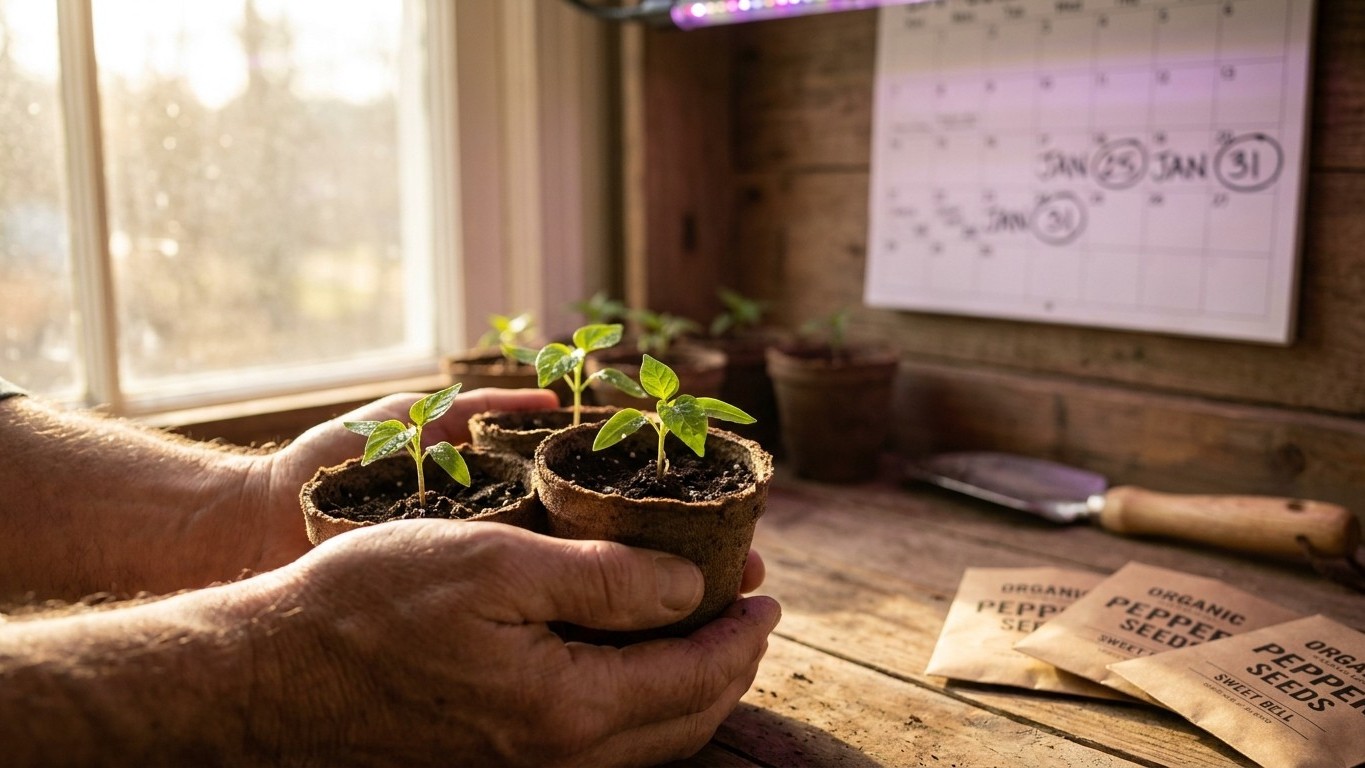

In Arkansas, start pepper seed indoors roughly 8 to 10 weeks before you plan to set transplants outside, safe from frost and into soil that’s reached 60°F. For most counties that lands the seed-starting window somewhere between late January and early February. The exact date shifts with your county’s frost record and how fast your soil warms, but the heat and cold that stall pepper fruit later in the season depend on conditions this site can only partly measure for you.
The short answer
Little Rock’s reference station logs 69.2 days a year at or above 90°F, based on NOAA NCEI’s 1991-2020 Climate Normals. That’s not a handful of scorching afternoons. It’s close to ten weeks scattered across a typical Arkansas summer, and it lands right on top of the window when a lot of home gardeners expect their pepper plants to be loaded with fruit. Pepper flowers don’t hold up well once daytime highs push past 90°F. The blossoms open, but pollen turns sticky and unviable, and the plant often drops the flower rather than push it to fruit. A plant can look green, healthy, and full of buds through a heat spell like this and still set almost nothing for two or three weeks running.
The other failure point sits at the opposite end of the thermometer. Utah State University Extension notes that pepper fruit set fails just as reliably when nights drop below 55°F. Cold nights don’t kill the plant, but they interrupt pollen development the same way extreme heat does, and a string of chilly nights early in the season, or a late cold snap after a warm spell, can knock out a round of blossoms before the gardener even notices anything wrong.
This is where the record gets thin for planning purposes. This site tracks how many days a year cross 90°F for a given territory, because that number is published and consistent, but it does not carry summer overnight low temperatures for Arkansas or any other state. Nighttime minima in July and August vary by elevation, by how close you are to a river or lake, by tree cover, and by whether cool air pools in a low spot on your property. None of that can be inferred from where the state sits on a map, and guessing from latitude or from January’s average low will mislead you. If your peppers are dropping blossoms on a run of nights that feel unusually mild during the day but stay cool after dark, a basic outdoor min-max thermometer left in the garden for a week will tell you more than any regional average.
When to start seed here
The math for backing into a seed-starting date is straightforward once you know your own frost record. Arkansas has two frost thresholds worth separating, because they point to different calendar windows.
| Threshold | Date range | Source |
|---|---|---|
| 32°F freeze probability (30-70% band) | March 12 to March 28 | NOAA NCEI 1991-2020 Climate Normals, station USW00013963 |
| 36°F light-frost threshold | April 3 (spring) / October 31 (fall) | NWS Little Rock |
Pepper transplants are tender at any frost, light or hard, so the 36°F date is the one that matters for timing, not the 32°F freeze window. Here’s how the backward count works:
- Start from the light-frost date for your area. In the Little Rock reference record, that’s April 3 in spring.
- Confirm your soil has actually warmed to 60°F before you plan to move transplants outside, since a cold snap can push soil warming later than the calendar date, and pepper roots stall in cold soil even after the air has warmed.
- Count back 8 weeks from your planned transplant date for a minimum indoor head start, or 10 weeks if you want larger, more established transplants going into the ground.
- From an April 3 transplant target, 8 weeks back lands seed-starting around February 6. Ten weeks back lands it around January 23.
- Adjust for your own county. If your local frost record runs later than the Little Rock reference date, because you’re in a cooler pocket, upland area, or northern county, push your transplant date and your seed-starting date back to match.
- Build in a buffer of a week or so for germination variability. Pepper seed germinates unevenly compared to something like tomato, and a cool room can slow the process further.
That gives most Arkansas gardeners a seed-starting window somewhere between late January and early February, with the exact week depending on how your local frost date compares to the Little Rock record and how quickly your particular garden bed warms in spring.
What goes wrong here
- Blossom drop in a hot spell. Once daytime highs push past 90°F for several days running, pepper flowers open and fall without setting fruit. Arkansas averages 69.2 such days a year, so this isn’t a rare event, it’s a recurring feature of the growing season. There’s no way to force pollination through a heat spell, but light afternoon shade cloth over the plants during the worst stretches, and keeping soil moisture even so the plant isn’t fighting drought stress at the same time, helps the plant hold onto the blossoms it opens once temperatures ease.
- Blossom drop on a cool night. The same failure shows up at the other end of the thermometer, when nights drop below 55°F. This tends to catch gardeners off guard early in the season, right after they’ve moved transplants outside, or during an unusual cool snap in an otherwise warm summer. Since this site doesn’t track nighttime lows for Arkansas, the practical fix is watching your own thermometer and, if a cold night is forecast during flowering, covering plants overnight with a lightweight row cover to hold in a few extra degrees.
- Sunscald on exposed fruit. Where Arkansas summer sun is strong and consistent, pepper fruit that develops without enough leaf cover can develop pale, papery patches on the side facing the afternoon sun. This usually follows aggressive pruning or a plant that’s lost lower leaves to disease. Leaving the plant’s natural leaf canopy intact, rather than trimming for looks, keeps fruit shaded through the hottest part of the day.
- Blossom-end rot on developing fruit. Fruit that looks fine at one stage and then develops a sunken, leathery brown patch at the blossom end usually points to inconsistent watering rather than a soil nutrient problem outright. Uneven watering interrupts how the plant moves calcium into developing fruit, and Arkansas’s mix of heavy summer downpours followed by dry stretches makes this a common pattern. Mulching to even out soil moisture and watering on a regular schedule, rather than only when the plant looks stressed, addresses most cases.
Common questions
Can I start pepper seed earlier than 8 weeks before transplanting?
Starting much earlier than 10 weeks tends to produce leggy, rootbound transplants that struggle after transplant shock, rather than getting you an earlier harvest. The 8 to 10 week window, per Utah State University Extension, reflects the amount of time pepper seedlings typically need to reach a sturdy transplant size without outgrowing a small indoor container.
What if my county’s frost date is different from the Little Rock reference station?
Use your own local frost record if you have one. The dates in this article come from a specific reference station and represent averages for that location; counties further north, at higher elevation, or in a low-lying frost pocket can run a week or more later in spring, which shifts both the transplant date and the seed-starting date back to match.
Is it the 32°F date or the 36°F date I should plan around?
For pepper transplants, plan around the 36°F light-frost date, since pepper plants are tender and don’t tolerate light frost any better than a hard freeze. The 32°F freeze probability window is a different, and in this case less useful, threshold for a tender crop like peppers.
How do I know if my summer nights are dropping below 55°F?
The only reliable way is to measure it yourself. A basic outdoor min-max thermometer, or a simple digital logger, placed in the garden will show you your actual overnight lows through the flowering period, since this varies by yard and can’t be reliably estimated from regional averages or from the state’s daytime heat record.