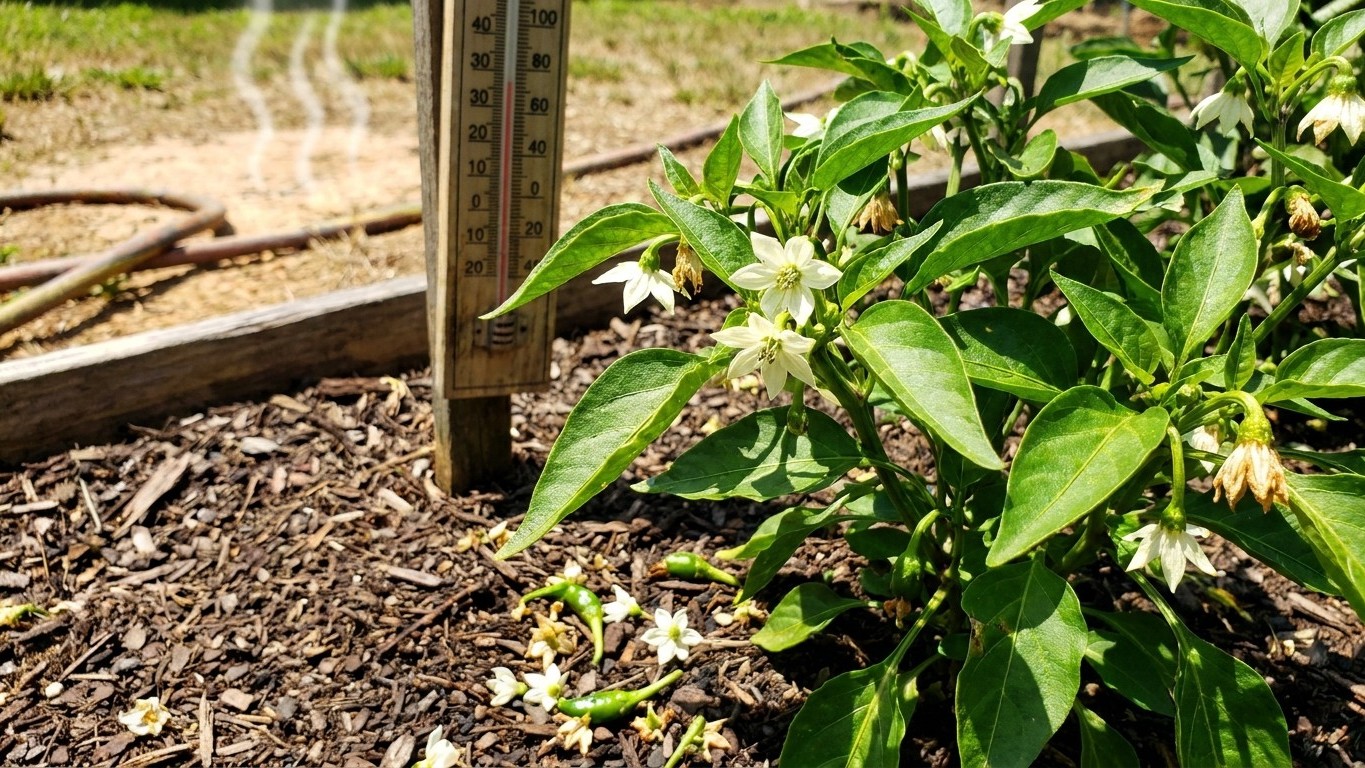

Pepper fruit set in the Northwest Territories has almost nothing to do with heat. This far north, the challenge sits at the cold end of the scale: nights that drop below 55 F stall pollen and blossoms, and the growing window itself is short enough that starting seed at the wrong time can cost a grower the whole crop before a single flower opens.
The short answer
Start with the number that actually describes summer here: at the reference station in Yellowknife, the average is 0.0 days a year at or above 90 F. Zero. That figure comes from Environment and Climate Change Canada’s climate normals, and it tells you something concrete: heat-driven blossom drop, the kind that hits pepper growers in hotter states when afternoon temperatures climb past 90 F and flowers abort rather than set fruit, is not a factor a Northwest Territories gardener needs to plan around. The hot end of the pepper fruit-set problem is effectively closed here.
That is the easy half of the story. Pepper fruit set fails at both ends, not just one, and the cold end is where this territory does its damage. Utah State University Extension puts the failure threshold at nights below 55 F: when nighttime temperatures drop under that mark, pollen becomes less viable, blossoms can drop before they ever set fruit, and a plant that looked healthy in the afternoon shows nothing but bare stems by morning.
Here is where a Northwest Territories grower needs to do their own homework. This site tracks days at or above 90 F for the territory, because that figure is published and comparable across regions. It does not track summer night minima, and no reliable way exists to guess at those from latitude or from how cold the depths of winter get. A high-latitude location can still run mild summer nights in a sheltered valley, or brutally cool ones on open ground exposed to wind off the water. The only way to know whether your peppers are hitting that 55 F floor on a given night is to put a min-max thermometer in the garden and read it, ideally over several nights in a row during the weeks when plants are flowering.
Put those two pieces together and the picture for the Northwest Territories comes into focus. There is essentially no heat-stress season to worry about, but the cool-night risk runs long, likely stretching well into what would be considered mid-summer in warmer states. A pepper crop here is less about protecting plants from a blast of heat and more about giving them every extra week of warmth the short season allows, then watching nighttime readings closely once flowers appear.
When to start seed here
Timing a pepper crop this far north is an exercise in counting backward from two fixed points: the date the soil reasonably warms enough to accept a transplant, and the number of weeks a pepper seedling needs indoors before it can go outside. Utah State University Extension sets that indoor period at 8 to 10 weeks, and sets the transplant trigger at two conditions that both need to be true: frost has passed, and the soil has reached 60 F.
- Find your frost reference. For the Northwest Territories, the Yellowknife A station puts the average last spring frost at May 25, according to Environment and Climate Change Canada’s 1981-2010 climate normals. Treat that as a midpoint, not a guarantee: it is a mean date, which means in roughly one year out of two the last frost actually falls later than May 25. Communities north of Yellowknife, or those sitting in low-lying or exposed terrain, should expect to push that date back further still.
- Wait for the soil, not just the calendar. Air temperature crossing above freezing does not mean the soil is ready. Peppers need soil at 60 F before transplant, and in a climate this cool that can lag well behind the frost-free date. A soil thermometer pushed a few inches into the bed, checked over several mornings, is the only reliable way to confirm it.
- Count back 8 to 10 weeks from your realistic transplant date. If a grower is working toward a transplant date in the first half of June, accounting for both the May 25 frost average and the extra lag for soil warmup, seed should go into indoor trays roughly 8 to 10 weeks earlier, which lands in the first half of April. Growers further north, or those who know their local frost tends to run later than the Yellowknife reference, should shift the whole schedule a week or two later rather than risk a transplant that sits in cold soil doing nothing.
The arithmetic is simple once the two anchor points are set: local frost expectation plus soil-temperature lag equals transplant date, and transplant date minus 8 to 10 weeks equals seed-starting date. What changes county to county, or even yard to yard, is how much lag to add between frost and 60 F soil, and that number is worth tracking with an actual thermometer rather than assuming.
What goes wrong here
- Blossom drop from a cool night. This is the dominant failure mode in the Northwest Territories. When nighttime temperatures fall below 55 F during flowering, pollen viability drops and blossoms fall before fruit sets. The remedy is monitoring, not guesswork: track nighttime lows with a thermometer left in the garden, and if a cold stretch is forecast during flowering, cover plants overnight with row cover or move container-grown peppers into a garage or greenhouse until temperatures recover.
- Blossom drop from a hot spell. Rare here given the 0.0 average days at or above 90 F, but not impossible in an unusual warm run. If daytime heat does spike, the same principle applies as it would anywhere: shade cloth over the afternoon sun and consistent watering reduce the stress that triggers dropped flowers.
- Sunscald where the sun is strong. Long summer daylight hours at this latitude mean fruit can be exposed to intense, prolonged direct sun even without extreme heat, and unprotected fruit can develop pale, papery patches on the sun-facing side. Leaving the plant’s natural leaf canopy intact rather than over-pruning, and using light shade cloth during the sunniest weeks, protects developing fruit.
- Blossom-end rot. This shows up as a dark, sunken patch at the bottom of the fruit and traces back to inconsistent watering disrupting calcium uptake, not to a soil calcium shortage in most cases. Even, regular watering, especially through the short but intense growing window here, is the most direct remedy.
Common questions
Do Northwest Territories summers ever get hot enough to stop pepper fruit set?
Based on the 0.0 average days a year at or above 90 F recorded at the Yellowknife reference station, heat-driven blossom drop is not a realistic concern in a typical season here. The far more common failure comes from the cold end, nights below 55 F, which this climate experiences routinely during the growing season.
How do I know if my nights are too cold for pepper fruit set?
Put a min-max thermometer in the garden bed and check it each morning during flowering. If readings are falling below 55 F, expect blossom drop and consider row cover or bringing container plants indoors overnight. This site does not publish summer night minima for the territory, so a direct reading is the only reliable check.
When is it safe to transplant peppers outdoors in the Northwest Territories?
Wait until frost has passed and the soil has reached 60 F. The Yellowknife A average last frost date is May 25, but since that is a mean date, plan for the real possibility that frost arrives later in a given year, and confirm soil temperature directly before moving plants outside.
How early should I start pepper seeds indoors here?
Utah State University Extension recommends 8 to 10 weeks indoors before transplant. Working back from a realistic early-to-mid June transplant date in most Northwest Territories communities, that puts seed-starting in the first half of April, with an adjustment later for districts that typically see frost persist past the Yellowknife average.