
Start pepper seed indoors around mid-March in most of the Northwest Territories, counting back 8 to 10 weeks from a transplant date set near the region’s average last frost of May 25, once soil has warmed to 60°F. But timing indoors is the easy part. The harder question is whether nights will hold warm enough once the plants go outside, and that’s a number this territory simply doesn’t run in your favor by default.
The short answer
Yellowknife averages 0.0 days a year at or above 90°F, according to Environment and Climate Change Canada’s Canadian Climate Normals for 1981-2010. That figure measures summer heat load: the days that push water demand up and stall fruit set in plants that can’t handle a scorcher. For pepper growers farther south, that upper threshold is the thing to fear. Here, it barely registers. A pepper plant in the Northwest Territories is not going to sit through an afternoon at 95°F and drop its blossoms from heat stress, because that afternoon essentially never arrives at the reference station.
That’s the good news, and it’s worth sitting with for a second, because most pepper guidance written for the Lower 48 spends a lot of ink warning about heat. None of that applies at this end of the country. What does apply is the other side of the same coin. Pepper fruit set fails at both ends: nights below 55°F shut it down just as reliably as days above 90°F do, according to Utah State University Extension’s guidance on peppers. A plant that never sees a 90-degree day can still lose its whole crop to a run of cool nights in July, and that’s the risk that actually matters in this climate.
The problem is this site doesn’t carry summer night minimum temperatures for the Northwest Territories, and neither does the source behind the fruit-set threshold. There’s no published number here to hand you that says “your nights average X in mid-July, so you’re fine” or “so you’re not.” That has to come from your own observation, not from a guess based on how far north you are or how cold the coldest month runs. Latitude tells you about day length and season length. It does not tell you what a thermometer will read at 2 a.m. in your own yard in July, and a hard winter doesn’t predict a cool or mild summer night either.
So the short answer has two halves. The heat-failure threshold is functionally a non-issue here, backed by a measured zero. The cold-failure threshold is the one to track, and tracking it means keeping a min-max thermometer near your plants once they’re outside, not assuming anything from the calendar or the map.
When to start seed here
Working backward from transplant to seed-starting date is the most reliable way to land on a sowing window that fits your own property, rather than a generic date printed on a seed packet. Here’s how the arithmetic runs for this territory.
- Start with the frost baseline. The average last spring frost at Yellowknife A runs May 25, per Environment and Climate Change Canada’s 1981-2010 Canadian Climate Normals. That’s a mean, not a guarantee: in roughly half of all years on record, frost arrived later than that date, so treat May 25 as the midpoint of a window rather than a safe line to plant on.
- Build in a buffer past the mean. Because half of past years ran later than May 25, many gardeners push their actual transplant target into early June rather than transplanting right on the average date, to reduce the odds of setting tender pepper seedlings out just ahead of a late frost.
- Wait for 60°F soil, separately from frost. Air temperature clearing frost risk and soil temperature reaching 60°F are two different milestones, and soil often lags behind air. Utah State University Extension names 60°F soil as the transplant threshold for peppers, after frost has passed. Check the actual soil with a probe thermometer rather than assuming it has caught up just because the air has warmed.
- Count back 8 to 10 weeks for indoor sowing. Utah State University Extension calls for 8 to 10 weeks of indoor growing time before peppers go into the ground. If your working transplant target is the first week of June, 8 to 10 weeks back lands seed-starting in the last week of March through the first week of April.
- Adjust for your own district. The Northwest Territories is not one climate. Yellowknife A is a single reference station, and northern or upland areas commonly run behind it in spring warmth. If your ground typically thaws and warms later than the territorial capital’s, shift your seed-starting date correspondingly later, since starting too early just means longer, leggier growth indoors waiting for outdoor conditions to catch up.
The math is simple once you have your own transplant target: pick the date you actually intend to move plants outside, then count back 8 to 10 weeks. Everything else, the frost mean, the soil check, the local lag, exists to help you set that transplant date honestly instead of copying a date from somewhere with a different climate.
What goes wrong here
- Blossom drop from a rare hot spell. With 0.0 days a year averaging 90°F or above at the reference station, heat-driven blossom drop is a low-odds event in this territory, but not a zero-odds one in an unusually warm stretch. If temperatures do spike, temporary shade cloth over plants during the hottest hours can keep blossoms from aborting.
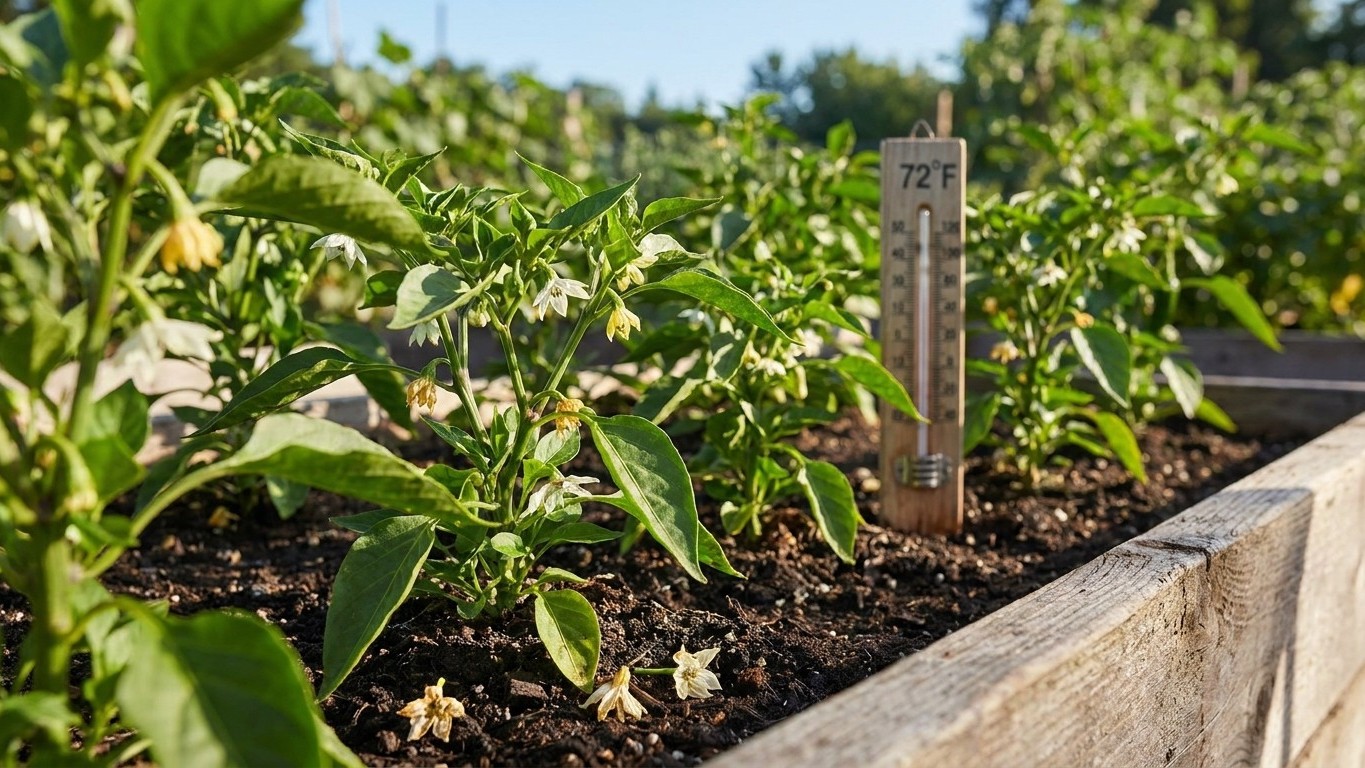
- Blossom drop from a cool night. This is the more realistic failure point in the Northwest Territories, since nights below 55°F stop pepper fruit set according to Utah State University Extension, and this site does not track summer night minimums for you to check in advance. Watch your own thermometer through the growing season, and if a cold snap is forecast, cover plants overnight with row cover or move container-grown peppers indoors or into a sheltered spot.
- Sunscald on exposed fruit. Peppers that lose leaf cover, from over-pruning, wind damage, or disease, can suffer sunscald when fruit is suddenly exposed to direct sun after being shaded by foliage. Keep plants bushy and avoid stripping leaves near developing fruit; if scald has already started, use light shade cloth over the exposed side of the plant.
- Blossom-end rot from uneven watering. Irregular soil moisture interferes with calcium uptake and shows up as a dark, sunken patch on the fruit’s blossom end. Even watering on a consistent schedule, along with a layer of mulch to hold soil moisture steady, addresses most cases without needing a calcium spray.
Common questions
Can I direct-sow pepper seed in the Northwest Territories?
Direct-sowing outdoors is a poor fit here. Peppers need 8 to 10 weeks of indoor growing time before they’re transplant-ready, per Utah State University Extension, and with an average last frost of May 25 (itself only a midpoint, not a safe date), the outdoor season simply isn’t long enough to sow seed directly in the ground and still get a harvest before fall.
What soil temperature do pepper seeds need to germinate here?
The 60°F figure from Utah State University Extension applies to transplanting seedlings outdoors, not to germinating seed indoors. For starting seed, use a warm indoor spot or a seedling heat mat rather than relying on outdoor soil, since outdoor soil in this territory won’t be warm enough for seed-starting purposes for weeks after you need to begin indoors.
Does the territory ever get too hot for peppers?
Rarely, based on the record. The 0.0 average days per year at or above 90°F at the Yellowknife reference station means heat-driven fruit-set failure is not the typical risk in this territory, unlike much of the continental United States. That doesn’t rule out an unusual hot spell in any given year, but it’s not the pattern to plan around.
How do I know when my nights are warm enough for peppers?
Use a min-max thermometer placed near your plants and check it through the growing season. This site does not carry summer night minimum temperatures for the Northwest Territories, and the 55°F threshold from Utah State University Extension has to be checked against your own readings, not inferred from your latitude or from how cold your winters run.