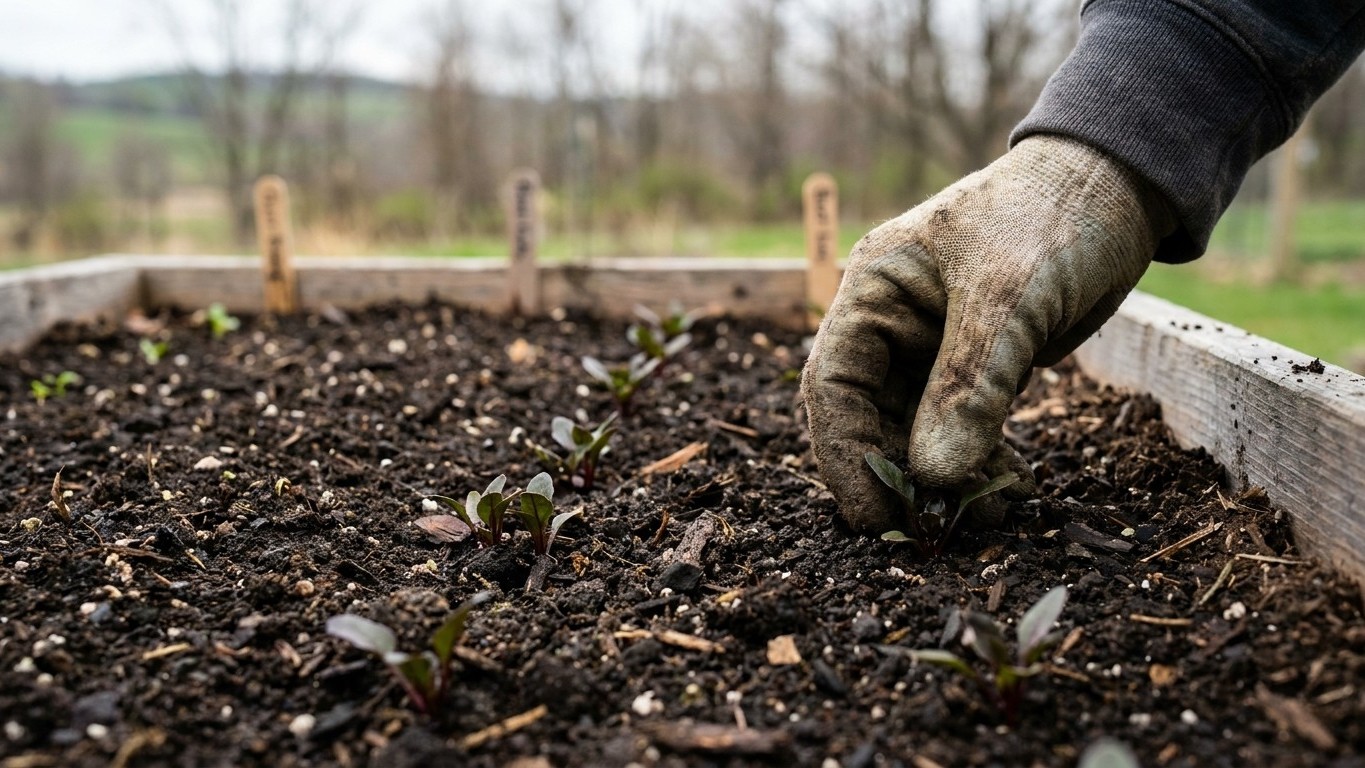

New York’s representative topsoil, the Honeoye series, is a well-drained silt loam that suits beets reasonably well once you add a modest amount of compost. The bigger variable is timing: sow 2 to 3 weeks before the last spring frost (March 23 to April 3 in the New York City area), then manage the first six weeks so the seedlings never dry out. For a full breakdown of these planting windows, see When to Sow Beets in New York. Get that window right and the roots stay tender; get it wrong and you’re pulling up something closer to a woody radish.
The short answer
Start with what’s actually under a New York garden bed, at least according to the soil the USDA lists as representative of the state. The Beet Soil in New York is an Alfisol, a forest-derived soil of moderate natural fertility that holds onto nutrients better than a sandy soil would. Its surface horizon runs 26 percent sand, 19 percent clay and 55 percent silt, which puts it solidly in loam-to-silt-loam territory, with organic matter around 3.0 percent and a surface pH near 6.3, just a touch acid. It’s classified well drained, meaning water moves through it at a workable pace rather than pooling around a taproot or draining away before the plant can use it.
What that texture means for a beet root
Beets want deep, sandy, well-drained ground rich in organic matter, and a silt loam like Honeoye gets most of the way there without extra work. The silt fraction (55 percent) holds moisture between waterings, the clay (19 percent) keeps a modest nutrient reserve, and the drainage class means a heavy spring rain won’t leave the root sitting in saturated soil. Where a lot of New York gardeners run into trouble is over-improving it: Utah State University Extension recommends no more than 1 inch of composted organic matter per 100 square feet worked into beet beds, and Honeoye’s 3.0 percent organic matter is already a decent baseline, not a soil that’s starving for compost.
| Property | Value (Honeoye series, surface horizon) |
|---|---|
| Sand | 26% |
| Silt | 55% |
| Clay | 19% |
| Organic matter | about 3.0% |
| Surface pH | about 6.3 |
| Drainage class | Well drained |
On the heat side, the figures published here don’t include a count of days New York City spends above 90 F in a given year, so that specific number isn’t something this page can state. What is documented is the threshold that matters for beets: temperatures above 85 F combined with water stress make the root turn woody. New York’s summers do produce stretches above that mark, especially inland and away from the coast, which is the practical reason late-planted beets can toughen up even in soil that started out ideal.
None of this makes Honeoye a stand-in for any one backyard. New York spans hundreds of mapped soil series, and river-bottom ground, hill-country clay, or anything a builder has scraped and filled will behave nothing like the state’s representative loam. Treat these numbers as a starting point for what the region’s ground tends to do, not a reading of your own bed.
The six weeks that decide it here
Sowing 2 to 3 weeks before the last frost date puts a New York City beet crop’s earliest, most fragile weeks somewhere around early March, with the frost-free point itself falling between March 23 and April 3. That timing matters more for beets than for most root vegetables, because the plant’s flowering trigger is set early: water stress during roughly the first six weeks after seeding is what pushes beets to bolt, sending energy into a flower stalk instead of a root. This is a separate failure from woodiness, which comes later and from heat, not from an early dry spell.
What that early season usually looks like
New York’s late-winter-into-spring stretch tends to swing rather than settle. Snowmelt and rain can leave a bed heavy and cold in early March, then a run of dry, windy days a few weeks later can pull moisture out of the top few inches fast, right when beet roots are barely established. That swing is the real risk window here, not a steady drought and not a steady soak, but the unpredictable stretch between the two. A bed that was saturated at sowing can be crusty and dry ten days later without anyone changing a watering routine, simply because a cold front moved through.
Because the last-frost window itself runs across roughly two weeks (March 23 to April 3), and upstate and inland areas run measurably later than the New York City figure quoted here, the practical takeaway is to treat those first six weeks after seeding as the period to check soil moisture by hand, not by calendar. A well-drained silt loam like Honeoye won’t stay soggy long after a rain, which is good for the root but means it also won’t hold reserve moisture through a dry snap the way a heavier clay would. Consistent shallow watering, rather than infrequent deep soaking, tends to match this soil’s behavior better during that stretch.
It’s also worth noting that this early-season bolting risk and the later heat-driven woodiness risk pull in opposite directions on scheduling. Sow too late trying to dodge a cold snap, and the beets mature into the hotter, drier stretch of a New York summer where the 85 F-plus threshold starts working against root texture. Sow at the recommended 2-to-3-week mark instead, and the crop’s most sensitive weeks stay in the cooler, if less predictable, early spring.
What goes wrong here
- Bolting from an early dry spell. A New York spring that turns from wet to windy-dry within a week or two can catch beet seedlings during their first six weeks, when water stress triggers premature flowering. The remedy is checking soil moisture by hand through that window rather than trusting a fixed watering schedule, and watering shallowly but consistently once the top inch starts to dry.
- Woody roots from a late-season heat run. Once temperatures push past 85 F, any accompanying water stress makes the root fibrous. This is unrelated to the early bolting risk and shows up later in the season, so a crop that survived its first six weeks fine can still toughen up in a July or August hot spell if watering lapses.
- Over-amending an already decent soil. Honeoye’s baseline organic matter (about 3.0 percent) is workable for beets as-is. Piling on more than the 1 inch of composted material per 100 square feet that Utah State University Extension recommends can throw off the balance and encourage leafy top growth at the root’s expense.
- Assuming the state soil is your soil. A garden on filled or graded ground, or on a floodplain, can have drainage or texture nothing like Honeoye’s well-drained silt loam. Compacted or heavier ground holds water longer after New York’s spring rains, which can rot beet seedlings before bolting even becomes a question.
- Sowing timed to the wrong frost date. The March 23 to April 3 window applies to the New York City area. Gardeners upstate or in the Adirondacks working from that figure risk sowing weeks before their actual frost-free date, exposing seedlings to a much longer cold, wet stretch than the six-week window assumes.
Checking this against your own county
Everything above describes a representative soil series and a single reference city’s frost dates, not any one garden. The most reliable next step is a local soil test and a local frost-date check through Cornell Cooperative Extension, which runs county-level offices across New York State. They can confirm whether your soil is closer to Honeoye’s silt loam or something heavier or sandier, and they hold frost-date records specific to your county rather than the New York City figure used here. For a crop as sensitive to timing as beets, that local number is worth having before you commit to a sowing date.
Common questions
Do beets need full sun in New York’s climate?
The soil and frost data here don’t cover sunlight requirements directly, but beets are grown as an in-ground, direct-seeded root crop, and consistent moisture in the first six weeks matters more than shade management for avoiding bolting.
How many days until beets are ready to harvest?
Because beets are direct-seeded rather than transplanted, the maturity clock (typically cited as 60 to 80 days by garden references) runs from the seeding date, not from any later transplant step, since beets aren’t transplanted at all.
Can I sow beets earlier than 2 to 3 weeks before the last frost to beat the summer heat?
Sowing earlier shifts the sensitive first six weeks into colder, often wetter conditions, which raises the risk of poor germination rather than solving the later heat-and-woodiness problem, so the 2-to-3-week guideline is meant as a balance, not a minimum.
Is New York’s representative soil good enough for beets without amendment?
Honeoye’s well-drained silt loam and roughly 3.0 percent organic matter are workable for beets largely as they are; Utah State University Extension’s guidance caps composted amendment at 1 inch per 100 square feet, meaning a small addition rather than heavy overhaul is the more fitting approach on this soil type.