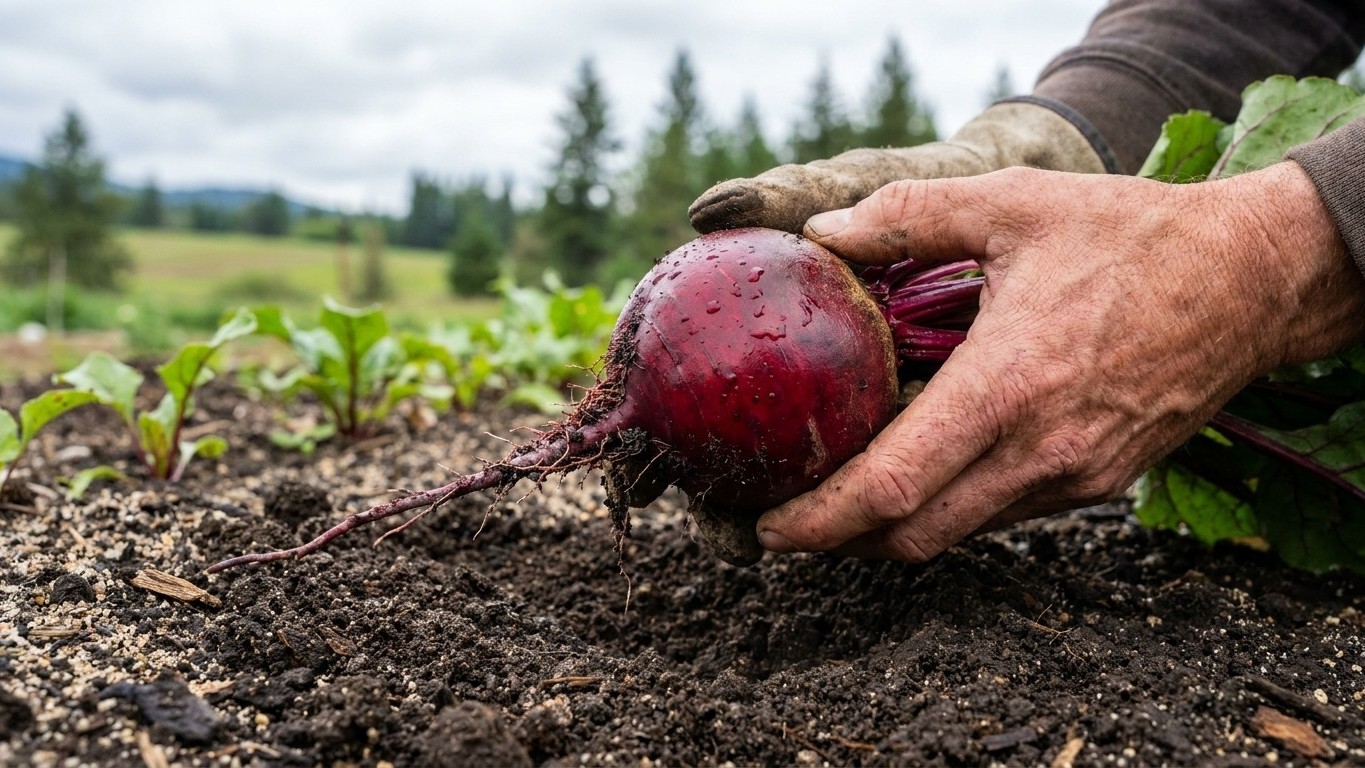

British Columbia’s farmland soil runs young and slightly acid, sandy loam over silt, well drained but light on the clay that holds moisture. That’s mixed news for beets, which want steady, even moisture from the day they sprout. When to Sow Beets in British Columbia generally means two to three weeks ahead of the province’s average last frost, March 18, and the plant’s first six weeks land in a spring that can turn dry fast. Get the timing and the water right, and roots stay tender rather than woody or bolted.
The short answer
Across the mapped agricultural surface of British Columbia, the most common soil order is a Brunisol, a young soil whose horizons are only beginning to separate, typically formed on recent or coarse parent material. It covers about 33 percent of the mapped surface (Podzolic soils come next). The median surface texture runs loam to silt: 52 percent sand, 10 percent clay, 38 percent silt, with organic matter around 5.0 percent and a median pH near 5.8, slightly acid. Drainage is classed as well drained. That data comes from Agriculture and Agri-Food Canada’s Canadian Soil Information Service, drawn from the surface horizons of 2,593 mapped soil components across the province, and it forms the baseline picture of Beet Soil in British Columbia.
For a beet, that profile is a mixed bag. Utah State University Extension notes that beets want deep, sandy, well-drained soil rich in organic matter, amended with no more than 1 inch of composted organic matter per 100 square feet. The province’s dominant sand-heavy, well-drained texture fits that description reasonably well on paper. But 10 percent clay is a thin reserve for holding water between rains, and a soil this coarse dries out at the surface faster than a heavier loam would, exactly the layer where a beet’s seedling roots are working in the first weeks after sowing.
The figures gathered for this page don’t include a count of days above 90°F for a specific British Columbia reference station, so nothing invented will be offered here. What can be said plainly is that the province’s coastal and valley growing regions run a milder summer than continental interior climates, which shifts the practical risk for BC growers toward early-season bolting from dry spells rather than late-season woody roots from sustained heat, the second failure mode Utah State ties to temperatures above 85°F combined with water stress.
None of this describes any single garden. British Columbia’s agricultural land spans hundreds of soil series across the Fraser Valley, the Okanagan, Vancouver Island and the Peace region, and this Brunisol profile is a mapped median across nearly 2,600 sampled components, not a diagnosis of the ground under your own raised bed. River-bottom soils, old muskeg, and anything a builder has cut, filled or graded will read completely differently from the number above. Treat the province’s median as a starting point for what the region’s ground tends to do, then confirm your own texture and pH with a soil test before you decide how much compost to work in.
The six weeks that decide it here
Utah State University Extension is specific about the stakes: water stress in the first six weeks after beets germinate causes premature flowering, the technical name for bolting. Sowing two to three weeks before the last frost, the standard advice for a cool-season root crop, puts that six-week clock ticking through a fairly predictable stretch of the British Columbia calendar, because the province’s average last spring frost, recorded at the Vancouver Int’l A station, falls on March 18.
That date is a mean, not a guarantee, and it needs to be read that way. Environment and Climate Change Canada’s Climate Normals for 1981 to 2010 report March 18 as the average across three decades of records at that one station. By definition, in roughly half of those years the last frost actually arrived later than March 18. Treating that date as a safe line to sow past is the single easiest way to lose a bed of beets to a cold snap that the average simply doesn’t rule out. Treat it as the midpoint of a window, not a fixed calendar mark, and hold a little sowing in reserve for a second pass if a late frost pushes the first one back.
What that means for the six-week clock is straightforward. A grower sowing in late February to early March, following the two-to-three-week rule against a March 18 average, is asking those beets to establish roots and put on their first true leaves right as the province moves out of its wettest stretch and into the drier run-up to summer. Coastal districts tend to carry more residual soil moisture through that window than interior valleys like the Okanagan, where spring dries out earlier and faster. Either way, the sandy, well-drained texture described above sheds water from the surface quickly, which means the six-week window is precisely when a missed watering, not a missed fertilizing, does the damage that shows up later as a bolted plant instead of a root.
The station behind that March 18 figure sits at Vancouver’s airport, at low elevation on the coast. A province this size is not one climate: northern districts, the Interior Plateau and higher-elevation valleys all run their own last-frost dates, some considerably later. The number here is a reference point for the coastal lowlands, not a province-wide sowing calendar.
What goes wrong here
- Bolting from a dry start. The sandy, low-clay surface texture common across the province’s mapped soils drains fast and holds little reserve water in the top few inches, exactly where a beet seedling’s roots sit for its first six weeks. A single week without rain or irrigation during that stretch can trigger premature flowering. The remedy is even moisture through that window specifically, not a general watering schedule that ramps up later in the season when the damage is already done.
- Woody roots from a late heat spell paired with dry soil. This is a different failure from bolting, tied to Utah State’s second threshold: temperatures above 85°F combined with water stress, occurring later in the growing season once roots are sizing up rather than in the first six weeks. Coastal BC summers run milder than continental interior climates, which lowers this risk somewhat, but a hot dry stretch in the Okanagan or a Fraser Valley heat wave can still toughen a root that missed water at the wrong time.
- Over-amending a soil that doesn’t need much. With organic matter already around 5.0 percent in the province’s typical mapped soils, piling on more compost than Utah State’s recommended cap of 1 inch per 100 square feet can push nitrogen high relative to phosphorus and potassium, encouraging leafy top growth at the expense of root development. Test before adding, rather than assuming more organic matter is automatically better.
- Slow, patchy germination in acid, cool ground. A median surface pH near 5.8 is on the acid side, and combined with a cool coastal spring, beet seed can sit and rot rather than germinate evenly. Waiting for soil to warm slightly past the earliest possible sowing date, and testing pH rather than assuming it, reduces the gaps in a row.
- Standing water in low or compacted spots despite a “well drained” soil class. The province’s median drainage rating is well drained, but that describes the typical mapped profile, not every low corner of a yard or a bed sitting on fill. A raised bed or worked-in organic matter corrects a soggy spot that the regional average doesn’t predict.
Checking this against your own county
Everything above describes a median across nearly 2,600 mapped soil components and one weather station at Vancouver’s airport. Your own garden could sit on river-bottom silt, old fill, or a soil series that shares almost nothing with that profile. Before planning a beet bed around the numbers on this page, get your own soil tested for texture and pH, and check your own district’s typical last-frost timing rather than assuming the coastal average applies inland or at elevation.
British Columbia’s Ministry of Agriculture and Food publishes regional growing information and can point you toward local extension resources and soil-testing services for your specific area: gov.bc.ca/gov/content/industry/agriculture-seafood. That’s the better source for anything specific to the Okanagan, the Peace region, Vancouver Island or your own valley, where the numbers here may not hold.
Common questions
When should I sow beets in British Columbia?
The general rule is two to three weeks before your last expected frost. For the Vancouver Int’l A station, the average last frost is March 18, but that’s a 30-year mean, not a safe date; in about half of past years frost has come later. Hold back part of your seed for a second sowing if a cold snap arrives after your first planting.
Why are my beets going to seed instead of forming roots?
That’s bolting, and Utah State University Extension ties it to water stress in the first six weeks after germination. It happens early, tied to dry soil right after sowing, not to later heat. Consistent watering through that specific window is the fix, not watering more heavily overall.
Why are my beet roots tough and woody?
This is a separate problem from bolting. Utah State University Extension links woody roots to temperatures above 85°F combined with water stress, occurring later in the season as roots are sizing up. Even watering during a hot, dry stretch, whenever it lands in your growing season, is the remedy.
Do I need to add compost to grow beets in British Columbia?
The province’s typical mapped soils already run around 5.0 percent organic matter, so a heavy hand isn’t automatically needed. Utah State University Extension recommends no more than 1 inch of composted organic matter per 100 square feet. Test your own soil first rather than assuming your garden matches the provincial median.