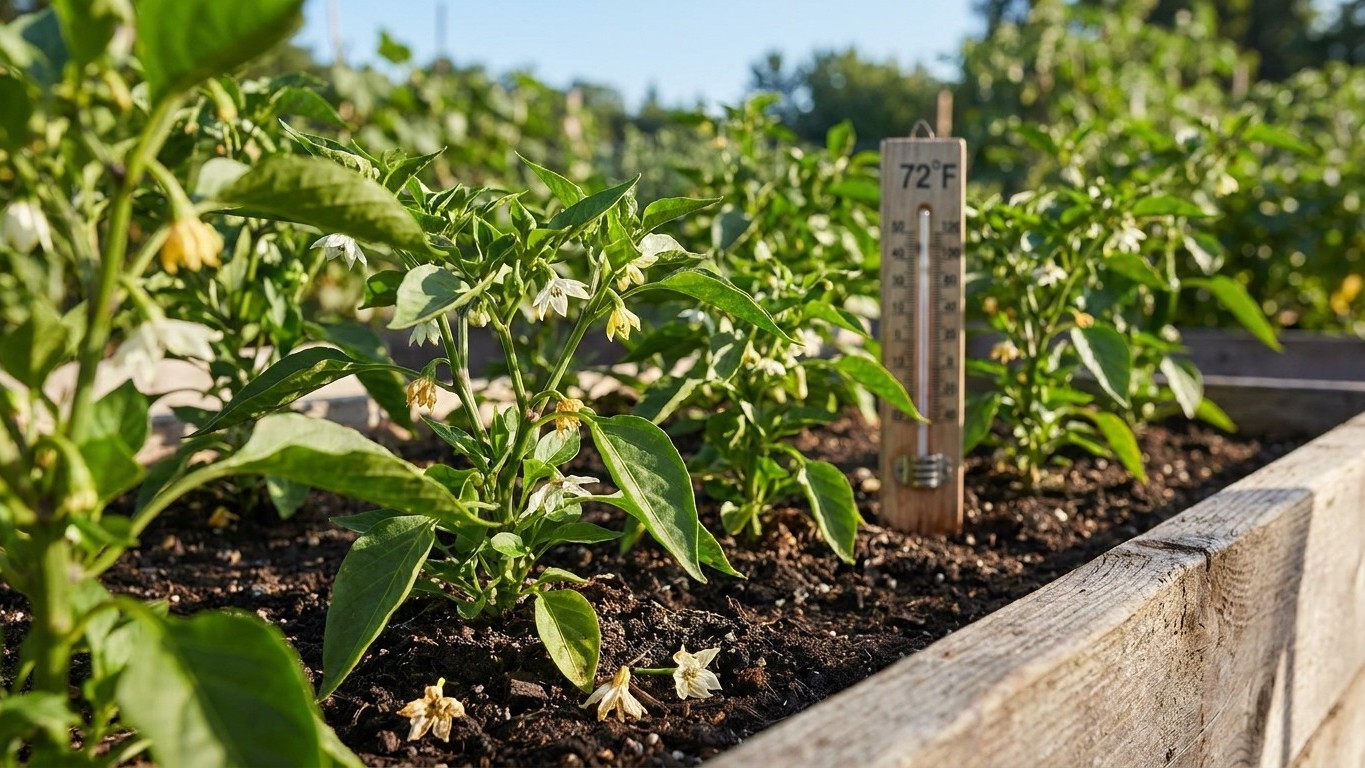

In the Piedmont around Charlotte, start pepper seed indoors between mid-January and early February. That puts transplants at 8 to 10 weeks old when soil hits 60 F after the last frost, which falls between March 23 and April 5 here. Coastal counties can start a bit later; mountain counties need to wait.
The short answer
Charlotte averages 35 days a year at or above 90 F, based on NOAA NCEI Climate Normals from the 1991-2020 period. That’s not a handful of scorching afternoons in August. It’s more than a month of days where pepper flowers can abort before they ever set fruit. Heat stress at that level pushes pollen viability down and blossoms drop off the plant with nothing to show for them. If your county runs hotter than the Charlotte reference station, plan for more of those days, not fewer.
The other end of the fruit-set window matters just as much, and it’s the one gardeners tend to forget. Utah State University Extension is blunt about it: pepper fruit set fails when nights drop below 55 F, just as surely as it fails when days climb past 90 F. A stretch of unseasonably cool nights in late spring, the kind that can still show up in the Piedmont well into May in a slow year, will stall flowering even if the daytime numbers look perfect for peppers.
Here’s the catch for North Carolina gardeners specifically: this site tracks days above 90 F by location, but it does not carry summer night minima. There’s no dataset here telling you how many nights in your county drop below 55 F in a given stretch. That’s not a gap you can fill by guessing from latitude, and it’s not something the coldest month of the year will tell you either, since a cold January says nothing about a cool snap in late May. The only reliable move is to watch your own nighttime lows as the season opens, especially if you garden at elevation or in a low spot that collects cold air.
Put those two thresholds together and you get a real, if narrow, planting logic. You’re aiming to get transplants in the ground after the cool nights have reliably passed, and you want fruit set to happen before the worst of the 90-degree stretch arrives in July and August. Miss on either side and the plant spends energy on foliage instead of peppers.
When to start seed here
The math is the same one Utah State University Extension lays out for pepper growers anywhere, but the dates you plug in are local. Here’s how to run it for your own county.
- Start with your transplant date. Peppers go into the ground after the last frost and only once soil temperature has reached 60 F. Soil warms slower than air, so don’t rely on the calendar alone. A soil thermometer pushed a few inches into the bed will tell you more than any date on a chart.
- Anchor that to the local frost window. For the Charlotte area, NOAA NCEI’s 1991-2020 climate normals put the last spring frost, defined by the 30 to 70 percent probability band for a 32 F freeze, between March 23 and April 5. That’s a Piedmont number. If you garden in the coastal plain, your window opens earlier than that. If you’re in the Blue Ridge foothills or higher, expect your last frost to run several weeks later than the Charlotte date, sometimes well into May depending on elevation.
- Add the soil-temperature lag. Even after frost risk passes, soil often takes another week or two to climb to 60 F, especially in a cool, wet spring. Don’t transplant on the frost date alone; check the ground.
- Count back 8 to 10 weeks for seed starting. Utah State University Extension recommends starting pepper seed indoors 8 to 10 weeks before that transplant date. For a Piedmont gardener transplanting in the first half of April, that lands seed-starting in mid-January to early February.
- Shift the whole schedule for your region. Coastal plain gardeners with an earlier frost date can start seed correspondingly earlier. Mountain gardeners working with a later frost date should push seed-starting back to avoid holding leggy, overgrown transplants indoors for weeks longer than necessary.
Run those five steps with your own county’s frost data and you have a schedule that fits your ground, not a generic zone map.
What goes wrong here
Most pepper problems in North Carolina trace back to one of the two thresholds above, or to how the plant handles direct sun once it’s fruiting.
- Blossom drop in a hot spell. When daytime highs push into the 90s, and Charlotte sees that 35 days a year on average, flowers can abort before pollination. The remedy is timing, not chemistry: aim for fruit set to happen in the cooler weeks before peak summer heat sets in, and use light shade cloth over plants during the worst afternoon stretches if a heat wave lands during flowering.
- Blossom drop in a cool night. The same failure shows up at the other extreme, when nights fall below 55 F. Because this site doesn’t track summer night minima for North Carolina, you’re the sensor here. Keep an eye on overnight forecasts in late spring, and hold off setting plants out, or cover them, if a cool snap is forecast right as flowering begins.
- Sunscald on exposed fruit. Strong summer sun can scorch pepper fruit that isn’t shaded by foliage, leaving pale, papery patches on the side facing the sun. Keep plants pruned lightly rather than heavily, so leaf cover stays over developing peppers, and avoid stripping foliage to “let more light in,” which does more harm than good here.
- Blossom-end rot. Dark, sunken patches on the bottom of the fruit usually point to inconsistent watering rather than a soil deficiency. Peppers that dry out between waterings and then get soaked struggle to move calcium to the fruit. Even soil moisture, especially through the hot stretch of days above 90 F, does more to prevent this than any additive.
Common questions
Can I direct-sow pepper seed outdoors in North Carolina?
It’s possible in theory, but the 8 to 10 week indoor head start recommended by Utah State University Extension exists for a reason: peppers are slow to germinate and slow to size up, and direct-sown seed in North Carolina’s Piedmont often doesn’t catch up before the hot stretch of days above 90 F arrives. Starting indoors gives the plant a running start before summer heat becomes a factor in fruit set.
What if my county’s last frost date is different from Charlotte’s?
Use your own county’s frost data if you have it, and shift the whole schedule by however many days or weeks your local frost date differs from the March 23 to April 5 Piedmont window. Coastal counties generally run earlier, mountain counties later, sometimes by several weeks.
How do I know if my nights are too cool for fruit set?
Watch your local overnight forecast directly rather than estimating from the calendar or from how cold your winters get. Nights below 55 F during flowering can cause blossom drop, and that threshold can show up even after the last frost date has safely passed.
Does the 90 F day count mean I should plant peppers later to avoid the heat?
Not later, earlier in terms of your seed-starting schedule so that flowering happens before the bulk of those 35 annual days above 90 F arrive. The goal is to get fruit set finished, or well underway, before the hottest weeks of summer land on the Piedmont.