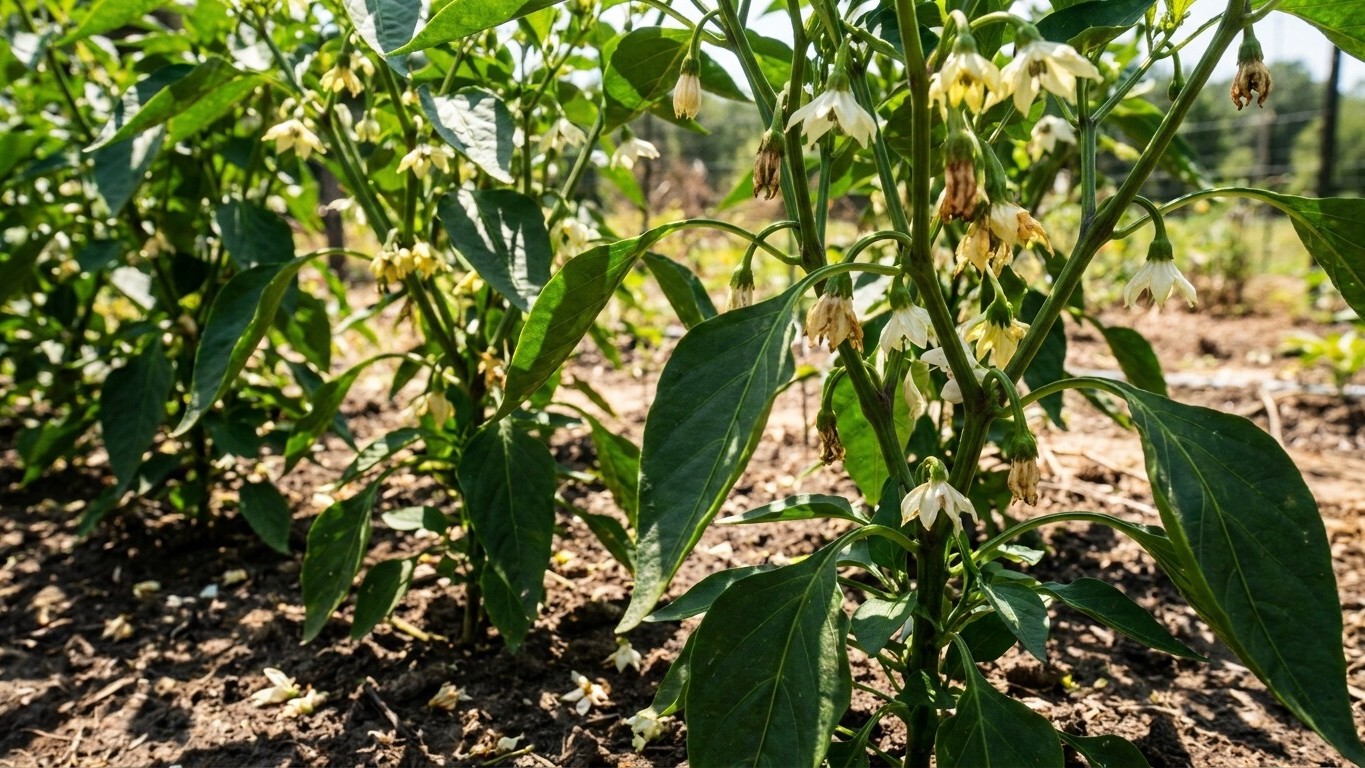

Fruit set in North Carolina peppers hinges on two thresholds crossing in the same window: nights need to stay above 55 F and days need to stay below 90 F. Charlotte’s reference station logs 35 days a year at or above 90 F, which tells you how often the hot side of that window closes. The cool side depends on your own nighttime lows, which this site doesn’t track for you.
The short answer

Thirty-five days a year at 90 F or hotter, that’s the count from the NOAA NCEI Climate Normals for 1991-2020 at the Charlotte reference station. Spread across a growing season that runs from late spring frost into fall, that’s roughly one week in five during peak summer where pepper flowers can abort before they ever become fruit. Pollen becomes non-viable, blossoms drop, and a plant that looked loaded with flowers in June can sit fruitless through the hottest stretch of July and August.
That 35-day figure isn’t spread evenly. Most of it clusters in July and the first half of August, which happens to be exactly when a spring-transplanted pepper plant is hitting peak flowering. A pepper set out in early May and given 8 to 10 weeks to establish before flowering lands its first heavy bloom right in the middle of the state’s hottest stretch, which is why knowing When to Start Pepper Seed in North Carolina matters so much for timing that bloom window away from peak heat. Utah State University Extension notes that fruit set failure at the hot end runs from flowering, not from the date you put transplants in the ground, so a plant can look perfectly healthy for weeks and only show the damage once flowers open during a heat spike.
The other end of that window matters just as much, and it’s the one growers tend to forget about. Nights that drop below 55 F cause the same fruit set failure as heat, just through a different mechanism, weak or absent pollen germination instead of pollen death. North Carolina’s spring nights can dip into that range well past the last frost date, especially in the mountains and in low-lying areas that pool cold air. This site carries days-above-90-F data by territory, but it does not carry summer night minimum temperatures. There’s no reliable way to infer those from latitude, from elevation guesses, or from the coldest month of the year. A county at the same latitude can run five or more degrees cooler at night depending on elevation and local terrain.
The practical takeaway: watch your own thermometer at night through late spring and early summer, not a regional average. If you’re seeing early flower drop and daytime highs aren’t yet in the 90s, cold nights are the more likely cause. If flowers are dropping in July and August, heat is almost certainly the driver, and understanding Why Peppers Fail to Set Fruit in North Carolina confirms there’s very little you can do about it except manage everything else, shade cloth, mulch, consistent watering, so the plant is under as little additional stress as possible, and lean on Pepper Varieties That Ripen in a North Carolina Season that set fruit before or after that hot mid-summer window closes in on flowering plantsss as possible when the heat hits.
When to start seed here
Working backward from a transplant date is the most reliable way to time pepper seed-starting, because the two hard requirements, no frost and 60 F soil, don’t move around from year to year nearly as much as air temperature does.
- Find your last spring frost window. At the Charlotte reference station, NOAA NCEI’s 1991-2020 climate normals put the last spring 32 F freeze in the 30-70% probability band between March 23 and April 5. Charlotte sits in the Piedmont. The Blue Ridge mountains to the west typically run several weeks later than that window, while the coastal plain runs earlier.
- Add a soil temperature check on top of the frost date. Frost passing doesn’t mean the soil is ready. Peppers need soil at 60 F before transplanting, and cool, wet Piedmont soil in late March often hasn’t reached that mark yet even after the frost risk has passed. A soil thermometer pushed 4 inches into the bed, checked over a few mornings, is the only way to confirm this locally, since soil warms at different rates depending on drainage, mulch, and sun exposure.
- Set your transplant date at whichever comes later, frost-safe or soil-ready. In much of the Piedmont that lands somewhere in the two weeks after the last-frost window closes, once the soil has had time to catch up.
- Count back 8 to 10 weeks from that transplant date to find your seed-starting date. If your target transplant date sits around April 5, 8 weeks back lands in the second week of February, and 10 weeks back lands near the end of January. If you’re transplanting later, say mid-April to let soil catch up, shift the seed-start window back by the same amount.
- Adjust for your specific county, not the state as a whole. Mountain counties should push both the transplant date and the seed-start date later by the number of weeks their local frost-free window lags behind the Piedmont. Coastal counties can generally move both earlier.
What goes wrong here
- Blossom drop from a hot spell. Once daytime highs push into the 90s during flowering, blooms can abort with no visible disease or pest cause, they simply fall off the plant. There’s no cure once the heat hits, but shade cloth over the plants during the worst afternoon hours, consistent deep watering so the plant isn’t drought-stressed on top of heat-stressed, and mulch to keep root zone temperatures down all reduce the severity.
- Blossom drop from a cool night. The same symptom, dropped flowers, can come from nights that stay below 55 F, which happens in North Carolina more often in early and late season than gardeners expect, particularly in the mountains and in frost-pocket low ground. Since this site doesn’t track summer night minimums, the fix is to log your own overnight lows with a simple min-max thermometer near the pepper bed, and hold off expecting fruit set until nights consistently clear 55 F.
- Sunscald on exposed fruit. North Carolina summer sun is strong enough that fruit exposed after aggressive pruning or leaf loss can develop pale, papery patches on the side facing the sun, which then break down and rot. Leaving foliage in place to shade developing fruit, rather than pruning heavily for airflow, is the main preventive step, along with row cover or light shade cloth if a plant has already lost significant leaf cover to disease or wind damage.
- Blossom-end rot. A dark, sunken patch on the bottom of the fruit shows up when the plant can’t move enough calcium into the developing fruit, usually because watering has been inconsistent rather than because the soil actually lacks calcium. Even, regular watering, especially through the same hot spells that cause blossom drop, is the most direct remedy, since the underlying cause is almost always uneven soil moisture rather than a nutrient deficiency that needs correcting.
Checking this against your own county
Charlotte’s numbers are a reference point, not a forecast for every backyard in the state. A garden in Asheville is working with a different frost calendar than one in Wilmington, and a garden in a low-lying hollow can run colder at night than one on a nearby ridge, regardless of what the regional averages say.
For a planting date, a soil temperature reading, or a frost-date range specific to your own county, the North Carolina Cooperative Extension maintains county offices with local staff who track exactly this kind of variation. That’s the resource to check before locking in a seed-starting date, especially if you garden in the mountains, on the coast, or in any spot known locally for holding frost later than the surrounding area.
Common questions
Can I still get a pepper harvest if my nights stay below 55 F into late May?
Fruit set will simply wait until nights warm up. The plant itself isn’t damaged by cool nights in this range, it just won’t set fruit until temperatures clear that threshold, so a slow start doesn’t mean a lost season.
Does the 35 days above 90 F mean I’ll lose over a month of fruit set?
Not necessarily. Fruit set fails during flowering on hot days, but plants that already have fruit developing continue to ripen it through a heat spell. The bigger risk is new flowers not converting to fruit during those specific days, which slows the pipeline rather than stopping the plant entirely.
Should I start seed earlier than 8 weeks to get ahead of summer heat?
Starting much earlier than 10 weeks tends to produce leggy, stressed transplants that don’t perform better once in the ground. It’s more effective to time transplanting around your local frost and soil data and manage the summer heat window with shade cloth and watering rather than trying to outrun it with an earlier start.
Are some pepper varieties better suited to North Carolina’s heat swings?
Utah State University Extension’s guidance names several common pepper varieties without assigning any of them a heat tolerance rating, a days-to-maturity figure, or a size classification, so no variety can be reliably recommended as more heat-tolerant based on that source. Local extension staff are the better resource for variety performance specific to your county’s conditions.