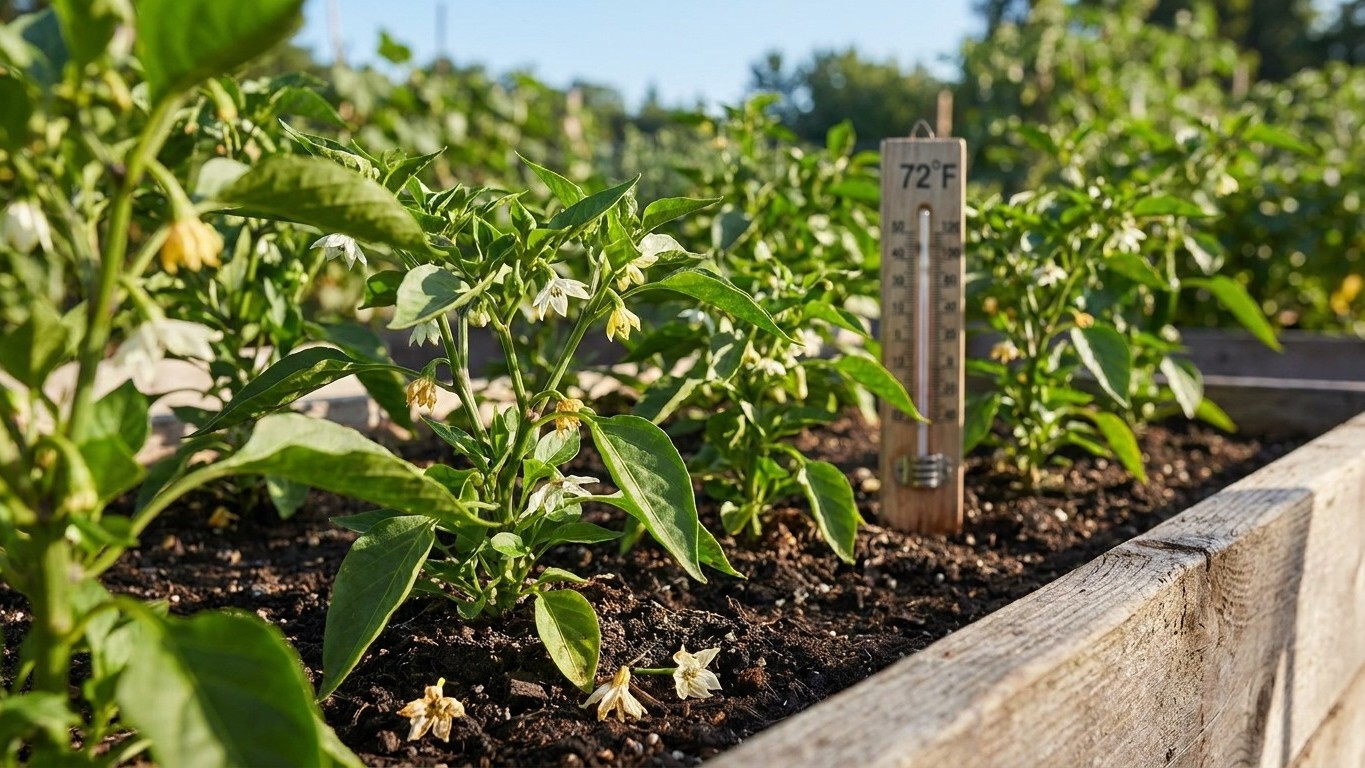

In central Ohio, expect to start pepper seed indoors somewhere between late February and mid-March, counting back 8 to 10 weeks from a transplant date that falls after the last frost and once soil has warmed to 60 F. The exact window shifts a little depending on where in the state you garden and how cold your spring runs, but that back-counting math is the reliable part.
The short answer
Columbus averages 15.3 days a year at or above 90 F, based on NOAA NCEI Climate Normals for 1991-2020. That’s the reference station for central Ohio, and it’s a useful number because pepper fruit set doesn’t fail gradually as heat climbs. It fails at a threshold. Once daytime highs push past 90 F, blossoms drop instead of setting fruit, and a run of 15 or so days like that scattered through a typical Ohio summer means most gardeners here will see at least a few stretches where their pepper plants simply stop producing for a while.
That’s the hot end of the problem, and it’s the one this site can quantify for Ohio. The other end matters just as much, and it can’t be quantified the same way. Pepper fruit set also fails when nights drop below 55 F. Cool spring nights in the 40s, or an unseasonable cold snap in early summer, will cause the same blossom drop as a heat wave, just from the opposite direction.
Here’s where accuracy requires a caveat instead of a number: this site tracks days at or above 90 F for Ohio, but it does not carry summer night minimum temperatures. Nobody should guess at those numbers based on where Ohio sits on a map, and a coldest-month average from January tells you nothing useful about a June or July night. If you garden in a valley, near a lake, in an urban heat pocket, or on a hilltop that catches wind, your overnight lows in the growing season could differ meaningfully from a neighbor five miles away. The only dependable move is to track your own overnight lows with a simple min-max thermometer once plants go in the ground, and to watch the forecast closely during the first few weeks after transplant, when a late cold night is still possible even after the official frost date has passed.
Put together, Ohio pepper growers are managing a narrow band. Too cool at night, no fruit set. Too many days above 90 F, no fruit set. The growing season here isn’t short on warmth, but it isn’t short on volatility either, and that volatility, not the calendar date alone, decides how many peppers actually make it onto the plant.
When to start seed here
The math behind a pepper seed-starting date is the same everywhere, but the local numbers that go into it change by county and even by microclimate. Ohio State University Extension’s Ohio Gardening Calendar puts the last spring frost date for zone 6a Ohio at May 5 to May 15. That’s the anchor point everything else counts back from.
- Start with your frost date. For zone 6a Ohio, that’s the May 5 to May 15 window. If you’re in a colder pocket of the state, your local frost date may run later than this range, so check with your county extension office rather than assuming.
- Add the soil temperature requirement. Utah State University Extension notes that pepper transplants shouldn’t go into the ground until soil reaches 60 F, and only after frost risk has passed. In a cool, wet Ohio spring, soil can lag behind air temperature by a couple of weeks, so the frost date and the 60 F soil date don’t always land on the same day. Your transplant date is whichever of the two comes later.
- Count back 8 to 10 weeks from that transplant date. This is the indoor seed-starting window. If your transplant target sits at May 10, 8 weeks back lands you at roughly March 15, and 10 weeks back lands you at roughly March 1. That gives you a start window rather than a single day, which is realistic since seed doesn’t germinate on a fixed schedule.
- Adjust for your specific spot in Ohio. Gardeners in the warmer river valleys along the Ohio River may see soil warm to 60 F a week or two earlier than gardeners in the state’s higher, colder northeast counties. Recalculate using your own frost date and your own soil readings rather than a statewide average.
- Build in a buffer for slow germination. Pepper seed germinates unevenly and sometimes slowly, especially at cooler indoor temperatures. Starting at the earlier end of the 8-to-10-week range gives you room if germination drags or if a cold snap pushes your transplant date back.
The redo-it-yourself version of this math works in any county: find your local last frost date, check when your garden soil actually hits 60 F with a soil thermometer rather than guessing, take the later of the two dates, and count back 8 to 10 weeks. That’s your indoor seed-starting window, no matter where in Ohio you garden.
What goes wrong here
- Blossom drop during a hot spell. When daytime highs push above 90 F, something Columbus sees on roughly 15.3 days a year on average, plants shed blossoms instead of setting fruit. There’s no fix once the heat hits, but shade cloth over plants during the worst afternoon hours can reduce the stress, and keeping soil consistently moist (not soggy) helps plants tolerate short heat spikes better than drought-stressed plants do.
- Blossom drop during a cool night. Nights below 55 F cause the same failure from the other direction. Since this site doesn’t track summer night lows for Ohio, the fix starts with knowing your own numbers: keep a min-max thermometer in the garden through late spring and early summer, and if a cold night is forecast soon after transplant, cover plants overnight with a row cover or even an overturned bucket.
- Sunscald on developing fruit. Ohio summers deliver enough direct sun that exposed pepper fruit, especially on plants that have lost leaves to disease or wind damage, can develop pale, papery patches where sunlight scalds the skin. Keeping the plant’s foliage full and healthy is the main defense, since leaves shade the fruit naturally; avoid heavy pruning during peak summer heat.
- Blossom-end rot. This shows up as a sunken, dark leathery patch on the bottom of the fruit, and it’s driven by inconsistent watering rather than a nutrient shortage in most cases. Uneven soil moisture, common during Ohio’s swings between dry stretches and heavy rain, interrupts calcium uptake in the fruit. Mulching to hold soil moisture steady and watering on a regular schedule instead of only when plants look wilted reduces how often this shows up.
Common questions
Can I start pepper seed too early in Ohio?
Yes. Starting much earlier than 10 weeks before transplant tends to produce leggy, rootbound seedlings sitting indoors waiting for warm soil and safe overnight temperatures outside. If your transplant window is around May 5 to May 15, starting seed in early January instead of late February or March usually works against you rather than for you.
Does Ohio’s frost date mean it’s safe to transplant peppers right after?
Not necessarily. The last spring frost date (May 5 to May 15 for zone 6a Ohio) tells you when frost risk drops off, but pepper transplants also need soil at 60 F. If your soil is still cold when the frost date passes, wait for the soil to catch up rather than transplanting on the frost date alone.
Why do my pepper plants stop flowering in July?
A midsummer stall in flowering commonly lines up with a run of days at or above 90 F, something Columbus averages about 15.3 of per year. High heat causes blossom drop, and plants often resume setting fruit once temperatures moderate. It’s not a disease or a nutrient problem in most cases, just a temporary heat response.
How do I know if my nighttime lows are hurting fruit set?
Since local summer night minimums aren’t tracked on this site, the only reliable way is to check directly with a min-max thermometer placed in your garden. If overnight lows are consistently under 55 F during flowering, that’s likely suppressing fruit set regardless of how warm your days are.