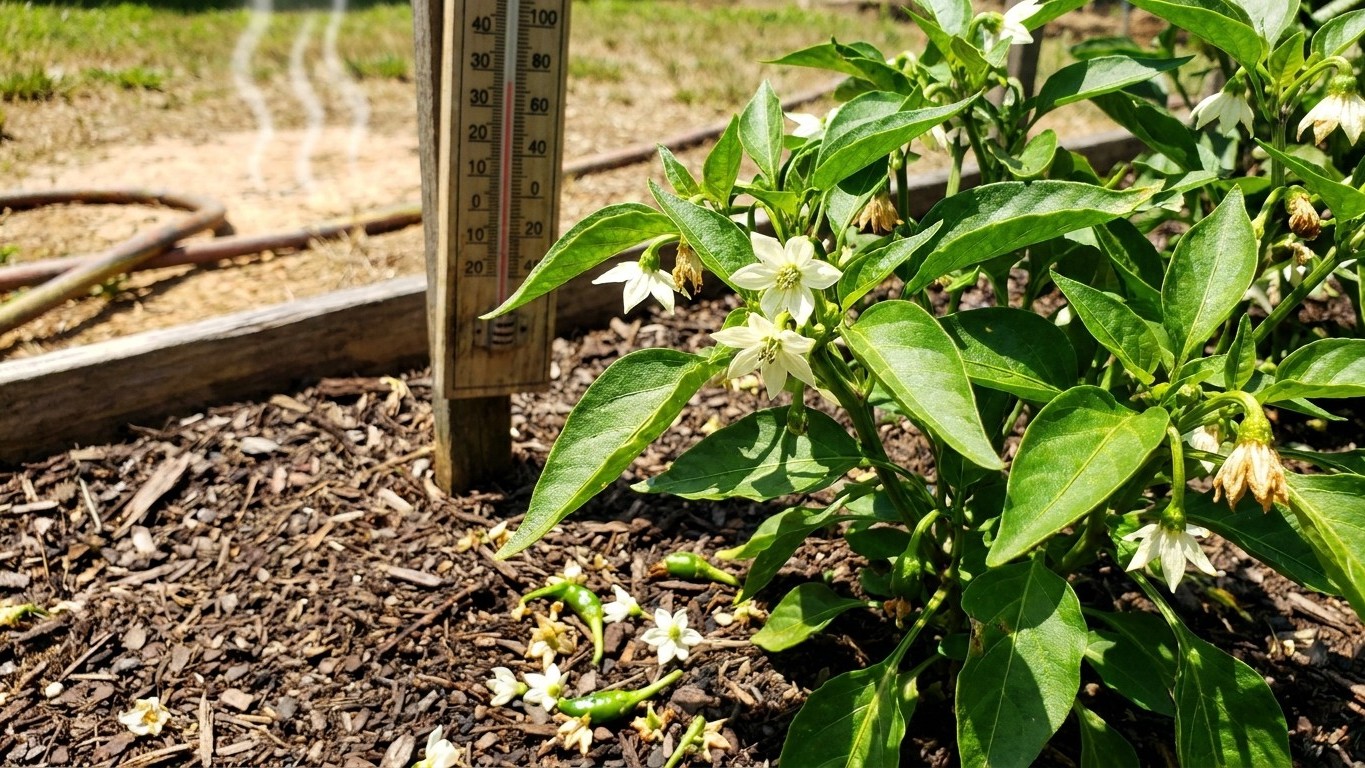

Peppers stop setting fruit in Oklahoma for one of two reasons: heat that scrambles pollen viability on the days that hit or cross 90 F, or nights that drop below 55 F and stall flower development. Transplant timing built around the state’s last frost date and soil warmth determines which problem you’re more likely to meet first.
The short answer
Oklahoma City, the reference station for state climate normals, averages 70.7 days a year at or above 90 F, according to NOAA NCEI Climate Normals covering 1991-2020. That’s not a stretch of a few sweaty weeks in late July. It’s more than ten weeks scattered across a growing season, and each one of those days can knock blossoms off a pepper plant before they ever become fruit. Peppers pollinate poorly once daytime highs push past 90 F, because the pollen itself becomes less viable and the plant redirects energy into surviving heat stress rather than finishing a flower. Growers who watch a healthy, flowering pepper plant suddenly drop buds in mid-summer are usually watching this exact mechanism play out, and the 70.7-day average tells you it’s not a rare event here. It’s a built-in feature of an Oklahoma summer.
The other failure point sits at the opposite extreme, and it matters just as much. Utah State University Extension’s guidance on peppers is direct on this: fruit set fails at both ends, nights below 55 F included. A cool snap in late spring or an early-fall dip can stall flowering just as effectively as a 90-degree afternoon, even if the daytime temperature that same day looks perfectly reasonable. The tricky part for Oklahoma gardeners is that this site tracks days above 90 F by territory, but it does not carry summer night minimum temperatures. There’s no substitute figure to lean on here, and guessing based on how far south or north a county sits doesn’t work either, since local terrain, elevation and even a nearby lake or river bottom can shift overnight lows in ways that latitude alone won’t predict. The only reliable move is to track your own overnight lows during flowering, whether with a simple min-max thermometer in the garden bed or a weather station reading close to your actual planting site. A backyard in a low spot can run several degrees cooler at 4 a.m. than a forecast for the nearest city implies, and that gap is exactly where pepper flowers quietly fail without an obvious cause.
Put those two thresholds together and the practical takeaway is that Oklahoma pepper growers are managing a narrow window, not a long lazy summer. The plant needs nights warm enough to hold onto its flowers and days cool enough to let pollen do its job, and in a state averaging over 70 days above 90 F, that window can close for stretches at a time even in a well-tended garden.
When to start seed here
Working backward from transplant date to seed-starting date is simple arithmetic once you have the two anchor points: the last frost date and the 8 to 10 week indoor head start peppers need before they’re ready to go in the ground, per Utah State University Extension.
- Find your last frost window. At the Oklahoma City reference station, NOAA NCEI’s 1991-2020 climate normals put the last spring frost between March 28 and April 10, based on 32 F freeze probabilities. Suburban and rural gardens typically see frost linger later than an airport station reading, often by one to two weeks, and more at higher elevation. So a garden outside the metro area might reasonably plan on frost risk running into mid-April rather than early April.
- Wait on soil temperature, not just the calendar. Peppers transplant safely once soil hits 60 F, per Utah State University Extension, and soil often lags a week or two behind the air warming up. If frost clears by April 10 but soil is still sitting at 52 F under a cool snap, the safe transplant date slides into late April.
- Count back 8 to 10 weeks from that transplant date. If your realistic transplant date is April 20, counting back 8 weeks lands on February 23; counting back 10 weeks lands on February 9. That gives a seed-starting window of roughly February 9 through February 23 for that scenario.
- Adjust for your own county. A garden with a later, mid-April frost and slower soil warm-up might push the whole schedule two weeks later, meaning seeds go in around late February to early March instead.
The arithmetic doesn’t change from county to county, only the dates you plug in. Anyone can redo this by swapping their own expected transplant date into the same 8-to-10-week countback.
What goes wrong here
- Blossom drop in a hot spell. When daytime highs push past 90 F, plants shed flowers and buds rather than complete pollination, a direct consequence of the heat load reflected in Oklahoma City’s 70.7-day annual average above that threshold. Shade cloth over the hottest afternoon hours during a heat spell, along with steady watering so the plant isn’t compounding heat stress with drought stress, keeps more flowers intact through a rough stretch.
- Blossom drop from a cool night. The same failure shows up when overnight temperatures fall below 55 F, per Utah State University Extension, even outside the coldest part of the season. Since this site doesn’t track summer night minimums, the fix starts with monitoring your own garden’s overnight lows during flowering and using row cover or a cold frame on nights that dip low enough to threaten open blossoms.
- Sunscald on exposed fruit. Oklahoma’s strong summer sun can scorch pepper fruit left without leaf cover, especially on plants that have lost foliage to stress or pruning. Leaving the natural leaf canopy in place, rather than stripping leaves for more “light,” protects developing fruit from a sunburned, papery-white patch that ruins the pepper for eating.
- Blossom-end rot. Irregular watering interferes with calcium uptake and shows up as a sunken, dark patch on the fruit’s bottom end. Consistent soil moisture, achieved with mulch and a steady watering schedule rather than feast-or-drought cycles, is the standard remedy.
Common questions
Can peppers still set fruit if nights stay above 55 F all summer?
Yes. The 55 F night threshold is a floor, not a target; as long as nights stay above it and days don’t push past 90 F too often, flowers have a normal chance to set fruit.
Does this site list which pepper varieties handle Oklahoma heat best?
Utah State University Extension names several pepper varieties for home gardens but does not attach a heat rating, days-to-maturity figure, or fruit size to any of them, so no variety-specific heat tolerance claim can be made here.
How can I get a faster read on soil temperature in spring?
A simple soil thermometer pushed a few inches into the bed, checked in the morning over several consecutive days, gives a more reliable read than guessing from air temperature alone.
Is the March 28 to April 10 frost window the same everywhere in Oklahoma?
No. That range comes from the Oklahoma City reference station’s climate normals. Rural and suburban gardens commonly see frost linger later, sometimes by one to two weeks, so it’s worth checking conditions specific to your own county rather than relying on the reference-station date alone.