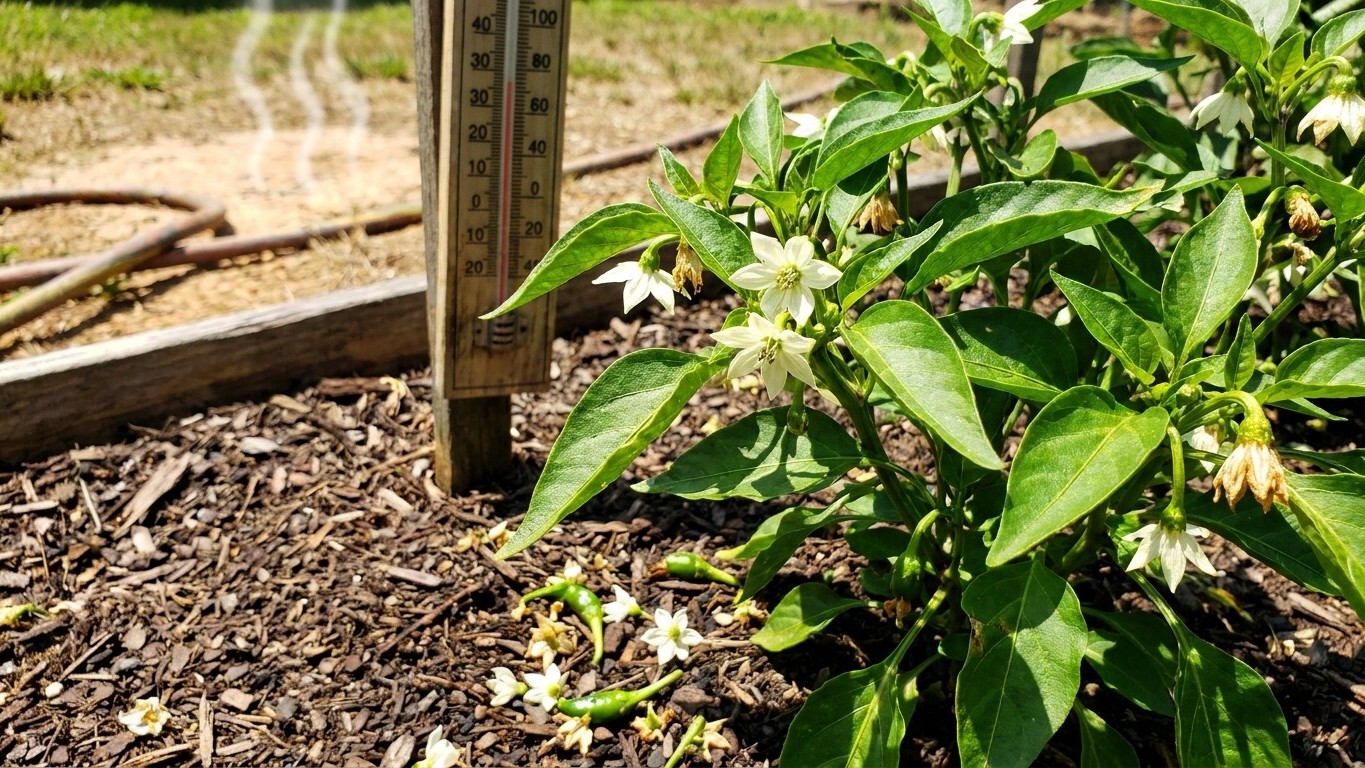

Pepper plants in Pennsylvania often flower heavily but never turn those flowers into fruit. The main culprits are heat stress during the state’s warmest stretches and cool nights the plant can’t tolerate, and the fix has less to do with soil or fertilizer than with timing your transplant and tracking the temperature swings in your own yard.
The short answer
Philadelphia’s climate record, the reference station NOAA uses for southeastern Pennsylvania, shows an average of 24.0 days a year that reach 90 F or higher, based on the NOAA NCEI Climate Normals for 1991-2020. That number matters more than it might seem. It’s not a measure of how hot the average summer day feels; it’s a count of how often the state crosses the threshold where pepper flowers start aborting instead of setting fruit. Each one of those 24 days is a day your plants are under enough heat load that pollen can go sterile and flowers drop before they ever swell into a pod.
Philadelphia sits in the mildest corner of Pennsylvania. Areas farther from the city, especially the Alleghenies and the northern tier, typically see fewer days that hot, but they trade that advantage for a shorter, cooler growing season overall, which raises the risk on the other end of the scale.
That other end is just as important, and it’s the one gardeners overlook. Pepper fruit set fails in heat. Also, when nighttime temperatures drop below 55 F. Cool nights slow pollen development and stall fruit formation just as effectively as a heat wave does, according to Utah State University Extension’s guidance on peppers. The problem for Pennsylvania growers is that this site tracks daytime heat data like the 90 F day count, but it does not carry summer night minima for any Pennsylvania location.
That means the cool-end risk is something you have to observe directly rather than look up. Don’t guess at your overnight lows based on your latitude or on how cold your winters run. Summer nights depend on elevation, valley drainage, tree cover, and how close you are to a large body of water, and none of those show up on a general climate map. A backyard thermometer left outside overnight for a week during a cool spell in June or September will tell you far more than any regional average. If you’re watching flowers form but not converting to fruit, and the days haven’t been especially hot, check your nights before you blame the soil or the variety.
When to start seed here
Getting pepper timing right in Pennsylvania is mostly arithmetic, and it starts from the transplant date and works backward, not forward from when you feel like planting.
- Start with your last spring frost date. For the Philadelphia area, NOAA’s 1991-2020 climate normals put the 32 F freeze probability window at March 29 to April 6. That’s the earliest general marker for frost risk easing off, and it applies to the mildest part of the state.
- Adjust for where you actually garden. Philadelphia is the mildest corner of Pennsylvania, so if you’re in the northern tier or up in the Alleghenies, push that frost window two to four weeks later. A county in the state’s northern edge working from a mid-April frost date, for example, should plan on a transplant date closer to early May.
- Don’t transplant on frost date alone. Peppers need soil that has warmed to 60 F, not just air that’s frost-free, according to Utah State University Extension. Soil typically lags behind air temperature by one to two weeks after the last frost, so add that buffer before you plan to move seedlings outside.
- Set your transplant date using both markers together. If your last frost falls in early April and soil takes another two weeks to hit 60 F, your realistic transplant date lands in mid-to-late April for the Philadelphia area, and later for cooler counties.
- Count back 8 to 10 weeks from that transplant date to find your indoor seeding date. For a mid-to-late April transplant, that puts seed-starting somewhere in mid-February to early March.
- Recalculate for your own county rather than borrowing Philadelphia’s numbers outright. Take your local last-frost estimate, add one to two weeks for soil warm-up, then subtract 8 to 10 weeks for the indoor start. The math is the same everywhere in the state; only the starting date shifts.
One detail worth flagging separately: once flowering begins, Utah State University Extension notes that fruit typically takes 35 to 45 days to mature from that point, not from the sowing or transplant date. That timeline is useful for estimating harvest, but it starts counting at the first flower, not at planting.
What goes wrong here
Pennsylvania’s mix of hot spells and cool snaps sets up a specific handful of failures, and most of them show up as flowers that never become fruit, or fruit that develops with visible damage.
- Blossom drop in a hot spell or a cool night. Flowers form, look healthy, then fall off without ever swelling. This happens at both temperature extremes: heat above 90 F on the day count Philadelphia averages 24 times a year, or nights that drop below 55 F, which this site doesn’t track for Pennsylvania locations. The remedy is timing and observation rather than fertilizer. Shift planting so heavy flowering doesn’t line up with the hottest stretch of July and August, and keep a thermometer outside overnight during cool spells in late spring or early fall to catch the cold-end problem before it wipes out a flush of blooms.
- Sunscald where the sun is strong. Exposed fruit and stems can develop pale, blistered patches on the side facing direct afternoon sun, especially on plants that lost leaves to wind, disease, or over-aggressive pruning. Keeping the plant’s natural leaf canopy intact is the simplest fix, since foliage shades the fruit the way it’s meant to. Light shade cloth over the row during the hottest weeks can help on plants that have already thinned out.
- Blossom-end rot. Fruit develops a dark, sunken patch at the blossom end, usually while the pepper is still sizing up. It’s tied to inconsistent watering, which is common during Pennsylvania’s swings between humid, rainy stretches and short dry spells during a heat run. Keeping soil moisture even, mulching to buffer against rapid drying, and avoiding letting containers or beds dry out completely between waterings reduces the problem more reliably than adding extra calcium products.
Common questions
Why are my pepper flowers falling off without turning into peppers?
Flower drop in Pennsylvania usually traces back to temperature extremes on either end. Utah State University Extension identifies both nights below 55 F and days above 90 F as thresholds where fruit set fails. Philadelphia’s climate normals show an average of 24.0 days a year at or above 90 F, and this site doesn’t carry night minimum data, so check your own overnight temperatures during a drop-off period.
What’s the latest I can transplant peppers outdoors in Pennsylvania?
There’s no single date for the whole state. Start from your local last-frost window (Philadelphia’s runs March 29 to April 6 per NOAA NCEI, with the northern tier and Alleghenies running two to four weeks later), then wait until soil hits 60 F before moving transplants outside, since air temperature alone isn’t a reliable guide.
How long after flowering will pepper fruit actually be ready?
Utah State University Extension puts that window at 35 to 45 days after flowering begins, not from the date you seeded or transplanted. Keep track of first bloom date on your plants rather than the calendar date you put them in the ground.
Can I prevent blossom-end rot by adding calcium to the soil?
Inconsistent watering is the more common driver of blossom-end rot than a calcium shortage in most home gardens. Keeping moisture level and steady, especially through Pennsylvania’s swings between wet spells and short dry heat runs, addresses the problem more directly than soil amendments in most cases.