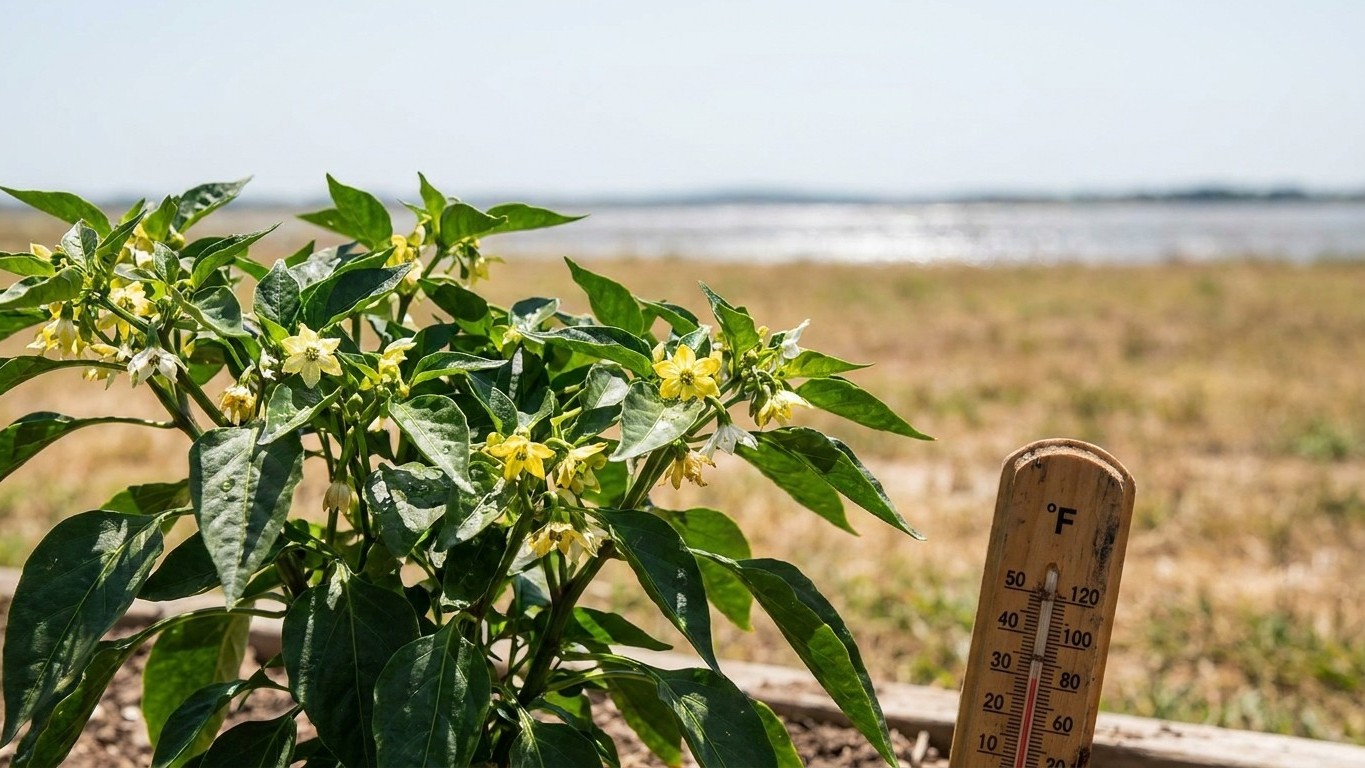

Arkansas peppers often set plenty of flowers but few fruits, and the reason usually traces to temperature, not soil or fertilizer. The state logs 69.2 days a year at or above 90 F on average, which stalls pollen viability during the hottest stretches of summer. Cold snaps below 55 F cause the same failure at the other end of the scale, so timing and daily temperature swings matter more than most gardeners expect.
The short answer
Little Rock’s reference station averages 69.2 days a year at or above 90 F, based on NOAA NCEI Climate Normals covering 1991 to 2020. That’s not a handful of scorching afternoons in late July. It’s more than two months of the calendar year where daytime highs push past the threshold where pepper pollen starts to lose viability and blossoms drop before they ever become fruit. Anyone who has watched a healthy, bushy pepper plant covered in flowers produce almost nothing in mid-summer has likely watched this exact mechanism play out, even if they blamed it on watering or fertilizer at the time.
Heat this frequent changes how a grower has to think about the whole season. A plant that sets fruit well in May and again in September, but goes quiet through July and much of August, isn’t failing. It’s responding to a heat load that simply exceeds what pepper flowers can tolerate for pollination. Growers in counties that run even hotter than the Little Rock reference station, which is common across the state’s southern and western lowlands, should expect the unproductive stretch to run longer, not shorter.
The cold end of the equation matters just as much, and it’s the part gardeners tend to overlook once summer arrives. Pepper fruit set fails when nights drop below 55 F, a threshold that most commonly shows up in early spring right after transplanting, and sometimes again in early fall as the season winds down. This site tracks daytime heat extremes for Arkansas, but it does not carry summer night minima for this territory. That figure varies by elevation, by how close a property sits to water, and by how much a yard is shaded or exposed, so no one can responsibly infer it from latitude or from how cold the coldest month runs. The only reliable approach is to watch a home thermometer through the night during the shoulder seasons and treat any run of nights under 55 F as a signal that fruit set will pause, even if the days feel comfortably warm.
When to start seed here
Pepper transplants need 8 to 10 weeks indoors before they go into the ground, and they should not go outside until two conditions are both met: the frost danger has passed and the soil has warmed to 60 F. Here’s how to work backward from those two facts using Arkansas’s own frost data.
- Find the light-frost date for your area. NOAA NCEI’s 1991-2020 Climate Normals put the 32 F freeze probability window for station USW00013963 between March 12 and March 28. But tender transplants like peppers are damaged well before a hard freeze, so the more useful figure is the 36 F light-frost threshold. NWS Little Rock lists April 3 as the spring date for that threshold, and October 31 as the fall date. Peppers should not go into the ground before April 3, and ideally later, since that date only marks light-frost risk, not the guarantee of 60 F soil.
- Check soil temperature separately from air temperature. Air can feel warm on an April afternoon while soil four inches down is still in the 50s. A simple soil thermometer, checked in the morning before the sun heats the surface, tells the real story. Peppers should not be transplanted until that reading holds at 60 F for several consecutive days.
- Count backward 8 to 10 weeks from whichever date comes later, the frost-free date or the 60 F soil date. If April 3 turns out to also be the date soil hits 60 F in a given yard, seed should go into trays 8 to 10 weeks earlier, landing somewhere between January 23 and February 6. If soil takes another two or three weeks to warm past April 3, as it often does in shaded or heavier clay yards, push the whole schedule back by that same amount.
- Reset the count every year against actual conditions, not the calendar. Frost dates are averages built from three decades of data, not promises. A gardener who starts seed on the same January date every year regardless of that spring’s weather will occasionally transplant into a cold snap or, just as often, waste weeks of greenhouse space waiting on soil that’s already warm enough.
What goes wrong here
- Blossom drop during a heat spell. Once daytime highs climb past 90 F, something that happens on 69.2 days a year on average at the Little Rock reference station, pepper pollen loses viability and flowers fall without setting fruit. There’s no fix for the heat itself, but light afternoon shade cloth over the hottest weeks, along with consistent soil moisture so the plant isn’t fighting drought stress on top of heat stress, keeps more of the remaining blossoms viable until temperatures ease.
- Blossom drop from a cool night. The same failure shows up when nights drop below 55 F, most often in the first few weeks after transplant or again as fall approaches. Since summer night minima aren’t tracked here, the only defense is watching a home thermometer overnight during those shoulder periods and using row cover or a cold frame if a cool stretch is forecast while plants are still flowering.
- Sunscald on exposed fruit. Arkansas summers deliver strong, direct sun during those same 90-plus-degree stretches, and fruit that develops on the sunny side of a plant with sparse foliage can develop pale, leathery patches. Leaving more of the plant’s natural leaf cover in place, rather than pruning heavily for airflow, shades the fruit without blocking the light the plant needs to keep producing.
- Blossom-end rot on developing peppers. This shows up as a dark, sunken patch at the fruit’s bottom end and traces to inconsistent water delivery, which disrupts calcium uptake, rather than a calcium shortage in the soil itself. Even, regular watering, especially through the driest weeks of the same hot stretches that cause blossom drop, prevents most cases without any soil amendment.
Common questions
Can I transplant peppers earlier than April 3 in Arkansas?
Not safely for most yards. April 3 is the light-frost threshold NWS Little Rock publishes for the 36 F risk that damages tender transplants, and it’s often not the limiting factor anyway since soil frequently hasn’t reached the 60 F peppers need until a bit later.
Why did my pepper plants stop flowering in July?
That gap almost always lines up with the stretch of days at or above 90 F, which averages 69.2 a year at the Little Rock reference station. Pollen loses viability in that heat, so flowers form but don’t set fruit until temperatures ease.
Does watering more fix blossom drop in the heat?
No. Blossom drop from heat is a pollen viability problem, not a moisture problem, though keeping soil evenly moist prevents the plant from adding drought stress on top of heat stress, which does help it hold onto whatever blossoms remain viable.
How do I know if my area’s nights are too cold for fruit set?
Track it yourself with a thermometer left outside overnight, since this site doesn’t publish summer night minima for Arkansas and that figure varies too much by elevation and yard exposure to estimate from general climate data. Any run of nights below 55 F while plants are flowering is worth watching closely.