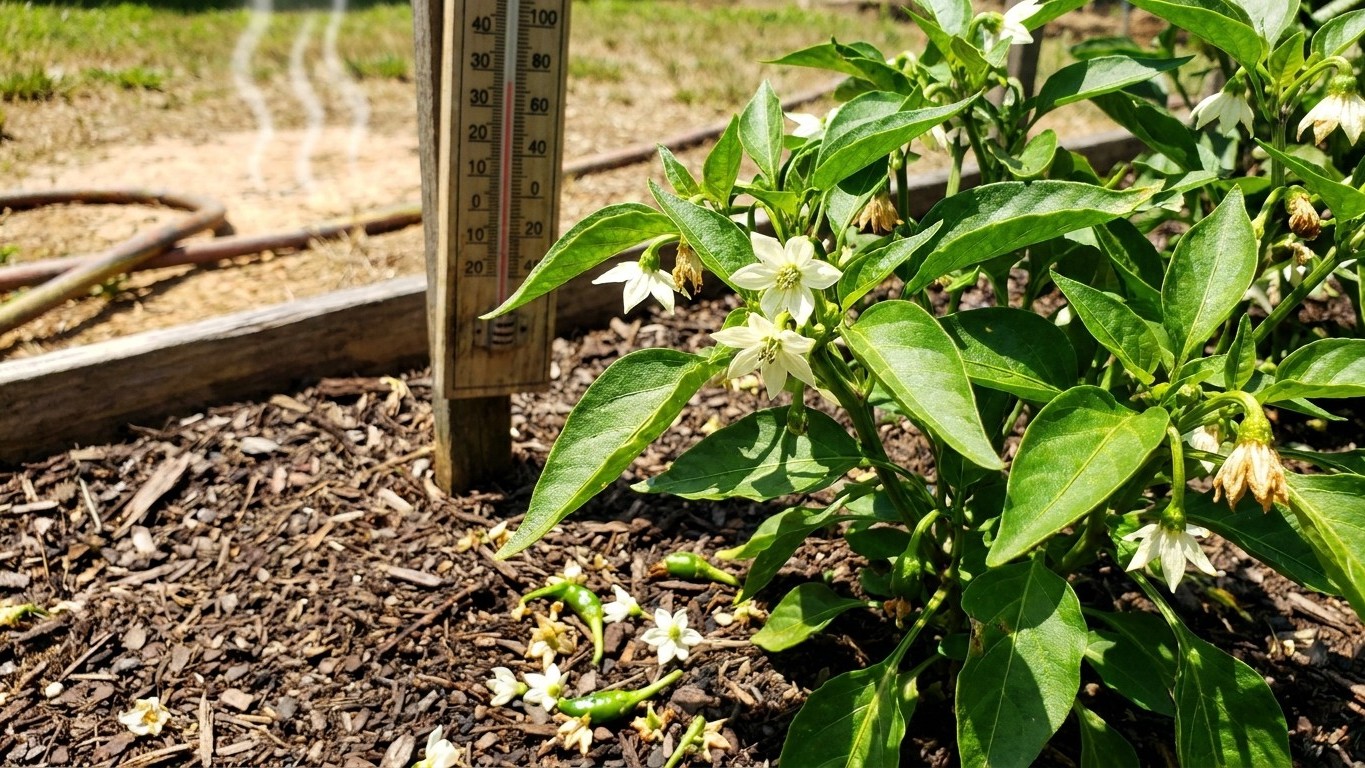

Peppers in Connecticut usually Fail to Set Fruit because a heat spike pushes daytime temperatures past 90 F right when the plant is flowering, or because a stretch of cool nights drops below 55 F before the plants ever get established. Both ends of that range knock blossoms off before they become peppers, and the fix starts with timing your transplant correctly and watching your own microclimate closely.
The short answer
Bridgeport’s climate record, the reference station for this state under the NOAA NCEI 1991-2020 Climate Normals, shows an average of 6.2 days a year that reach 90 F or hotter. That number looks small next to a Southern state’s summer, and it is. But 6.2 days is an average, not a ceiling, and it doesn’t need to happen every day in a row to cause damage. A single 90-plus afternoon landing during peak bloom is enough to trigger blossom drop, because pepper flowers abort when heat stress interrupts pollen viability. The plant isn’t dying. It’s just deciding, chemically, that this is not the week to invest energy in fruit.
That’s the hot end of the problem, and in Connecticut it’s a real but limited risk. Most seasons, the heat load stays modest enough that a well-timed planting sails through July and August without a dropped blossom crop. The bigger, less visible risk is the other end of the range.
Pepper fruit set also fails when nighttime temperatures fall below 55 F, according to Utah State University Extension’s guidance on pepper culture. Cool nights slow pollen germination and can cause flowers to abort just as effectively as heat does, and this failure mode tends to show up early in the season, right after transplant, or late in the fall as nights start slipping. Here’s the catch: this site tracks days at or above 90 F for Connecticut, but it does not carry summer night minima for this state. There’s no published figure here to point to for how many nights in a typical Connecticut summer dip under 55 F, and that figure would vary a lot depending on whether you’re gardening near Long Island Sound or up in the northwest hills.
That means the cool-end risk is on you to track directly. A basic min-max thermometer left in the garden bed will tell you more about your own pepper patch than any statewide average ever could. If you see a run of nights reading 50 F or 52 F, especially in late May or early June, don’t be surprised if flower clusters stall out or drop rather than set fruit. Don’t try to guess this from a map or from how far north you live. Latitude alone won’t tell you whether your particular yard sits in a cold pocket or a warm microclimate, and neither will the coldest month of the year. Only a thermometer in your own bed will.
When to start seed here
Working out a seed-starting date for peppers is really just counting backward from two conditions that both have to be true before a transplant goes in the ground: the frost risk has passed, and the soil has actually warmed up. Here’s how the arithmetic works for Connecticut, and how to redo it for your own county.
- Start with the last spring frost window. For the Bridgeport station, NOAA NCEI’s 1991-2020 normals put the 32 F freeze probability window at April 2 to April 12. That’s the coastal reading, and Bridgeport sits on Long Island Sound, which makes it the mildest corner of the state. Inland and northwest Connecticut freeze noticeably later in spring and earlier in fall, so if you’re gardening away from the coast, push your working frost date back by however many extra frost-risk weeks your area typically sees.
- Add the soil temperature requirement. Frost clearing isn’t enough on its own. Utah State University Extension is specific that peppers should go into the ground only once soil temperature reaches 60 F, which in Connecticut usually lags several days to a couple of weeks behind the last frost date, since soil warms more slowly than air. Cold, wet spring soil is common in this state, and a thermometer pushed a few inches into the bed will save you from guessing.
- Count backward 8 to 10 weeks for indoor seed starting. That’s the window Utah State University Extension gives for how long pepper seedlings need indoors before they’re ready to go outside. Take your expected transplant date, whatever that turns out to be once frost and soil temperature both cooperate, and subtract 8 to 10 weeks. That’s your seed-starting date.
- Redo the math for your own county. Because Bridgeport is the mild edge of the state, gardeners further inland or in the northwest corner should expect to start seed slightly earlier relative to the calendar, simply because their outdoor transplant date arrives later. The method stays the same. Only the calendar shifts.
None of this is exact to the day, and it shouldn’t be treated that way. Frost dates are probabilities, not guarantees, and soil temperature swings with sun exposure, mulch, and whether your beds are raised or in-ground. Treat the count as a planning window, then confirm with a thermometer before you commit trays of seedlings to the garden.
What goes wrong here
- Blossom drop from a hot spell. When daytime temperatures climb into the 90s during flowering, even for a single afternoon, pepper blossoms can abort rather than set fruit. Connecticut only averages 6.2 such days a year at the Bridgeport reference station, so this isn’t a constant threat, but it clusters unpredictably and can hit right at peak bloom in July. There’s no fix for the heat itself, but shade cloth over the bed during a forecast heat spike, and consistent watering so the plant isn’t also fighting drought stress, both reduce how many blossoms are lost.
- Blossom drop from a cool night. The other half of the same failure. Nights below 55 F stall pollen and abort flowers just like heat does, and this shows up most often right after an early transplant or during a cool snap late in the season. Since summer night minima for this state aren’t published on this site, the only reliable defense is watching your own garden’s overnight lows with a min-max thermometer and holding off on transplanting until nights are reliably staying above that threshold.
- Sunscald on exposed fruit. Once fruit does set, Connecticut’s summer sun is strong enough to scald peppers that lose their leaf cover, whether from pruning, wind damage, or disease dropping foliage. The result is a pale, papery patch on the fruit’s shoulder that eventually turns into a sunken, rotted spot. Keeping the plant’s canopy full, and avoiding heavy pruning during the hottest stretch of summer, is the main defense.
- Blossom-end rot on developing peppers. This shows up as a dark, leathery patch on the bottom of the fruit and is driven by inconsistent watering that disrupts calcium uptake, not by a calcium shortage in the soil itself. Connecticut’s mix of clay-heavy and sandy soils, combined with uneven summer rainfall, makes this a common complaint. Even, consistent watering, with mulch to hold soil moisture between waterings, is the standard remedy.
Common questions
Can peppers recover after a round of blossom drop?
Yes. Blossom drop from a single hot day or cool night usually costs that flush of flowers, but a healthy plant will keep producing new blossoms as conditions moderate. The bigger risk is repeated drop events stacking up over a season and shortening the total harvest window.
Does Connecticut’s coast really grow peppers differently than inland areas?
The frost data bears this out. Bridgeport, the coastal reference station, sees its last spring frost between April 2 and April 12, and it’s specifically the mildest part of the state. Inland and northwest Connecticut push both the spring and fall frost dates outward, which shortens the frost-free growing season and shifts the seed-starting math earlier relative to the calendar.
Should I trust an average like 6.2 days above 90 F to plan around?
Treat it as a baseline, not a forecast. It tells you that extreme heat is the exception rather than the rule in a typical Connecticut summer, which is useful for deciding how much you need to worry about heat-driven blossom drop overall. It won’t tell you whether this particular July will bring zero such days or ten.
What’s the fastest way to check if my soil is ready for pepper transplants?
A basic soil thermometer, pushed a few inches into the bed at the same time each day for several days running, is the most direct method. Utah State University Extension’s benchmark is 60 F, and taking readings after the sun has been on the bed for a few hours, rather than at dawn, gives a more realistic picture of daytime soil warmth.