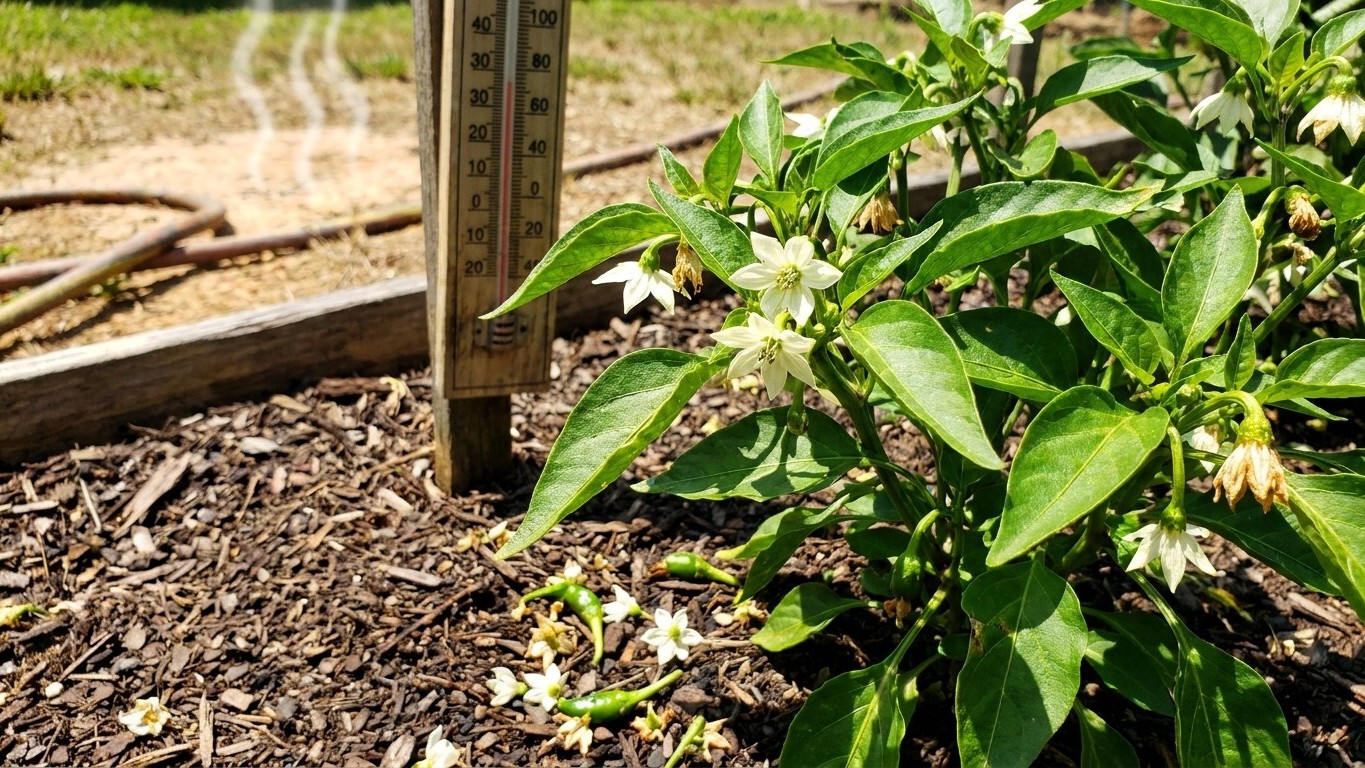

Peppers stop setting fruit in Florida mostly because the state’s long stretch of 90-plus-degree days crosses the threshold where pollen stops working, not because the plants are unhealthy or under-fed. The fix isn’t more fertilizer or different soil. It’s timing the bloom window around the heat, and paying attention to a cold-side risk that’s easy to overlook in a state known for warmth.
The short answer
At the Jacksonville reference station, NOAA’s 1991-2020 Climate Normals put the average at 73.2 days a year hitting 90 F or higher. That’s not a handful of scorching afternoons. It’s the equivalent of a solid ten weeks somewhere in the calendar sitting at or above that mark, and most of those days cluster together across the hottest stretch of summer rather than spreading out evenly. For a pepper plant, that block of heat is the single biggest reason a garden full of blossoms produces almost no fruit. Above roughly 90 F, pollen loses viability fast, flowers that looked perfectly normal the day before drop off the stem, and the plant simply idles until conditions cool back down. It’s not a disease, a pest, or a watering mistake. It’s chemistry, and no amount of fertilizer reverses it.
The other failure point sits at the opposite extreme, and it matters more than most Florida gardeners expect. Nights below 55 F also stop fruit set, because pepper flowers need warm overnight temperatures to release pollen properly. In north Florida’s shoulder seasons, late-winter and early-spring nights can dip into that range even after daytime highs feel warm enough for planting. This site tracks daytime heat loads county by county, but it does not carry summer night minima for this territory. That’s a gap worth being honest about: don’t assume a warm afternoon means a warm night, and don’t estimate overnight lows from how far south you are on the map. Latitude is a poor stand-in for a thermometer. If flowers are forming but not setting fruit in March or early April, check an actual overnight low from a nearby source before assuming heat is the problem. It may not be yet.
When to start seed here
Working out a seed-starting date for peppers in Florida means counting backward from two separate benchmarks and using whichever lands later.
- Find your last frost window. For the Jacksonville area, NOAA’s 1991-2020 Normals put the 30 to 70 percent probability band for a 32 F freeze between February 16 and March 7. That’s a genuine risk window, not a guarantee. Over the thirty years in that dataset, three winters saw no freeze at all, which shows how much year-to-year variation exists even at one station.
- Wait for soil, not just air, to warm. Utah State University Extension’s guidance on peppers is direct: transplant after frost risk has passed and once soil temperature reaches 60 F. Soil lags behind air temperature, sometimes by a couple of weeks, so a frost-free week in early March doesn’t automatically mean the ground is ready.
- Set your transplant date as the later of the two. If frost risk clears in early March but soil doesn’t hit 60 F until closer to mid-March, mid-March is your real transplant date, not the frost date alone.
- Count back 8 to 10 weeks indoors from that transplant date. A mid-March transplant date means starting seed indoors sometime in the first half of January, depending on which end of that 8 to 10 week range you use.
- Check that bloom timing lands before the heat stacks up. Fruit set takes roughly 35 to 45 days counted from the flower opening, not from transplanting or sowing. If a plant transplanted in mid-March starts flowering in May, that fruit-set window needs to close before the daily 90-plus stretch really sets in, or the flowers from that round are likely to drop regardless of how well the plant was raised.
None of this applies the same way once the calendar moves south. In central and south Florida, hard freeze risk drops close to zero and the whole growing season inverts: peppers go in through fall and winter, and summer becomes the season to avoid rather than the season to chase. Applying a north Florida frost window to Orlando or Miami will throw the whole schedule off in the wrong direction.
What goes wrong here
- Blossom drop during a hot spell. Once daytime highs push past the mid-90s, especially with several days in a row, flowers abort before pollination can happen. There’s no cure for heat mid-bloom, but shade cloth over the row during the hottest afternoon hours and steady, deep watering reduce the added stress that makes drop worse. The better fix is scheduling: get flowering finished before the heaviest run of 90-plus days arrives, using the backward count from the previous section.
- Blossom drop from a cool night. Early in the season, a night that drops under 55 F can cause the same blossom drop as a heat spell, just from the opposite direction. If flowers are forming but nothing is setting in late winter or early spring, check the actual overnight low rather than assuming the season is warm enough because the calendar says spring. A floating row cover on a cold night, or simply holding transplants a week or two longer, avoids losing an early flush of blooms.
- Sunscald on exposed fruit. Florida’s summer sun is intense enough that fruit left uncovered after heat stress thins out the plant’s leaf canopy can develop pale, papery patches where direct sun hits it. Avoid heavy pruning during the hottest months, and keep plants watered enough that they hold onto their natural leaf cover, which shades the fruit without any extra material needed.
- Blossom-end rot from uneven watering. Florida’s pattern of heavy afternoon storms followed by dry stretches makes calcium uptake inconsistent, and that shows up as a dark, sunken patch on the blossom end of the fruit. Mulching around the base and watering on a steady schedule, rather than letting the plant swing between soaked and dry, keeps calcium moving into the fruit consistently.
Common questions
Can peppers be grown through a Florida summer at all?
In north Florida, the stretch of 90-plus days makes summer fruit set unreliable, which is why the spring planting window is built around finishing bloom before that heat arrives. In central and south Florida, growers generally skip summer for peppers entirely and shift the main season to fall and winter instead.
Will extra fertilizer fix blossom drop?
No. Blossom drop from heat or cold is a temperature response, not a nutrient deficiency, and pushing more fertilizer, especially nitrogen, tends to encourage leafy growth at the expense of flowering rather than solving the drop.
What if my area rarely sees frost at all?
That’s the case for much of central and south Florida, where the growing calendar flips: peppers go in during the cooler months and summer heat becomes the limiting factor instead of frost.
How long after a flower opens does the fruit actually form?
Utah State University Extension puts that window at roughly 35 to 45 days from the flower opening, not from when the seed was started or the plant was transplanted. That’s the number to track when timing bloom around the hottest weeks of summer.