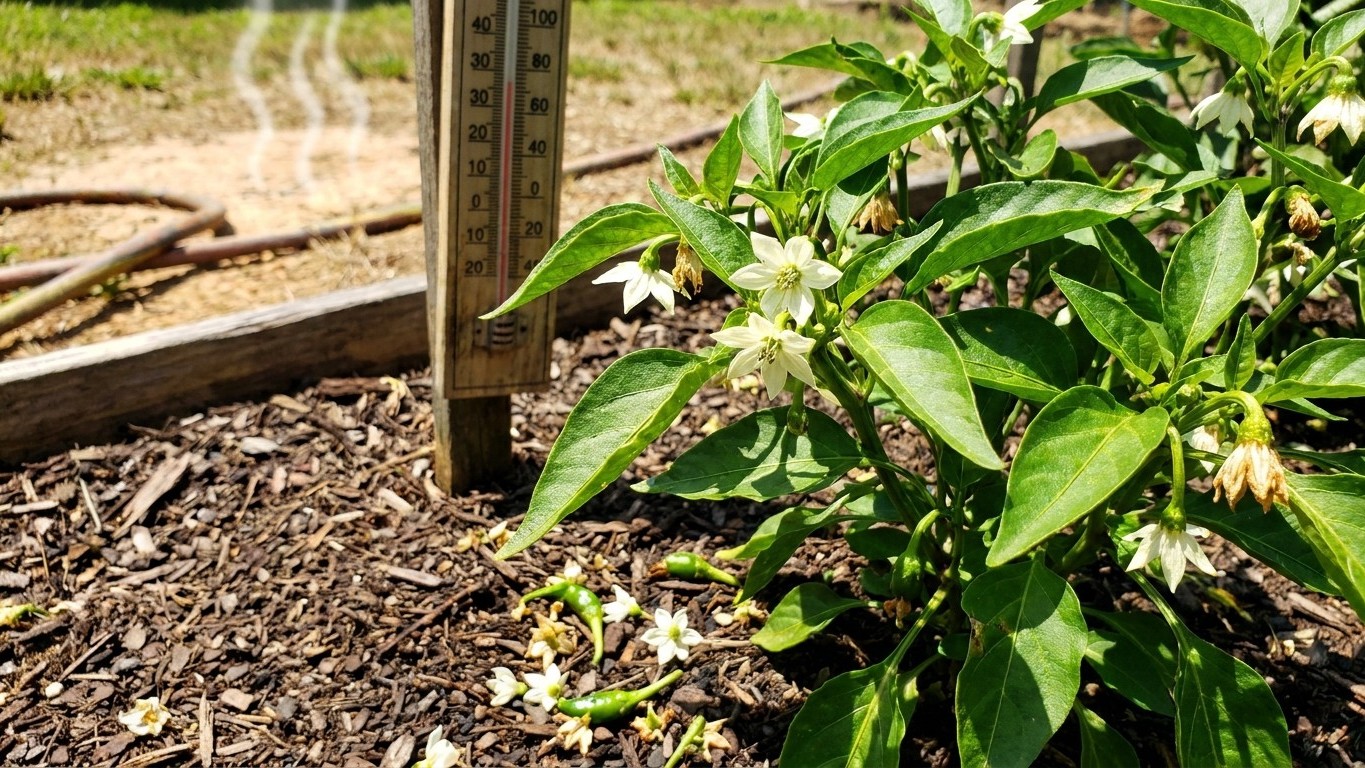

Peppers stall out in Indiana gardens for one of two reasons: a hot stretch that scorches the blossoms before they can pollinate, or a stretch of cool nights that keeps pollen from forming at all. Indianapolis logs 14.6 days a year at 90 F or hotter, and that heat load is the biggest single culprit statewide. The cool end matters just as much, but this site doesn’t track summer night minimums, so you’ll need to watch your own thermometer.
The short answer
Start with the number that’s actually measured here: Indianapolis averages 14.6 days a year at 90 F or above, based on the NOAA NCEI Climate Normals for 1991-2020. That’s not a string of two weeks in a row, usually. It’s scattered heat spikes through July and August, and each one is enough to shut a pepper plant down for a few days. Pepper flowers drop their pollen viability once daytime highs push past 90 F for more than a day or two, especially if nighttime lows don’t fall enough to let the plant recover. Fourteen and a half days sounds modest against a whole growing season, but peppers don’t average out heat stress the way a lawn does. One bad week during flowering can wipe out a full flush of blossoms, and the plant just moves on to the next round without setting fruit from the one it lost.
The other edge of the window is colder, and it’s just as real. Nights that drop below 55 F interfere with pollen development in peppers, according to Utah State University Extension, and a plant sitting in that cold-night zone for several nights running will drop blossoms or set them without seed, which shows up as small, misshapen fruit or nothing at all. Here’s the catch for Indiana gardeners: this site publishes days-above-90 data because that’s what NOAA’s climate normals track at the state level, but it does not carry summer night minimum temperatures for any Indiana location. Nobody should guess at that number by looking at a latitude line on a map or by checking how cold January gets. Summer night lows depend on local terrain, whether you’re in a river valley or on a ridge, how close you are to a city’s heat signature, and plenty of microclimate factors a statewide average can’t capture.
The practical move is to keep a simple outdoor thermometer or a cheap remote sensor near the pepper bed and actually log what your nights are doing during bloom season, typically June through August. If you’re seeing repeated blossom drop and you’ve ruled out the obvious heat spikes, cool nights are worth checking before you blame the variety, the soil, or the fertilizer schedule.
When to start seed here
Working backward from transplant date is the only reliable way to time pepper seed starting, and the math is simple once you know your local frost window. Utah State University Extension recommends starting pepper seed 8 to 10 weeks before transplanting, and transplanting only after frost has passed and soil has warmed to 60 F.
- Find your last spring frost date. For the Indianapolis station, NOAA NCEI’s 1991-2020 climate normals put the 32 F freeze probability window between April 9 and April 21. Southern Indiana typically clears frost a week or two earlier than that; northern counties often run a week or two later. Purdue notes there’s still roughly a 10% chance of a 32 F event after the published date, so if you’re transplanting on the early edge of your window, keep row cover or an old sheet ready.
- Confirm soil temperature, not just the calendar. A frost-free date doesn’t guarantee 60 F soil. Push a soil thermometer four inches into the bed on a few mornings before you plan to transplant. Cold soil slows pepper roots even if the air feels warm enough for a T-shirt.
- Count back 8 weeks for an early estimate. If your local last-frost target is April 9, eight weeks earlier lands on February 12. If your target is closer to April 21, eight weeks back is February 24.
- Count back 10 weeks for a fuller estimate. Using the same two dates, ten weeks before April 9 is January 29, and ten weeks before April 21 is February 10.
- Pick your seed-start date inside that range based on how warm and bright your indoor setup is. A sunnier windowsill or a grow light pushes growth faster, so gardeners with weaker light often start closer to the 10-week mark to compensate for slower seedling development.
This arithmetic works the same way no matter where you garden in the state. Swap in your county’s actual last-frost estimate, and the 8-to-10-week countback follows automatically.
What goes wrong here
Even with good timing, Indiana’s climate throws a handful of specific problems at pepper plants once they’re in the ground and flowering.
- Blossom drop during a heat spell. When daytime highs push past 90 F, especially with humidity making the air feel heavier, pepper flowers can abort before pollination finishes. The remedy is shade cloth rated for 30 to 40% shade draped over the bed during the hottest afternoon hours, plus consistent watering so the plant isn’t fighting drought stress on top of heat stress.
- Blossom drop during a cool night. If nights fall into the range where pollen doesn’t develop properly, which Utah State University Extension identifies as below 55 F, blossoms can drop the same way they do in heat. Since this site doesn’t track night minimums for Indiana locations, the fix starts with monitoring: log your own nights during bloom season, and if a cold snap is forecast, consider row cover overnight to hold in a few extra degrees near the plant.
- Sunscald on exposed fruit. Once fruit has set, direct afternoon sun on a hot day can scorch the skin, especially on plants that have lost leaf cover from wind, disease, or over-aggressive pruning. Leaving the plant’s natural canopy intact, rather than stripping lower leaves, gives developing peppers some shade of their own.
- Blossom-end rot. This shows up as a sunken, leathery patch at the bottom of the fruit and traces back to uneven calcium uptake, usually triggered by inconsistent watering rather than a true calcium shortage in the soil. Deep, regular watering on a set schedule, rather than letting the bed dry out and then flooding it, keeps calcium moving steadily to the fruit.
Common questions
How many days above 90 F does Indianapolis average in a normal year?
14.6 days a year, based on NOAA NCEI’s 1991-2020 Climate Normals for the Indianapolis reference station. That’s the figure to weigh against pepper heat stress, not the average summer temperature, which runs much cooler than the days that actually cause blossom drop.
Does this site track how cold Indiana nights get in summer?
No. Summer night minimum temperatures aren’t published here for Indiana locations. If cool nights seem to be causing blossom drop, the only reliable approach is to watch your own outdoor thermometer during bloom season rather than estimating from latitude or winter cold.
When should I start pepper seed indoors for an Indianapolis-area garden?
Start 8 to 10 weeks before your planned transplant date. Using the Indianapolis last-frost window of April 9 to April 21, that puts seed starting somewhere between January 29 and February 24, depending on where in that frost window your county typically falls and how strong your indoor light setup is.
Is a frost-free date enough to transplant peppers safely?
Not on its own. Utah State University Extension recommends transplanting only after both frost has passed and soil has warmed to 60 F. Air temperature can feel mild well before soil catches up, so checking soil with a thermometer avoids setting transplants into cold ground that stalls their roots.