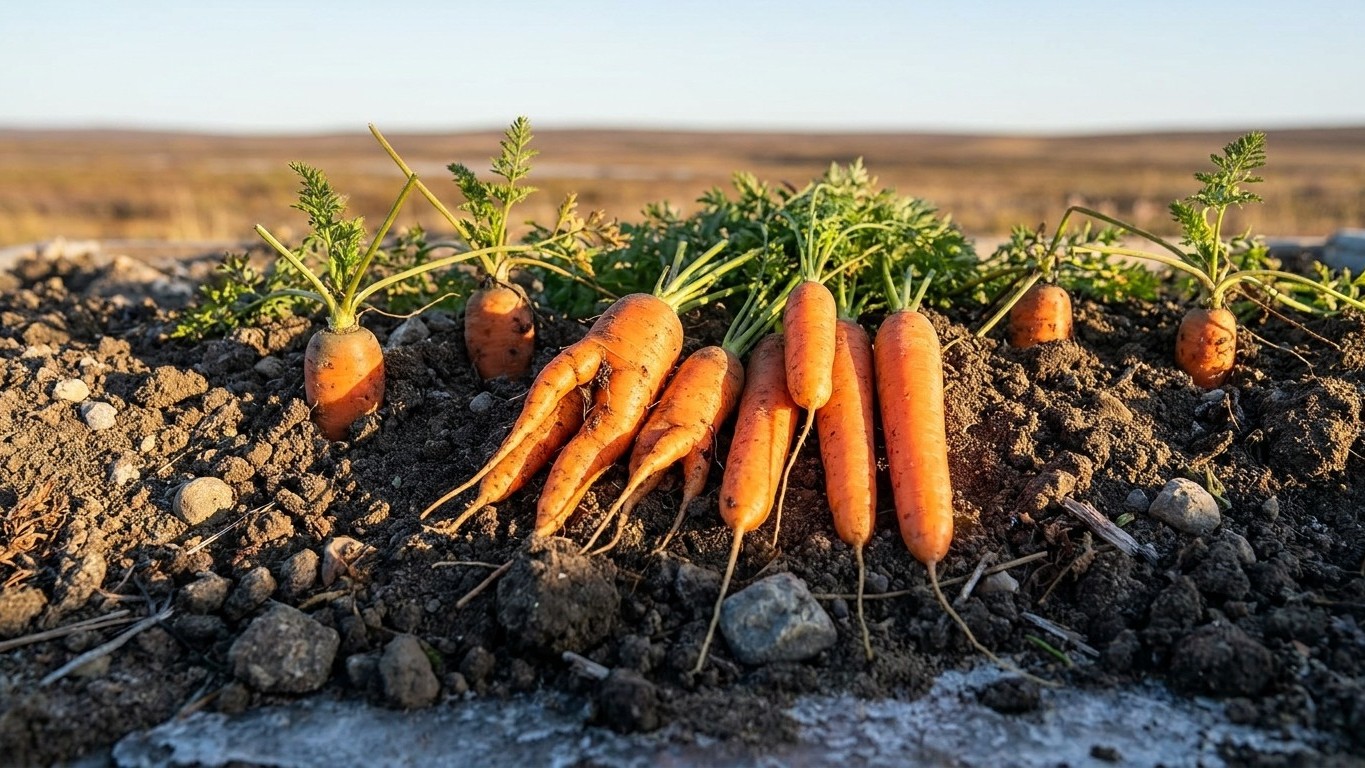

Northwest Territories carrots can grow straight and full-sized if you work with two things at once: growing-region soil that runs low in clay but sits over permafrost, and a spring that arrives late and moves fast. When to Sow Carrots in Northwest Territories matters just as much as soil texture in getting this right. Get the timing right and the texture is mostly on your side already. Get either piece wrong and you’re looking at forked roots, or a crop that barely germinates before the ground freezes again.
The short answer
Across the agricultural belt of Northwest Territories, the mapped soil surface comes back as Cryosol nine times out of ten, 99 percent of the surveyed ground, according to Agriculture and Agri-Food Canada’s Canadian Soil Information Service. That’s a soil built around permafrost: the top layer thaws out every summer, forming what soil scientists call the active layer, while everything below stays frozen year-round. The remainder of the mapped surface classifies as Regosolic, young soil with little developed structure. Texture-wise, this ground runs 55 percent sand, 39 percent silt and just 6 percent clay, on average, a loam-to-silt mix that drains well. Organic matter sits around 2.4 percent. No median pH is published for the surveyed area, so there’s no regional number to guess at.
What that means for forking
Carrots fork when a root meets resistance, whether that’s a rock, compacted clay, or something else in the way, according to Utah State University Extension. Will Carrots Fork in Northwest Territories Soil? With only 6 percent clay in the typical profile here, texture alone isn’t the main threat most gardeners in this region actually face. The bigger obstacle sits underneath: the active layer might only run a foot or so deep before it hits permafrost, and a carrot can’t push through frozen ground any more than it could push through rock. That works exactly like the hazards USU Extension warns about, even though frozen subsoil isn’t the specific case they name.
The fix follows the same logic recommended for heavy or rocky soil. A raised bed filled with a loose, compost-rich mix lets roots run their full length without ever reaching frozen ground. Where the active layer runs deeper and the native soil is workable, double digging and a heavy compost amendment loosens what’s there and adds organic matter this soil runs a little short on to begin with.
None of this is a diagnosis for your yard. Northwest Territories’ agricultural zone spans a wide range of soil series, and the figures above are a median drawn from eighty mapped components, not a reading from your own bed. River terraces, drained wetland, and any lot with disturbed or trucked-in fill can differ completely from that surveyed norm.
The test that settles it in your own garden
The state figures describe a median across dozens of soil components, not the ten-by-twenty bed behind your house. The only way to know what you’re actually planting into is to look at it yourself.
- Dig a test hole at least a foot deep in the spot you plan to sow. Note where the soil changes color or texture, and whether you hit ice, frozen ground, or standing water before reaching that depth.
- Run your fingers through the loosened soil to check for stones and hardpan. Frequent pebbles or a dense, compacted layer partway down are exactly what makes a carrot root fork or stall.
- Take a handful of moist soil and rub it between your fingers to feel the texture. Gritty and loose points to sand; smooth and sticky that holds a ribbon shape points to clay; something silky rather than gritty in between points to silt or loam.
- Fill the test hole with water and time how long it takes to disappear. Water that lingers for hours signals poor drainage, and a raised bed is worth the extra work. Water that vanishes quickly points to naturally well-drained ground, closer to what the regional figures describe.
- Track how deep the soil actually thaws before you sow. Because permafrost sits under so much of this region’s agricultural ground, hitting frozen soil within the top foot sets your real limit on root length, no matter what the texture looks like above it.
Reading the results
None of these steps produce a lab-grade number, and none should be read as one. What they give you is a plain picture: loose ground that drains, versus something denser, stonier, or shallower. Loose, deep, well-drained soil calls for little more than working in compost before sowing. Anything shallow, stony, or slow to drain calls for a raised bed or a well-amended, double-dug row, following the general remedy Utah State University Extension recommends for difficult ground.
When to sow here
Yellowknife A’s climate normals put the average last spring frost at May 25, according to Environment and Climate Change Canada’s Canadian Climate Normals covering 1981 to 2010. That’s a mean, not a guarantee. In roughly half the years on record, frost fell later than that date, so treat May 25 as the midpoint of a window, not a green light. Communities north of Yellowknife, or at higher elevation, typically lag behind that station by some amount the normals don’t specify, so plan later rather than earlier if you’re farther out.
- Start counting from soil temperature, not the calendar. Carrot seed needs soil at a minimum of 40 F to germinate at all, per Utah State University Extension. In a region built on permafrost, ground can sit well below that even after the air feels like spring, so check the soil itself before sowing anything.
- Aim to sow two to three weeks ahead of the last frost. Carrots tolerate a light frost once they’re up, and USU Extension’s general guidance is to sow that far ahead of the expected last frost date. Counting back from a May 25 average puts that window in early May in many years, with the caveats above still applying.
- Watch for the 55 to 65 F sweet spot. Germination is fastest in that range, and permafrost-influenced soil often lags behind a warming air mass by days, so a soil thermometer beats a wall calendar for deciding the actual sowing day.
- Count the growing season forward from the seeding date, not from any transplant date. Carrots go straight into the ground, and most varieties need 70 to 100 days from seed to harvest, so work backward from the first fall frost you expect to make sure that window fits before the ground freezes again.
Counting from your last frost
Put together, the safest approach in most of Northwest Territories’ agricultural areas is to check soil temperature directly in late April or early May, hold off until it reads a genuine 40 F, and sow as soon after that as the 55 to 65 F germination range allows. Given how short the frost-free season already runs this far north, losing two extra weeks to an overcautious start can be the difference between a full-size root and one pulled early out of necessity.
What goes wrong here
Most carrot failures in this region trace back to one of three things: the ground underneath, a short burst of heat, or water that comes in fits and starts.
The usual suspects
- Forking against permafrost. Even where the texture is fine and sandy, a shallow active layer stops the taproot cold. The fix is a raised bed with a full 10 to 12 inches of loose, compost-rich mix above the frozen line, so roots never reach it.
- Poor germination during a hot spell. Carrot seed slows down once soil runs past the 55 to 65 F ideal, and a sudden warm stretch after a cold spring can push soil past that range fast. Shading the row lightly and keeping it consistently moist until seedlings emerge prevents most of this.
- Splitting from uneven watering. Roots that dry out, then get soaked, swell unevenly and split along their length. Even, regular watering, especially through any dry stretch while roots are sizing up, prevents most of this without any change to soil or timing.
- Stunted roots from thin topsoil. Where organic matter runs close to the regional 2.4 percent average or lower, and the active layer is shallow, roots can run out of loose ground before they run out of season. Working compost in every year, not just at planting, gradually deepens what permafrost-influenced soil offers on its own.
Checking this against your own county
Northwest Territories doesn’t divide into counties the way many provinces and states do, but the same principle holds. Figures pulled from eighty mapped soil components and one Yellowknife weather station describe the region in general, not the specific patch of ground you’re planting into. Communities along the Mackenzie Valley, around Great Slave Lake, or farther north can run weeks apart from each other in when the ground actually thaws and warms enough to sow.
The Government of Northwest Territories’ agriculture services program fields exactly these local questions, from soil conditions to what’s realistically been grown in a given community. Their agriculture services page is the direct line for matching the numbers here against an actual growing season nearby. A quick call before committing a raised bed’s worth of compost is cheaper than finding out in August that your ground behaves nothing like the regional median.
Common questions
Do carrots need a specific soil pH in Northwest Territories?
No median pH is published for the region’s mapped agricultural soils, so there isn’t a regional number to aim for. A home soil test is the only way to know what your own bed is running, and it’s worth doing before adding anything to change it based on a guess.
Can I sow carrots directly into permafrost-influenced soil without a raised bed?
Yes, if your test hole shows the active layer thawing well past the 10 to 12 inches most varieties need before you hit frozen ground. Where it doesn’t, a raised bed is the more reliable fix, following the general remedy Utah State University Extension gives for heavy or obstructed soil.
How many days do carrots need in Northwest Territories’ short season?
Most varieties need 70 to 100 days from the day you sow the seed, since carrots go straight into the ground with no transplant step to shift the count. Working that number forward from your actual sowing date, against an expected first fall frost, is the only reliable way to check the season fits.
Is May 25 a safe date to sow after in Northwest Territories?
It’s the average last frost at the Yellowknife A station for 1981 to 2010, which means frost arrived later than that in roughly half the years on record. Treat it as the middle of a range, not a guaranteed cutoff, and lean later if you’re farther from Yellowknife.