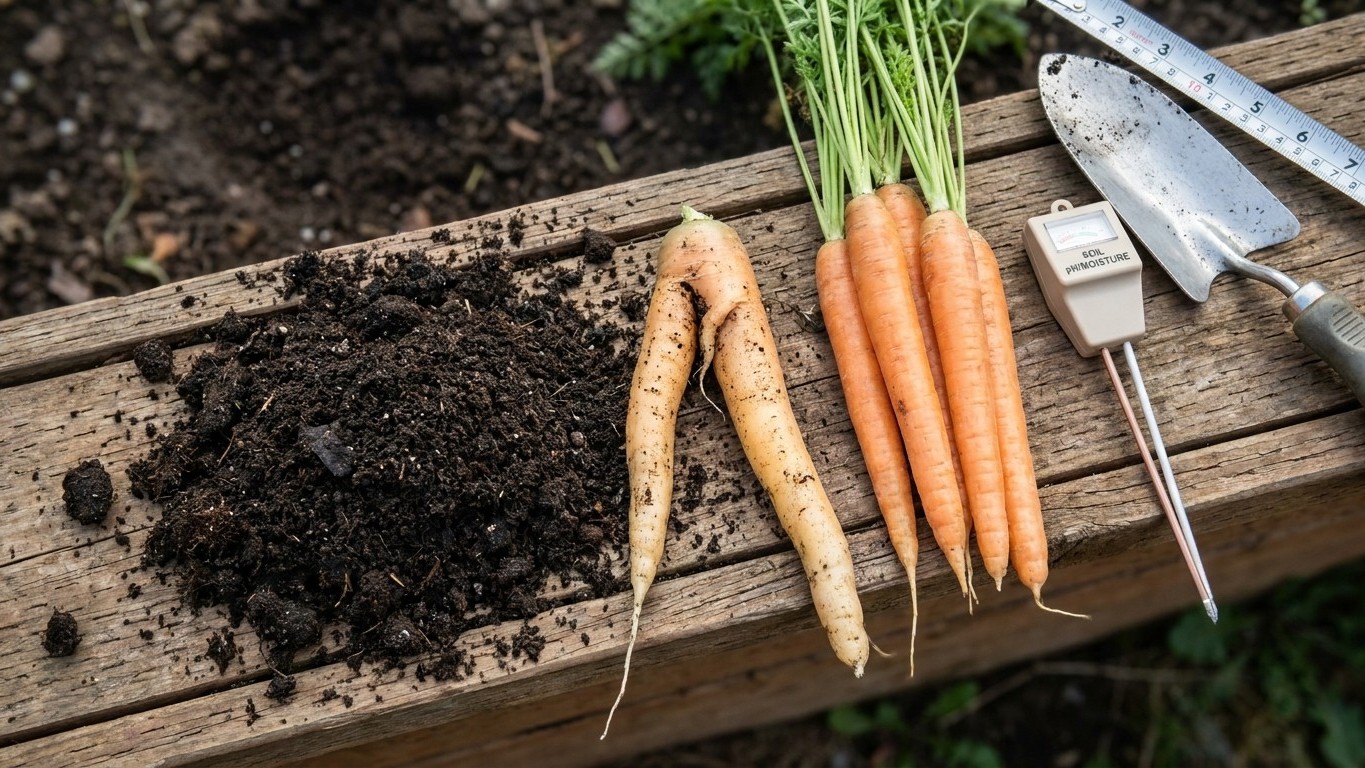

Alaska’s cold, acidic, poorly drained ground is not carrot-friendly by default, and the state’s signature soil actively encourages forked roots. The fix is not a different variety. It’s raised beds, heavy compost and double digging, paired with When to Sow Carrots in Alaska timed to the short frost-free window and a soil test that tells you what you’re actually working with.
The short answer
The soil USDA lists as representative of Alaska is the Tanana series, a Gelisol, meaning permafrost sits within reach of the profile. The surface horizon runs 30 percent sand, 7 percent clay and 63 percent silt, a loam-to-silt texture, with organic matter around 90.0 percent and a surface pH near 4.7, strongly acid. Drainage is classed as poor. Those numbers come from USDA NRCS Soil Data Access, averaged across 17 major components of the series as mapped, and they describe the natural surface layer, not a dug-over garden bed. An organic-matter figure that high almost always means peat, muck or forest litter sitting at the surface, something a cultivated plot won’t carry once it’s been turned and amended.
Put a carrot into ground like that and it will fork. Carrots want deep, sandy, well-drained soil rich in organic matter, according to Utah State University Extension, and heavy or rocky soil is exactly what pushes the taproot to split or branch as it hits resistance. Alaska’s Tanana series checks two of the wrong boxes at once: high silt content that compacts and holds water, and poor drainage that keeps the root zone cold and wet longer into the season. So Will Carrots Fork in Alaska Soil? Utah State’s answer for heavy soil is straightforward, work in plenty of compost and double dig the bed so the root has loose ground to push through for a foot or more. Where drainage is truly poor, as the poorly drained rating here suggests, a raised bed filled with a sandy, compost-rich mix sidesteps the problem instead of fighting it.
None of this is a verdict on any one yard. Alaska spans hundreds of mapped soil series, and the Tanana series is simply the one USDA names as representative of the state as a whole. River bottoms, hillside plots, and anything a builder has cut, filled or graded will read completely differently under a shovel. Treat these numbers as a starting point for what the region’s ground tends to do, run acid, drain slowly, stay cold, and then confirm what’s actually under your own carrots before you build a bed around a guess.
The test that settles it in your own garden
A state soil profile tells you the odds. Your own dirt tells you the answer. The following steps use nothing more than a shovel, your hands and a bucket of water, and they’ll tell you whether your ground is going to fork carrots before you’ve bought a single seed packet.
- Dig a test hole at least a foot deep. Carrots need loose, unobstructed ground to grow straight, so this is the depth that matters most. Note where the soil changes color or texture, and whether you hit a dense, compacted layer before you reach that depth.
- Check for stones and rocks as you dig. Pull out anything larger than a pea and set it aside. A pile of rocks after one hole is a strong sign that forking will be a problem anywhere in that bed unless you screen the soil or raise it above the native ground.
- Feel the texture between your fingers. Rub a moist handful between your palms. Gritty and loose suggests sand. Smooth and sticky when wet, hard when dry, suggests clay. Silky and slippery, holding a shape without much stickiness, suggests silt, close to what the Tanana series surface carries.
- Run a drainage check. Fill the test hole with water and watch how it behaves. Water that lingers for a long stretch instead of soaking away points to poor drainage, the same condition the state series carries, and it’s the strongest single argument for building up rather than digging down.
- Repeat in more than one spot. Garden soil is rarely uniform across even a small yard. A bed near a downspout or at the low point of a slope can behave nothing like ground ten feet away.
When to sow here
Carrots go into the ground as seed. There’s no transplant date to count from, no seedling tray to harden off, just soil temperature and the calendar working together.
- Start with the frost record. NOAA NCEI’s 1991-2020 climate normals put the last spring frost for the Anchorage station between May 3 and May 12. That’s a roughly nine-day band, not a single date, reflecting the normal spread of freeze risk in that period.
- Wait for the soil, not just the calendar, to warm. Carrot seed needs soil at a minimum of 40 F to germinate at all, and cold, wet, silt-heavy ground like the Tanana series warms more slowly in spring than a sandy bed does. Check the soil itself before sowing rather than relying on the date alone.
- Sow two to three weeks before that last frost window. Counting Back From the May 3 to May 12 range puts a typical sowing target somewhere in the second half of April for the Anchorage area, once the soil has actually cleared that 40 F floor.
- Aim for the germination sweet spot. Seed comes up best in soil between 55 F and 65 F. Early sowings into barely-thawed ground will germinate more slowly and unevenly than seed sown once the bed has warmed further into that range.
- Adjust further out from Anchorage. The Anchorage station sits in one of the mildest, longest-season parts of Alaska. The Interior and points north carry a shorter frost-free stretch than the roughly 143 frost-free days this normal implies for the Anchorage area, so a Fairbanks or North Slope garden should push sowing later, not earlier, and lean on the region’s long summer daylight to make up ground once seed is in.
What goes wrong here
- Forking in heavy, poorly drained ground. The Tanana series’ silt-heavy texture and poor drainage rating are close to a textbook setup for forked roots, since Utah State University Extension identifies exactly this combination, heavy or rocky soil, as the cause. Work compost deeply into the bed and double dig at least a foot down, or skip the native soil altogether and build a raised bed filled with a lighter, sandier mix.
- Poor germination during a warm, dry stretch. Carrot seed germinates best between 55 F and 65 F, and a sunny run of days can dry and crust a bare seedbed before the seed has finished sprouting. Keep the seedbed surface consistently moist with light, frequent watering until seedlings are up, rather than one heavy soak followed by a dry gap.
- Splitting from uneven watering later in the season. Roots that alternate between dry stress and a sudden heavy soak tend to crack along the length of the root as they swell too fast after a dry spell. A steady watering routine, rather than sporadic deep watering, keeps growth even.
- Cold, slow-to-warm soil delaying the whole season. The same poor drainage that causes forking also keeps soil temperature down longer into spring. Raised beds warm faster than the surrounding ground, which is part of why they solve two problems, forking and slow warming, at once in soil like this.
Checking this against your own county
Everything above starts from a single representative soil series and a single weather station. Your county, and quite possibly your own block, can differ from both. The University of Alaska Fairbanks Cooperative Extension Service is the land-grant extension body for the state and the right first call for a local soil test, a read on your area’s actual frost dates, and variety guidance suited to your specific growing zone. A soil test through your local extension office will also give you an actual pH and nutrient reading for your bed, numbers the state-level Tanana series data simply can’t provide for your particular yard.
Common questions
Why does Alaska soil cause carrots to fork so often?
The state’s representative soil, the Tanana series, is a poorly drained, silt-heavy Gelisol with permafrost near the surface. That combination of dense texture and standing moisture is close to the exact scenario Utah State University Extension flags as the cause of forked roots, heavy or rocky ground that resists a straight-growing taproot.
Do I need a raised bed to grow carrots in Alaska?
Not automatically, but it’s often the simplest fix where native soil is poorly drained and silt-heavy. A raised bed filled with a sandy, compost-rich mix sidesteps the drainage and compaction problems in one step, rather than requiring you to double dig and heavily amend the native ground in place.
When should I sow carrot seed if I garden near Anchorage?
Aim for two to three weeks before the local last-frost window of May 3 to May 12, once soil temperature has reached at least 40 F, and expect best germination once soil sits between 55 F and 65 F. That points to sowing in the second half of April for most Anchorage-area gardens, soil conditions permitting.
Is the pH of the Tanana series the pH of my garden bed?
No. The 4.7 figure is the representative surface pH for the Tanana series as mapped, a natural, undisturbed profile with very high organic matter. A worked garden bed will read differently once it’s been tilled and amended, so a local soil test through your county extension office is the only way to know your own number.