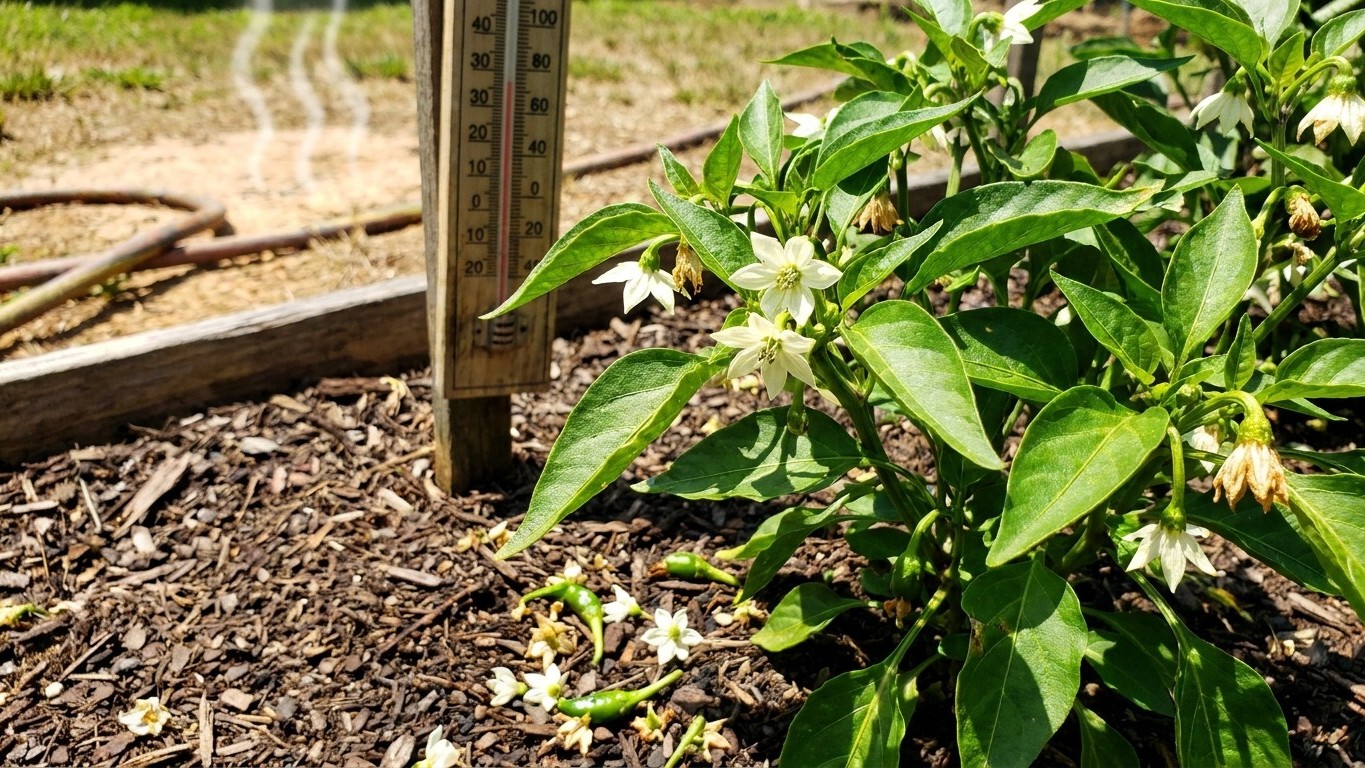

Nevada’s pepper plants abort their flowers mostly because of heat. Las Vegas logs 131.3 days a year at 90°F or above, and pepper fruit set collapses once daytime highs climb into that zone for stretches at a time. The same failure shows up at the cold edge, when nights fall below 55°F, though this site doesn’t track summer overnight lows, so growers need to watch their own yard. The fix starts indoors: seed 8 to 10 weeks before you plan to transplant, then move plants out once soil warms to 60°F, after the last frost.
The short answer
Start with the number that actually drives this problem: 131.3 days a year at or above 90°F, measured at the Las Vegas reference station. That’s not an average summer temperature, it’s a count of how often the thermostat gets pushed into the range where pepper flowers give up. A pepper plant under sustained heat stress will keep blooming, but the flowers drop before they ever set fruit. The pollen goes sterile, the plant redirects energy to surviving the afternoon instead of finishing pollination, and the gardener ends up with a bush full of blossoms and nothing to show for it come harvest.
That 131.3-day figure comes from the Las Vegas area specifically. If you garden in Reno, Carson City, or anywhere at elevation in the Nevada high desert, your own count of 90-degree days will run lower, sometimes dramatically lower, because elevation and distance from the valley floor change the heat load a lot. The mechanism stays the same wherever you are: cross whatever local heat count you’re dealing with against that 90-degree threshold, and you’ll know how much of a fight your peppers are in for this season.
Heat isn’t the only way to lose a fruit set, though. The other edge of the same problem shows up when nights drop below 55°F. Pepper flowers need warm nights to complete pollination just as much as they need to avoid scorching afternoons, and a string of cool nights in spring or early fall will cause the same blossom drop as a heat wave does, just from the opposite direction. This is where the guidance gets harder to hand over in a blanket statement, because summer night minima aren’t something this site tracks by territory. Nevada’s geography is too varied for a single number to mean anything useful anyway. A backyard in the Las Vegas valley and a garden bed in the Sierra foothills can differ by ten degrees or more on any given night, and that gap has nothing to do with latitude or with how cold the coldest month of the year gets. It comes down to elevation, local wind patterns, and how close you are to reflective pavement or open desert.
The practical move is to put a min-max thermometer in your own pepper bed and read it through the growing season. If you’re seeing repeated nights under 55°F during what should be your fruiting window, that’s your answer, not a chart, not a zone map, your own yard.
When to start seed here
Figuring out a seed-starting date for Nevada peppers means working backward from two moving targets: when your soil actually reaches 60°F, and when your last frost date falls. Neither one is a fixed day on a calendar here, because the state’s climate spans desert valley floors and mountain-town elevations that frost months apart from each other.
- Find your local last frost window. NOAA’s 1991-2020 climate normals put the 32°F freeze probability band at Las Vegas anywhere from January 7 to February 1, but that figure reflects a desert urban-heat-island extreme and should not be treated as guidance for the rest of the state. Reno, Carson City, and most elevated parts of Nevada see frost linger far later into spring and arrive far earlier in fall. Your county extension office can give you the actual freeze data for your specific location, and that’s the number to start this arithmetic from, not a statewide average.
- Wait for 60°F soil, not just calendar frost-safety. Air temperature clearing the frost threshold doesn’t mean your soil is warm enough for peppers. Push a soil thermometer a few inches into your bed on a sunny afternoon. Pepper transplants stall out and often never recover if they go into cold ground, even if the air overhead feels mild.
- Count backward 8 to 10 weeks from your transplant date. Once you know when your soil will realistically hit 60°F, after your last frost, subtract 8 to 10 weeks. That’s your indoor seed-starting date. If your target transplant date is, say, mid-spring for your elevation, you’re starting seed indoors in mid-winter to early spring, under lights, well before the ground outside is ready for them.
- Rerun the math if you move gardens. A backyard bed in the Las Vegas valley and a raised bed in a mountain town can be six to eight weeks apart on this schedule. There’s no single “Nevada date” that works for both, which is exactly why the county extension office, not a generic planting calendar, is the right source for your specific soil and frost numbers.
This backward count matters more in Nevada than in milder climates because the margin for error runs both directions. Start too early and you’re babying leggy transplants indoors for weeks past when they should be in the ground. Start too late and you’re pushing flowering into the hottest stretch of days-above-90 weather, right when fruit set is already working against you.
What goes wrong here
- Blossom drop from a hot spell or a cool night. This is the most common failure in Nevada gardens, and it runs in both directions. A heat spike during flowering, especially during a run of days above 90°F, causes flowers to drop before pollination finishes. A cool night below 55°F does the same thing from the other side. The remedy isn’t a single fix, it’s timing: aim your transplant schedule so peak flowering lands between the last frost risk and the thick of summer heat, and use shade cloth over plants during any unexpected heat spike that hits mid-bloom.
- Sunscald where the sun is strong. Nevada’s clear skies and high elevation in many parts of the state mean intense, direct sun exposure, and pepper fruit that’s left uncovered by foliage can develop pale, papery patches on the side facing the sun. This happens more often on plants that have lost leaves to heat stress or over-pruning, since the fruit no longer has natural shade. The remedy is to avoid heavy pruning during hot stretches and use shade cloth over exposed rows during the peak of summer afternoon sun.
- Blossom-end rot. This shows up as a sunken, dark patch on the bottom of the fruit, and it’s driven by inconsistent water delivery rather than a soil nutrient shortage in most cases. Nevada’s dry air and fast-draining desert soils make it easy for moisture levels to swing between soaked and bone-dry, which disrupts how the plant moves calcium into developing fruit. The remedy is even, consistent watering, ideally with drip irrigation and a layer of mulch that keeps soil moisture from swinging wildly between waterings.
Common questions
Why do my Nevada pepper plants flower but never set fruit?
The two most likely culprits are heat and cold working against pollination at opposite ends. If daytime highs are pushing past 90°F during flowering, or if nights are dropping below 55°F, the flowers will drop before fruit forms. Check your own thermometer during the bloom window to see which end you’re dealing with.
Should I start pepper seeds earlier in southern Nevada than in the north?
Yes, generally, but not by a fixed number of weeks. Southern desert valleys warm up earlier in spring, while northern and higher-elevation areas frost later into the season and cool off earlier in fall. Rather than guessing, check your county extension office for local freeze data and count backward 8 to 10 weeks from your realistic transplant date.
Does the 131.3 days-above-90 figure apply to all of Nevada?
No. That figure is measured at the Las Vegas reference station and reflects that specific area’s heat load. Elevation and location change this number a lot across the state, so use it as an illustration of how heat load affects fruit set, not as a statewide count.
Can I do anything once blossom drop has already started?
You can’t recover flowers that have already dropped, but you can protect the next round. Shade cloth during heat spikes, consistent drip watering, and avoiding fertilizer heavy in nitrogen during bloom all help the plant put its energy into the flowers that come next rather than leaf growth.