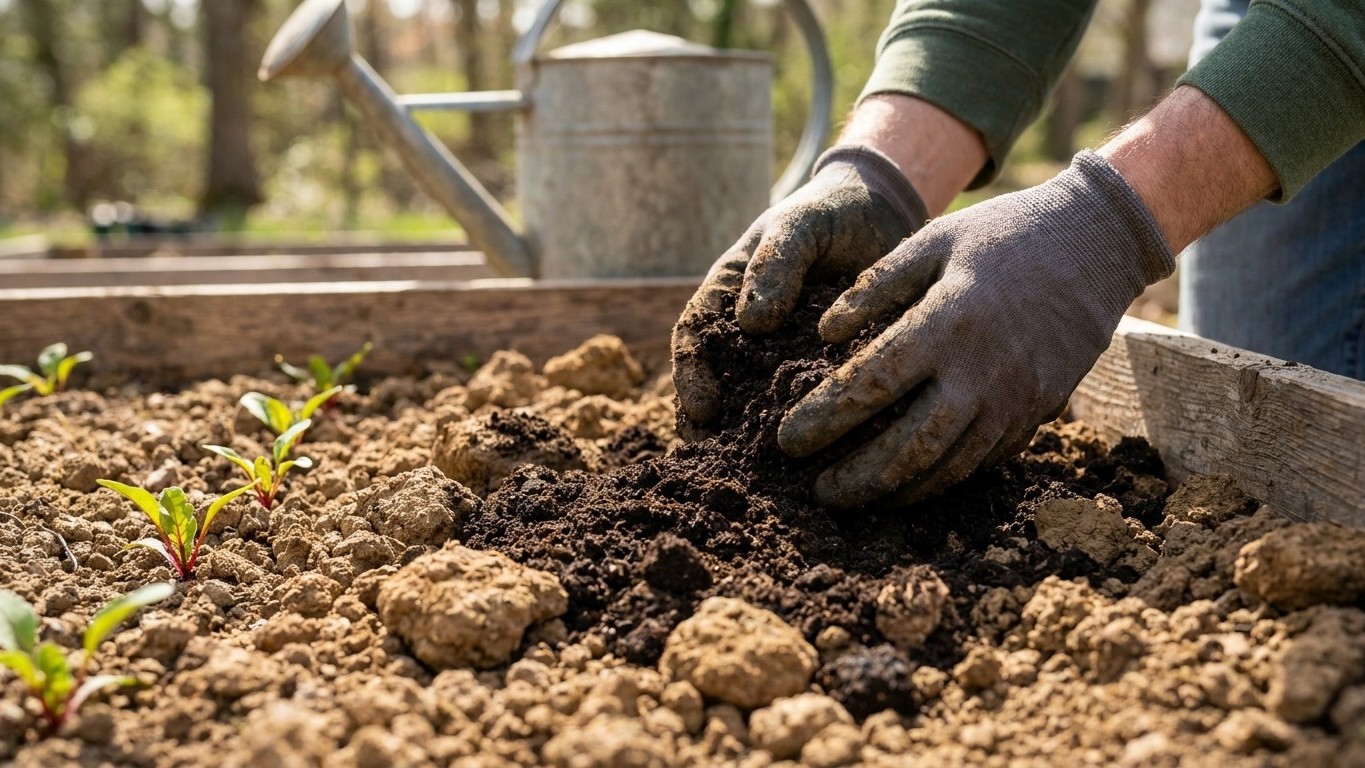

Beets do fine in most Ohio gardens once two things line up: sowing early enough that the roots form before summer heat sets in, and enough steady moisture in the first six weeks that the plant doesn’t flower instead of building a root. The state’s benchmark soil is workable but not naturally beet-ideal, which means amendment and timing matter more here than soil chemistry alone.
The short answer
Ohio’s representative soil, the one the USDA NRCS State Soils program lists as standing in for the state, is the Miamian series: an Alfisol, a forest soil of moderate fertility that holds nutrients reasonably well. Its surface horizon runs about 26 percent sand, 20 percent clay and 53 percent silt, a loam-to-silt mix, with a pH around 6.5 (slightly acid) and organic matter near 2.0 percent. It’s well drained. Those numbers come from USDA NRCS Soil Data Access, pulled from 401 mapped components of the series, and they form the baseline for understanding Beet Soil in Ohio.
Set that against what a beet actually wants. Utah State University Extension describes the ideal beet bed as deep, sandy, well-drained soil rich in organic matter. Miamian clears the drainage bar easily enough, but it’s silt-heavy rather than sandy, and its 2.0 percent organic matter sits well below “rich.” That gap doesn’t rule beets out. It just means the compost step isn’t optional the way it might be on a naturally loose, humus-heavy garden bed. USU caps the fix at 1 inch of composted organic matter per 100 square feet, worked into the top layer before seeding, not piled on top of it.
The heat side of the equation is where the risk changes character. USU is specific that woodiness sets in when temperatures climb above 85 F while the plant is also short on water. Ohio summers routinely spend stretches in that range, particularly in July and August, though the exact count of days above any given threshold isn’t part of the sourced record here. What matters for a gardener is the sequence, not the tally: a beet that’s already stressed for water when a hot stretch arrives is the one that turns fibrous underground.
None of this is a diagnosis of any one backyard. Ohio spans hundreds of mapped soil series, and a bottomland garden near a creek, a hillside plot, or a yard built on fill dirt from a subdivision can differ completely from the Miamian numbers above. Treat the state soil as a starting point for what the region’s ground tends to do, then confirm your own texture and pH with a soil test before you plan the bed.
The six weeks that decide it here
Beets are sown directly in place, never transplanted, and the standard advice is to get seed in the ground 2 to 3 weeks ahead of the last frost, a timing question covered in detail in When to Sow Beets in Ohio. Ohio State University Extension’s Ohio Gardening Calendar puts the last spring frost, for zone 6a, between May 5 and May 15. Working backward from that, most of the state is seeding beets sometime in mid to late April, which means the first six weeks of a beet’s life, the window USU flags as the make-or-break stretch for bolting, land squarely in an Ohio spring.
That’s a season with a known personality: it swings. April and May in Ohio can deliver a soggy cold snap one week and a dry, windy stretch the next, sometimes within the same month. Neither extreme by itself is the problem. What causes trouble is the dry stretch landing on a bed that was seeded but never got a follow-up watering schedule, because the seedling doesn’t show above ground for a while and it’s easy to assume it doesn’t need attention yet.
USU’s finding is specific on this point: water stress during those first six weeks is what triggers premature flowering, the failure gardeners call bolting. A bolted beet stops building a root and puts its energy into a flower stalk instead, and there’s no reversing it once it starts. That makes the Ohio spring’s habit of drying out unpredictably, right after a wet spell, the exact condition that catches beet growers off guard. A bed that looks fine because it was soaked ten days ago can already be dry enough at the root zone to matter.
The practical takeaway is less about total rainfall and more about consistency through that specific window. A spring that’s evenly damp start to finish and one that alternates soggy and parched can add up to the same total inches of rain, yet only one of them stresses a beet seedling.
What goes wrong here
- Surface crusting after a hard rain. The Miamian series’ silt-heavy texture (53 percent silt) can cap over and form a crust once it dries after a downpour, which slows or blocks a beet seedling trying to push through. Keep the seedbed loose at sowing and break up any crust gently with a rake tooth or a light scratch of mulch before germination is due.
- Organic matter below what a beet wants. At roughly 2.0 percent organic matter, the state’s representative soil sits under the “rich in organic matter” mark USU sets for beets. Work in compost ahead of sowing, but hold to the USU limit of 1 inch per 100 square feet; more than that isn’t shown to help and changes the bed’s structure in ways that can work against a root crop.
- A dry stretch inside the first six weeks after seeding. This is the bolting trigger, distinct from anything that happens later in the season. Set a watering reminder for the first six weeks specifically, rather than trusting rainfall totals, since an Ohio spring can look wet on paper and still deliver a dry week right when the seedling is most vulnerable.
- Heat arriving on top of a thirsty root later in summer. This is a separate failure from bolting: it produces a tough, fibrous root rather than a flower stalk. Once temperatures push past 85 F, keep watering deep and steady, and mulch to buffer soil temperature, since it’s the combination of heat and drought, not heat alone, that toughens the root.
Checking this against your own county
Everything above starts from a single representative soil series and a single reference climate window. Your yard may match that closely, or not at all, depending on whether it sits on a floodplain, a hillside, or ground that’s been graded and filled at some point. The way to find out is a soil test through your local Ohio State University Extension office, part of the statewide network. County offices can also confirm the local frost window, since a date that works for zone 6a may run a week or more earlier or later depending on where in the state you garden. That’s a cheap, fast way to replace a statewide starting point with a number that actually describes your bed.
Common questions
How long do beets take to mature in Ohio, counting from seed?
Beets are sown directly in the garden, not started as transplants, so the maturity clock starts at seeding. Most garden beets run 60 to 80 days from seed to harvest, which in Ohio means a mid to late April sowing can be ready sometime in the middle of summer, well ahead of the hottest stretch of the season.
Why did my beets bolt instead of forming a root?
Bolting is triggered by water stress during the first six weeks after seeding, according to Utah State University Extension. If that window landed on a dry spell, even a short one, the plant likely shifted its energy into flowering rather than root growth. It isn’t reversible once it happens, so the fix is timing the next sowing’s early watering more consistently rather than trying to correct the current bed.
Should I till compost into Ohio’s clay-loam soil before planting beets?
Generally yes, given that the state’s representative soil runs about 2.0 percent organic matter, below what USU considers ideal for beets. Work it in before sowing rather than topping the bed afterward, and hold to no more than 1 inch of composted organic matter per 100 square feet, the ceiling USU sets for this crop.
When is the best time to seed beets outdoors in Ohio?
The general rule is 2 to 3 weeks before the last spring frost. Ohio State University Extension’s Ohio Gardening Calendar lists the last frost for zone 6a as falling between May 5 and May 15, which puts most seeding dates somewhere in mid to late April, though a county-level extension office can narrow that further for a specific location.