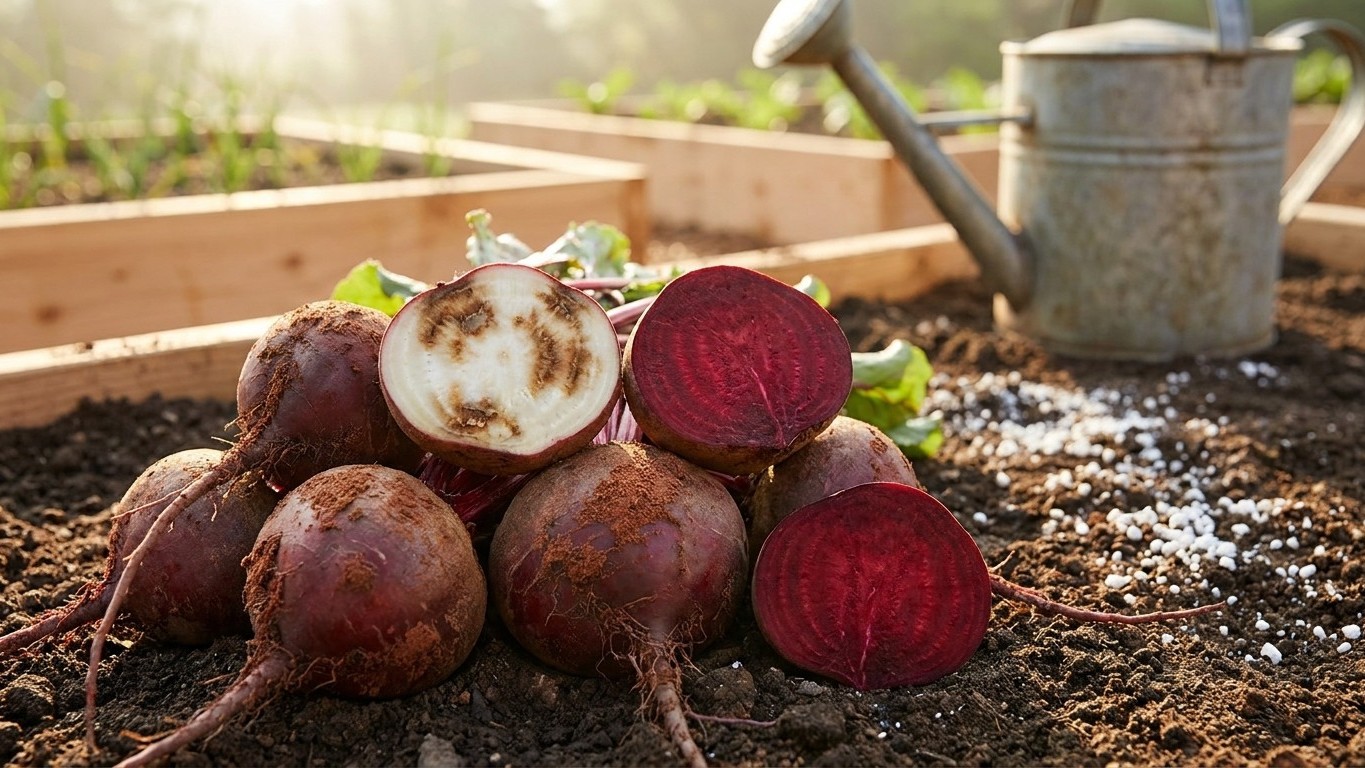

Prince Edward Island’s farmland leans acidic, sandy, and only fair at draining, which pushes beet growing toward raised beds, lime, and steady watering rather than the deep, moisture-holding loam beets prefer by default. Sowing timing around the Island’s late, unreliable frost date matters just as much as the dirt itself.
The short answer
Most of Prince Edward Island’s mapped farmland sits on Podzol, the acid, leached soil order that forms under conifers once rain has stripped the bases out of the topsoil. It covers 33 percent of the mapped surface, more than any other order on the Island, with Gleysolic ground running second. The median surface pH across those mapped soils comes in at 4.8, which is strongly acid, well below the near-neutral range beets actually want. Texture leans sandy too: 66 percent sand, 27 percent silt, and just 7 percent clay, with organic matter around 2.2 percent and drainage rated imperfect rather than good.
For a beet, that combination cuts two ways. Sandy, low-clay ground drains fast and warms early in spring, which beet seed appreciates at germination. But the same texture holds little reserve water between rains, and imperfect drainage means low spots can still sit wet after a heavy rain even while the beds ten feet away are already drying out. Add strongly acid soil to the mix and boron availability drops, which matters specifically for beets because a boron shortfall shows up as corky, discolored patches inside the root, not just a slow-growing top.
Utah State University Extension describes the beet’s own preference plainly: deep, sandy, well-drained soil rich in organic matter, amended with no more than 1 inch of composted organic matter per 100 square feet. Island ground matches the sandy and well-drained half of that description reasonably well, but falls short on organic matter and lands far outside the pH beets tolerate comfortably. That gap is the real story of growing beets here: not a soil that refuses beets outright, but one that needs its acidity corrected and its moisture managed before it behaves like the bed Utah State is describing.
Heat is a smaller worry on the Island than it is inland. Prince Edward Island’s maritime setting keeps summer temperatures moderate, and no count of days above 90°F for the province is published in the sources behind this page, so that figure won’t be guessed at here. What the source data does support is the acidity and drainage picture, and that’s the more useful number for a gardener planning beds this season.
None of this describes any one garden exactly. Prince Edward Island’s agricultural soils span hundreds of mapped series, from well-drained sandy loams to poorly drained clay pockets near watercourses, and the Podzol figures above are a province-wide median, not a reading from any particular yard. Treat them as the starting assumption to test against, not the final word on what’s under your own Beet Soil in Prince Edward Island.
The six weeks that decide it here
Beets are sown directly in the ground, never transplanted, and the standard advice is to get seed in 2 to 3 weeks ahead of the last spring frost. On Prince Edward Island, that frost date averages May 16 at the Charlottetown A station, based on the 1981-2010 climate normals from Environment and Climate Change Canada. That puts a typical sowing window in late April to early May, which means the first six weeks of root development, the stretch that decides whether a beet bolts or grows on normally, plays out through an Island spring that’s still cool, often damp, and prone to fog rolling in off the water.
That average frost date deserves a caution of its own. It’s a mean, not a safe cutoff: in roughly one year out of two, frost arrives later than May 16, sometimes well later. A gardener who sows by that single date alone is playing the wrong odds about half the time. Charlottetown A is also one station on an island where inland and northern districts routinely run behind the coast in spring warmth, so a garden even a short drive from Charlottetown may still be carrying frost risk after the provincial average has passed.
Where does bolting risk sit inside that window? Utah State University Extension is specific: water stress during the first six weeks after sowing is what triggers beets to flower prematurely instead of building a root worth harvesting. On the Island’s sandy, low-organic-matter, imperfectly drained ground, that risk shows up less from drought (rain is rarely scarce for long stretches) and more from short dry spells between rain events, when sandy topsoil dries out in the top few inches faster than a gardener expects. A week of sunny, breezy weather in late May, common enough on the Island once the fog lifts, can dry that shallow root zone even while the calendar still says “cool spring.”
The practical takeaway is timing discipline rather than heat management at this stage. Sow into the 2-to-3-week-before-frost window, expect the frost date itself to shift later almost as often as not, and treat any dry stretch in those first six weeks as the moment that decides bolting risk, not a later heat wave.
What goes wrong here
- Bolting from a dry spell right after sowing. Sandy, low-organic-matter soil loses surface moisture fast, and Utah State University Extension ties any water stress in the first six weeks directly to premature flowering. Remedy: check soil moisture in the top two inches every few days through that window and water before it dries out completely, rather than waiting for wilted leaves as the signal.
- Corky, discolored roots from acid soil locking out boron. With a median surface pH of 4.8 across the Island’s mapped farmland, boron availability runs low even where the nutrient is technically present in the soil. Remedy: get a soil test done and lime toward neutral pH if the test confirms strong acidity; don’t guess at lime rates without one.
- Waterlogged low spots despite generally sandy ground. Imperfect drainage means water can still pool in depressions after a heavy rain, even on soil that’s mostly sand. Remedy: build beds slightly raised or mounded in any spot known to hold water, so the root zone drains between rains instead of sitting saturated.
- Woody roots from a hot, dry stretch later in the season. This is a separate failure from early bolting: Utah State University Extension notes that heat above 85°F combined with water stress toughens the root’s texture rather than making the plant flower. Remedy: keep watering consistent through any hot spell in mid to late summer, independent of whatever watering routine was used in the first six weeks.
- Thin, unimproved topsoil limiting root depth. At roughly 2.2 percent organic matter, Island soil offers less structure and moisture-holding capacity than the deep, rich bed beets prefer. Remedy: work in composted organic matter ahead of sowing, capped at 1 inch per 100 square feet per Utah State University Extension’s guidance, rather than over-amending in one pass.
Checking this against your own county
The Podzol figures above describe the Island’s mapped farmland as a whole, not any one lot, and a garden on old marine clay near a river or on filled ground near a building site can differ from that median entirely. Before amending pH or building raised beds on assumption alone, get a soil test done for the actual plot in question. The Prince Edward Island government’s agriculture program, reachable through its agriculture topic page, is the right starting point for testing services and current guidance specific to the province.
Common questions
Do I need to lime my soil before growing beets on Prince Edward Island?
Likely yes on unimproved ground, given that the province’s mapped farmland runs strongly acid at a median pH of 4.8, well below what beets need for good boron uptake. Confirm with a soil test first rather than liming on assumption, since garden soils can vary widely from that provincial median.
When should I sow beets if the last frost date keeps shifting?
Sow 2 to 3 weeks before the average last frost date of May 16, but treat that date as a midpoint, not a guarantee: frost arrives later than average in roughly half of all years at the Charlottetown A station, so a spare row cover on hand for a late cold snap is a reasonable precaution.
Is bolting the same problem as woody roots?
No. Bolting comes from water stress in the first six weeks after sowing and causes premature flowering instead of root growth. Woody texture comes later, from heat above 85°F combined with water stress during the growing season. They call for the same fix, consistent watering, but at different points in the season.
Why does sandy Island soil still need careful watering if it drains well?
Good drainage and moisture retention aren’t the same thing. At 66 percent sand and only 2.2 percent organic matter, the province’s typical soil sheds excess water quickly but also holds little reserve moisture in the root zone, so short dry spells dry it out faster than a denser, richer soil would.