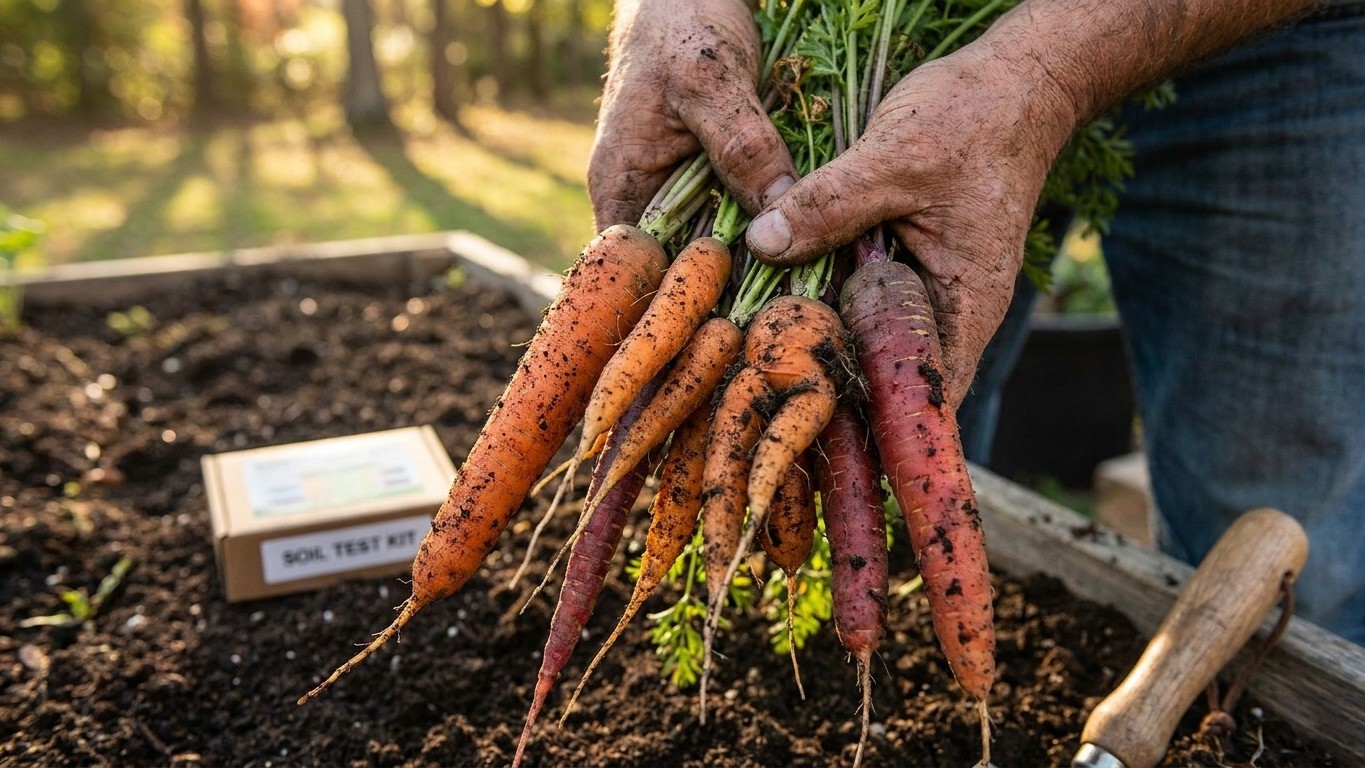

Virginia’s benchmark soil, the Pamunkey series, runs 50 percent sand and only 11 percent clay, well drained and slightly acid. That mix leans favorable for carrots, but it describes one mapped series, not your backyard. Whether roots grow straight or fork comes down to your own dirt: its clay content, its stones, its drainage. Test it, amend it if it needs work, and consult When to Sow Carrots in Virginia to time your planting 2 to 3 weeks ahead of your local last frost for a straight, sweet crop.
The short answer
USDA’s representative soil for Virginia is the Pamunkey series, an Alfisol, which is the technical term for a forest soil of moderate natural fertility that holds onto nutrients reasonably well. The surface horizon runs about 50 percent sand, 11 percent clay and 39 percent silt, a loam to silt loam texture, with a surface pH near 6.2 (slightly acid) and organic matter around 1.2 percent. The drainage class is well drained. That data comes from USDA NRCS Soil Data Access, averaged across 26 mapped components of the series.
Put that texture next to what carrots actually need. Utah State University Extension’s guidance on carrots is blunt: the crop wants deep, sandy, well-drained soil rich in organic matter, and heavy or rocky ground makes the root fork as it pushes against resistance instead of growing straight down. Judged against that standard, Pamunkey’s numbers read favorably, and the broader question of Will Carrots Fork in Virginia Soil? tends to hinge on exactly these factors. Eleven percent clay is low, sand is the dominant fraction, and the drainage class is already well drained, so the physical structure a carrot needs to grow long and straight is mostly already there.
The organic matter figure is the weak point. At roughly 1.2 percent, this surface soil is thinner in humus than the rich, loose bed carrots prefer, which matters less for forking and more for root size, flavor and how easily the soil crumbles around the growing taproot. The fix Utah State’s extension recommends for less-than-ideal ground is plain: work in compost generously and double dig the bed, loosening and enriching soil a full spade’s depth or more, so the root meets no resistance and no nutrient gap on its way down. Where garden ground runs even heavier than the state benchmark, thick clay, compacted subsoil, a yard full of construction fill, a raised bed filled with a loose, stone-free mix sidesteps the problem instead of fighting it.
None of this is a diagnosis of any particular garden. Virginia spans hundreds of mapped soil series, from river-bottom silt to mountain clay to sandy coastal plain, and a builder’s grading equipment can rearrange decades of topsoil in an afternoon. The Pamunkey figures are a starting point for what the region’s ground tends to do, not a stand-in for a soil test on your own bed.
The test that settles it in your own garden
State averages describe a mapped series, not the twelve feet of dirt behind your house. The only way to know what you’re actually working with is to look at it yourself, with a spade and a bit of patience.
- Dig a hole in the bed you plan to sow, going down as deep as your spade allows, then keep working with a trowel until you hit solid rock, hardpan, or dense subsoil you can’t easily break apart by hand.
- Note how deep you got before hitting that resistance, and pull out any stones as you dig. Carrots need clear, unobstructed room the full length of the root, and a buried rock a few inches down is enough to split a root around it.
- Take a handful of soil from partway down the hole, dampen it slightly, and squeeze it between your fingers into a ribbon. Sandy soil feels grainy and won’t hold a shape at all. Clay squeezes into a long, slick ribbon that holds together. Loam sits between the two, forming a shape briefly before it crumbles apart.
- Fill the hole with water and watch what happens. Water that soaks in and disappears steadily tells you the bed drains. Water that sits and pools for a long stretch tells you the ground stays soggy, which encourages rot rather than root growth and points toward raised beds or heavy compost amendment.
- Repeat the test in more than one spot in the yard. Soil composition can change within a few feet of the same property, especially near foundations, driveways, or anywhere fill dirt was brought in during construction or landscaping.
When to sow here
Carrot seed goes straight into the ground. There’s no seed tray, no transplant date, no hardening-off period, so every date below counts from the day seed goes into soil, not from any indoor start.
- Start with your last frost date. NOAA’s 1991-2020 climate normals put coastal Virginia Beach’s last spring freeze between March 20 and April 3, based on station USW00013769 at NAS Oceana. That’s the mild edge of the state. Inland ground, especially the Blue Ridge and southwest Virginia, holds frost weeks later, so treat this window as a coastal benchmark, not a statewide date.
- Count backward from whichever last-frost date applies to your area. Carrot seed goes into the ground 2 to 3 weeks before that date, so against a March 20 last frost, the sowing window opens roughly three weeks earlier, in the last days of February or the very first days of March.
- Check the soil itself before trusting the calendar. Carrot seed needs the ground at a minimum of 40 F to germinate at all. If a late cold snap keeps the soil colder than that, hold off on sowing even if the frost-based date on the calendar has already arrived.
- Aim for the temperature range where germination actually performs best, which is 55 F to 65 F soil temperature. Many gardeners get faster, more even sprouting by sowing toward the later end of that 2 to 3 week window rather than the earliest possible day.
- Remember the whole timeline runs from seed. The 70 to 100 days carrots typically need to mature are counted from the sowing date in the ground, since the crop is never transplanted and the taproot doesn’t tolerate being moved once it starts growing.
What goes wrong here
- Forking in heavy or compacted ground. Where garden soil runs heavier in clay than the sandy Pamunkey benchmark, or where it’s compacted from foot traffic and old construction, roots split and fork as they meet resistance underground. Working in compost and double digging the bed a full spade’s depth loosens the path enough for a straight root, and a raised bed filled with loose, stone-free soil solves it outright where the ground is too far gone to amend.
- Poor germination during a hot spell. Carrot seed germinates best between 55 F and 65 F soil temperature, and a sudden warm stretch can push soil well past that range, leading to spotty, uneven sprouting or seed that simply sits without germinating. Sowing earlier in the recommended 2 to 3 week window, keeping the seedbed consistently damp, and laying down a light mulch to moderate soil temperature all help.
- Splitting from uneven watering. A dry stretch followed by heavy rain or a deep watering makes roots swell too fast and crack from the inside. A steady watering schedule, and mulch to even out moisture between waterings, keeps growth rate consistent enough to avoid it.
- Thin, stunted roots from low natural organic matter. The state’s benchmark surface soil averages only about 1.2 percent organic matter, thinner than the rich, crumbly bed carrots grow best in. Working compost into the bed before sowing, regardless of the soil’s texture otherwise, addresses this directly.
Checking this against your own county
Everything above describes one mapped soil series and one weather station’s climate normals, useful as a starting point but not a substitute for local knowledge. Virginia Cooperative Extension, part of the USDA’s land-grant extension network, keeps county-level offices across the state that can pull the actual soil survey for your address, walk through frost timing specific to your elevation and region, and answer questions a state-level average can’t. Their site is ext.vt.edu, and it’s worth a look before committing a season’s seed to any single date or amendment plan drawn from statewide figures alone.
Common questions
Can I grow carrots in Virginia clay without a raised bed?
It depends on how much clay. Utah State University Extension’s guidance is that heavy soil needs plenty of compost and double digging before carrots will grow straight in it. If a soil test shows only moderate clay, that amendment approach can work. Where clay is dense and drainage is poor, a raised bed with loose, stone-free soil is the more reliable fix.
What soil pH do carrots need in Virginia?
The Pamunkey series, Virginia’s representative soil, runs a surface pH near 6.2, which is slightly acid. That’s a state benchmark figure, not a universal target, and it should be checked against a soil test of your own bed rather than assumed.
How early can I sow carrot seed in Virginia?
Sowing runs 2 to 3 weeks before your local last frost date, provided the soil itself has reached at least 40 F. Along the coast near Virginia Beach, NOAA’s climate normals put the last frost between March 20 and April 3, so sowing can begin roughly three weeks ahead of that. Inland and mountain areas run later, so the soil temperature check matters more than the calendar date.
Why do my carrots keep forking?
Forking happens when the taproot meets an obstacle it can’t grow through cleanly, most often heavy clay, compacted soil, or a stone buried in its path. Utah State University Extension points to compost and double digging as the standard fix for heavy ground, with a raised bed as the alternative where soil is too compacted or rocky to loosen effectively.