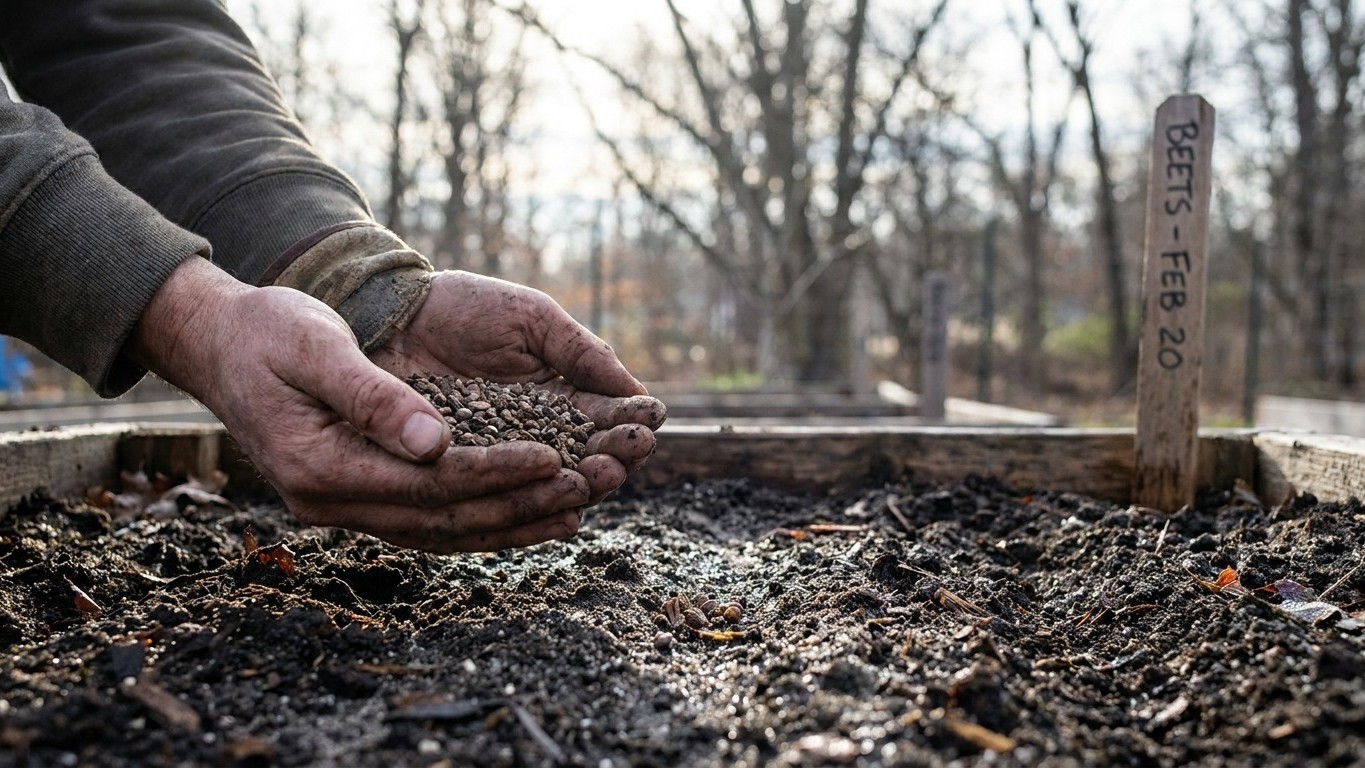

In Delaware, the safe window to sow beets runs from about three weeks before the last spring frost through early April, with succession sowings possible into summer for a fall crop. At the reference weather station, the last spring freeze falls between April 3 and April 14, which pushes the earliest sowing date into mid to late March for most of the state. Your own county may run later.
The short answer
Delaware’s official state soil, the Greenwich series, is an Ultisol, the kind of old, heavily weathered and leached ground that dominates much of the mid-Atlantic coastal plain. It runs acid, naturally low in nutrients, with a surface pH around 6.0. Texturally it sits in the loam-to-silt range: 48 percent sand, 9 percent clay, 43 percent silt, and it drains well. Organic matter in the mapped surface horizon averages about 1.7 percent, which is thin. The Delaware General Assembly named Greenwich the state soil in 2000, and USDA NRCS records these figures as representative values across the eleven major components sampled for the series.
For a beet, that combination is a mixed bag. Beets want deep, sandy, well-drained soil rich in organic matter, and Greenwich’s sand-silt balance and good drainage line up reasonably well with that description. The organic matter figure does not. At 1.7 percent, the native surface is on the lean side for a root crop that rewards a loose, fertile bed, which is why Utah State University Extension recommends working in composted organic matter, capped at roughly 1 inch per 100 square feet, rather than piling it on. Too little and the roots stay small and fibrous. Too much nitrogen-rich compost, and beets tend to put energy into leaves instead of the root.
On the heat side, no daily-temperature count for how many days a Delaware city spends above 90 degrees is published in the sources behind this page, so that specific number isn’t given here. What is documented is the threshold that matters most for beets: once temperatures climb past 85 degrees and the plant is also short on water, the root turns woody and loses the tender texture gardeners are after. That single fact should shape when you stop sowing for a spring crop, more than any general sense of how hot Delaware summers get.
None of this is a substitute for testing the dirt in your own yard. Delaware, like every state, spans hundreds of mapped soil series. Greenwich is the one chosen to represent the state, not a guarantee about what’s under your raised bed, your rental’s back corner, or a lot that a builder graded and refilled a few decades back. Treat these numbers as the regional tendency, then pull your own soil sample before you plant.
The six weeks that decide it here
Sowing beets 2 to 3 weeks ahead of the last frost date puts the first six weeks of the crop’s life inside a fairly predictable stretch of the Delaware calendar, starting roughly in mid-March and running into early May for most of the state. Those six weeks are the ones that make or break the root, because beets sown in place carry no transplant buffer. Whatever the soil and sky do during that stretch happens directly to the seedling.
Mid-Atlantic spring in this window tends to swing rather than settle. Cold fronts and warm-up stretches trade off through March and April, which means soil moisture can move from saturated to dry and back again in the span of a couple of weeks. That volatility matters more for beets than for many vegetables, because water stress in those first six weeks is the direct trigger for premature flowering, known as bolting. A beet that bolts stops building a usable root and puts its energy into a seed stalk instead. Once that switch flips, there’s no reversing it for that planting.
The practical risk in Delaware isn’t a single dry month. It’s the short, sharp dry spell that follows a wet front, catching a bed that looked fine a week earlier. Because the Greenwich series and similar coastal-plain soils in the state drain well, they don’t hold surface moisture long after a storm passes, which raises the odds that a bed looks dry again within days of a soaking rain. Checking soil moisture by hand, rather than relying on the calendar or the last time it rained, is the more reliable habit here.
The other edge of the six-week window sits closer to early May, when average temperatures start climbing toward the range where heat, not cold, becomes the concern. Sowing right at the early end of the 2-to-3-week-before-frost range, rather than waiting until the frost date has passed, buys the crop more of its early growth in cooler soil and less exposure to the heat-driven woodiness that shows up later in the season.
What goes wrong here
- Sowing into a bed that never got tested. Greenwich series numbers describe a mapped state soil, not your garden. If your bed sits on fill, on a river-bottom deposit, or on ground with more clay than the coastal-plain norm, drainage and pH can differ enough to change how beets grow. Pull a soil test before amending, rather than assuming a pH near 6.0.
- Letting the bed dry out during the first six weeks. This is the single biggest cause of bolting in the region’s swinging spring weather. A well-drained, sandy-silt soil like Greenwich sheds moisture fast after rain, so beds can go from wet to dry within days. Check soil moisture by hand every few days through that window instead of trusting the last rainfall.
- Sowing too late and hitting the 85-degree threshold with a thirsty bed. Woodiness in the root comes from heat above 85 degrees combined with water stress, a separate failure from bolting and one that shows up later in the season, typically with sowings pushed into late spring or early summer. Keep late sowings watered consistently rather than assuming a hot spell will pass quickly.
- Over-amending a naturally lean soil. Greenwich’s surface organic matter runs around 1.7 percent, thin by garden standards, which tempts gardeners to load on compost. University guidance caps composted organic matter at about 1 inch per 100 square feet; heavier applications tend to push leafy growth at the root’s expense.
- Ignoring how well-drained ground handles a dry stretch. Because the coastal-plain soils common in Delaware drain freely, they don’t store reserve moisture the way a heavier clay soil might. That means missed watering during a warm week hits beets here faster than it would in a slower-draining soil elsewhere.
Common questions
What’s the earliest safe date to sow beets in Delaware?
Counting back 2 to 3 weeks from the reference station’s last-frost window of April 3 to April 14 puts the earliest sowing in mid to late March for that location. Inland and northern parts of the state, and any spot at higher elevation, typically see their last frost later, so pushing the date back further is the safer call if you haven’t checked your own county’s pattern.
Do I need to worry about the exact pH of the Greenwich soil series?
Not directly, unless your own garden happens to sit on ground that maps to that series. The pH of 6.0 recorded for Greenwich describes the state soil’s mapped surface horizon, not a number you should apply to your own bed. A soil test is the only way to know what you’re actually working with.
How long does it take for beets to be ready after sowing in Delaware?
Beets sown in place generally run somewhere in the 60-to-80-day range to reach harvest size, counted from the seeding date rather than from any transplant, since beets aren’t started indoors and moved. That window gives you a rough way to plan a spring sowing against the arrival of summer heat.
Can I sow beets again later in the season for a fall harvest?
Succession sowing through summer is common practice for beets, provided the bed gets consistent water so a mid-summer planting avoids the 85-degree-plus, water-stressed conditions that make roots woody. Timing a later sowing so it matures as temperatures cool again tends to produce a more tender root than one that finishes during the hottest stretch of summer.