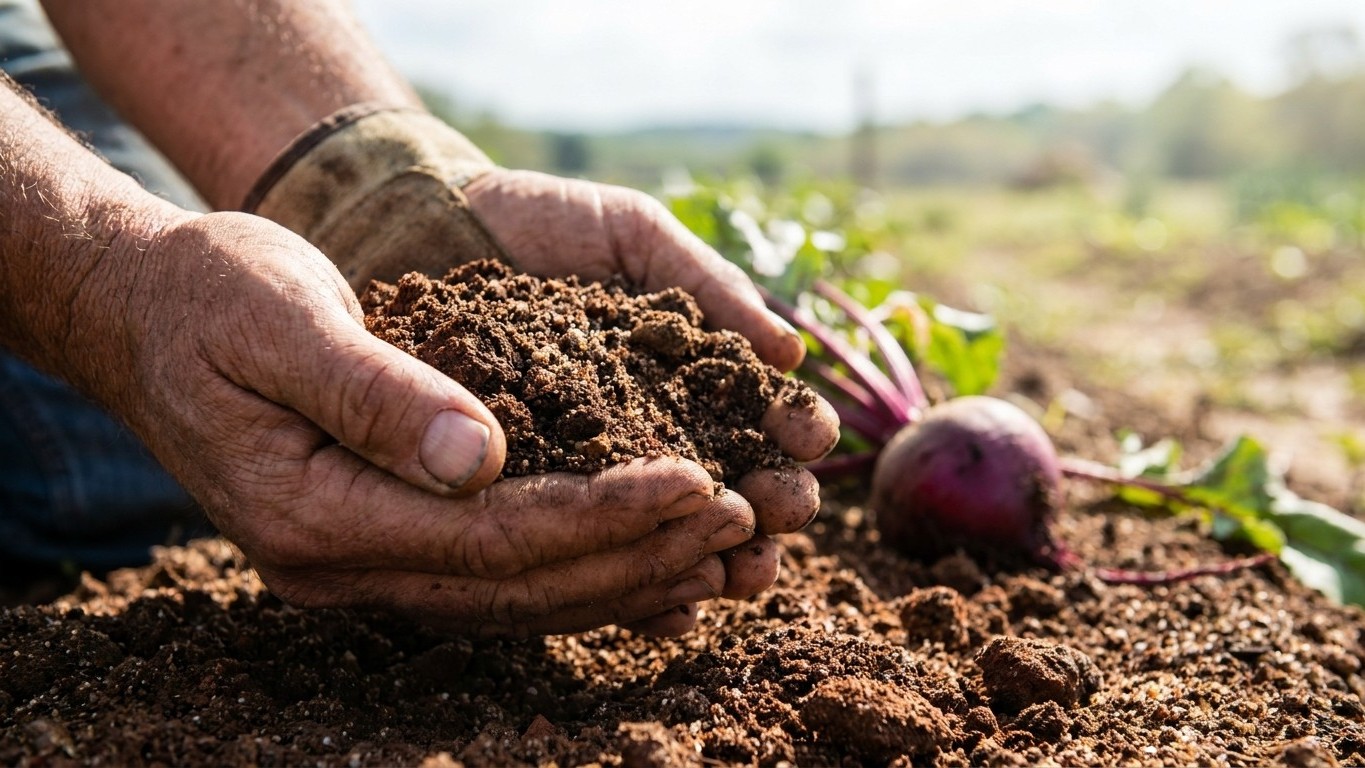

Florida’s answer isn’t a single soil at all. Statewide, ground tends to run sandy and acid, with drainage that varies by inches of elevation more than by county line. Beets want deep, well-drained soil loaded with organic matter; Florida’s official state soil gives the sand and the acid but almost none of the organic matter or reliable drainage on its own. North Florida sows into a documented spring frost window; central and south Florida never see frost worth mentioning and grow beets through winter instead. Match the soil work and the calendar to which Florida you’re gardening in, and the root has a real shot.
The short answer
Florida’s state soil is the Myakka series, a Spodosat named the official state soil by Florida law back in 1989 under the USDA NRCS State Soils programme. It’s about as sandy as soil gets: 97 percent sand, 2 percent clay, 1 percent silt in the surface horizon, with organic matter around 2.0 percent and a surface pH near 5.1, which is strongly acid. It’s also classed as poorly drained, a detail that surprises people who assume sand always drains fast. Myakka soils sit over a hardened, cemented layer below the surface, so water moves through the sandy top quickly and then stalls, which is exactly the kind of ground that a spodosol under pine forest, not a vegetable bed, was built to describe.
For a beet, that combination cuts two ways. The sand is close to what the crop wants, since beets do best in deep, sandy, well-drained ground. The acidity and the thin organic matter are not what the crop wants, and neither is a soil that can perch water in a wet spell and dry out fast the moment rain stops. A beet root pushing down through 97 percent sand with only 2 percent organic matter has almost nothing to buffer it against a dry week, and the strongly acid pH sits well below where beets grow their best roots.
Heat adds a second layer to the problem. The Utah State University Extension guidance on beets is specific that heat above 85 F combined with water stress is what turns a root woody, a separate failure from the early bolting that dry stress can trigger in the first six weeks. Florida summers push well past that 85 F line for long stretches, though the exact count of days a reference Florida city spends above 90 F isn’t a figure this page can put a number on; it isn’t published in the sources behind this article, so treat “long, hot summer” as the honest description rather than reaching for a stat that isn’t there.
None of this describes any one garden precisely. Florida spans hundreds of mapped soil series, and river bottoms, old citrus ground, fill dirt behind a new subdivision, and a backyard raised bed can all differ completely from the Myakka profile and from each other. The state soil is a starting point for what the region’s ground tends to do, not a stand-in for a soil test pulled from an actual bed.
The six weeks that decide it here
Beets are sown directly in place, not started indoors and transplanted, and the standard timing is 2 to 3 weeks before the last expected spring frost. That detail matters because it fixes exactly where the crop’s most fragile stretch, the first six weeks after seeding, falls on the calendar, and Florida’s calendar isn’t one thing.
In north Florida, using the Jacksonville-area station as the reference point, NOAA’s 1991-2020 Climate Normals put the last spring freeze somewhere between February 16 and March 7, based on the 30 to 70 percent freeze-probability band. Sowing 2 to 3 weeks ahead of that window lands the first six weeks of a beet crop’s life in late winter and very early spring, a stretch that swings between cold snaps and the season’s first warm, drying days. Sandy, fast-draining topsoil doesn’t hold a reserve through those swings, so a week without rain during that window is exactly the kind of water stress that Utah State’s guidance flags as the trigger for premature flowering, or bolting, well before the root has sized up.
Central and south Florida don’t get this window at all. Those regions run effectively frost-free, and the caution attached to the Jacksonville frost dates is direct on this point: never apply a north Florida frost calendar to Orlando or Miami. In the frost-free two-thirds of the state, the growing calendar flips. Beets go in through the cooler months, and the crop’s hard season becomes summer, when heat, not frost, is the threat that never lets up.
| Factor | North Florida (Jacksonville reference) | Central & South Florida |
|---|---|---|
| Last spring frost | February 16 to March 7 (NOAA NCEI normals) | Effectively frost-free |
| First six weeks after sowing | Late winter into early spring, cold-to-warm swing | Falls within a winter-season sowing window instead |
| Hardest stretch of the year | Summer heat after frost season ends | Summer heat is the primary limiting season |
Three of the thirty years behind the Jacksonville normals saw no freeze at all, which is a reminder that even the north Florida window is a probability band, not a guarantee, and that the airport station sits inland rather than on the coast.
What goes wrong here
- Bolting from a dry stretch in the first six weeks. Sandy topsoil like Myakka’s surface horizon holds almost no reserve, so a rainless week right after sowing is enough to trigger the water stress that pushes beets to flower early instead of building root. Water on a set schedule through that first six-week stretch rather than waiting for the soil surface to look dry.
- Woody roots from summer heat. Once temperatures push past 85 F, any added water stress toughens the root’s texture. This is a separate failure from bolting, and it shows up later in the crop’s life; mulch to hold soil moisture and plan the harvest window to land before the hottest stretch rather than fighting the root through it.
- Standing water in low spots despite sandy topsoil. The Myakka series is officially classed as poorly drained because of a hardened layer beneath the sand, so water that should percolate away can perch instead. Raised beds or mounded rows lift the root zone above that stall point.
- Roots that stay thin and pale. With organic matter around 2.0 percent in the mapped surface horizon, native ground often can’t feed a beet root the way it needs. Utah State’s guidance caps composted organic matter at 1 inch per 100 square feet worked into the bed, which is enough to build fertility without over-loosening sandy soil further.
- Poor germination and stunted early growth tied to acidity. A surface pH near 5.1 is well below where beets perform best. A soil test on the actual bed, not the state average, tells you whether lime is needed and how much, since garden soil that’s been worked, amended, or hauled in can sit far from the mapped Myakka number.
Common questions
Do I need to test my own soil if I already know Florida’s state soil?
Yes. The Myakka figures describe the mapped surface horizon of an uncultivated series representative of the state, not a worked garden bed. A cultivated bed’s pH, organic matter, and drainage can differ completely, especially if it’s been amended, filled, or graded at any point.
When should beets go in the ground in south Florida versus north Florida?
North Florida sows around the documented late-winter frost window, 2 to 3 weeks ahead of the last expected freeze. Central and south Florida are effectively frost-free, so the crop shifts to a winter-season sowing window instead, avoiding the region’s punishing summer heat.
How long from sowing to harvest?
Beets are direct-sown, and the maturity clock starts at seeding, not at any later transplant date, since there is no transplant step for this crop.
Is Florida’s sandy soil actually good for beets?
Partly. The sand and drainage characteristics beets prefer are present in principle, but the state soil’s low organic matter, strongly acid pH, and tendency toward perched water in low spots all work against a beet root unless the bed is amended and tested first.