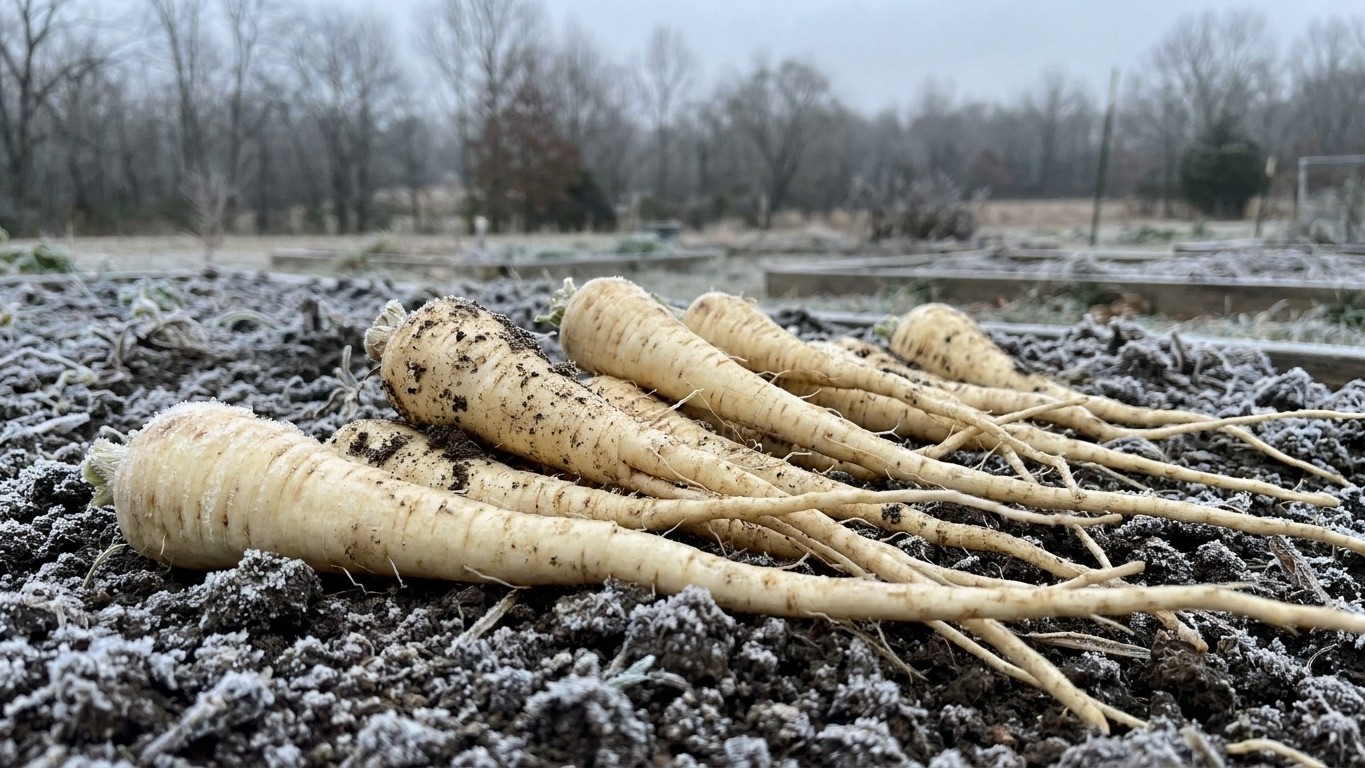

In most of Louisiana, parsnips will grow into full-sized roots without much trouble. The starch-to-sugar conversion that makes a parsnip taste sweet instead of starchy, though, depends on real, sustained cold, and that is the one thing much of this state cannot reliably deliver. South Louisiana gardeners can expect a decent parsnip. A genuinely sweet one is a coin flip at best.
The short answer
Everything here turns on one question: does this territory hand a parsnip several frosty weeks before you dig it? Not a mild chill. Not a cool snap. Repeated nights at or below freezing, the kind that stresses the root into converting stored starch into sugar. That is the mechanism, and it is separate from whether the plant survives the winter at all.
At the reference station near New Orleans, NOAA’s 1991-2020 Climate Normals put the mean daily minimum of the coldest month at 46.1°F. That is not a record low and not a seasonal average, it is the typical overnight low during January, the coldest stretch of the year. A mean minimum of 46.1°F sits fourteen degrees above freezing. In an ordinary January, most nights in this part of the state simply do not touch 32°F, let alone stay there long enough to sweeten a root sitting in the ground.
That number changes the answer for south Louisiana specifically. A parsnip sown, grown, and left in this soil through the cold season will almost certainly bulk up into a normal, edible root. It will not reliably pick up that nutty sweetness that makes gardeners in colder states bother growing parsnips at all. The starch stays starch when the cold does not show up in force, and 46.1°F as a mean minimum tells you the cold, most winters, does not show up in force.
North Louisiana is a different climate story than the New Orleans-area station these normals describe, and it sees more reliable freezing weather over the course of a winter. No verified mean-minimum figure for a northern parish appears in the data behind this page, so nothing here should be read as a number for that region. What can be said plainly is that a gardener in the Florida Parishes or along the Gulf Coast is working with a much narrower cold margin than a gardener near Shreveport, and the sweetening odds shift accordingly.
So the honest short answer for the majority of Louisiana, particularly the southern half: the plant will grow, the sweetening is not guaranteed, and a mild winter here is not a failure of your gardening, it is just the climate doing what it does most years.
Does the season fit?
- The rule. Parsnips are sown directly in place, never transplanted, and Utah State University Extension puts the timeline at 100 to 120 days from that seeding to a harvestable root, with sowing meant to happen two to three weeks before the last frost.
- Germination alone eats three weeks. Parsnip seed is slow, taking 14 to 21 days just to break the surface. A gardener who does not know this often assumes a failed sowing and re-seeds bare rows that were about to come up anyway.
- This territory’s last frost is unusually late in the calendar sense. NOAA’s 1991-2020 Climate Normals put the last spring 32°F freeze between January 18 and February 8 at the reference station, using the 30 to 70 percent probability band. That means sowing two to three weeks ahead of it lands in late December or early January.
- The fall frost side mirrors it. The first fall freeze, by the same NOAA normals and the same station, falls between December 17 and January 8. Put the two dates together and the entire freeze season is squeezed into roughly six to eight weeks that straddle the New Year.
- The frost-free window, by contrast, is enormous. From early February to mid-December, this station sees essentially no freezing weather at all in a typical year. Counted out, that is close to ten months of frost-free ground, far longer than the 100 to 120 days a parsnip needs to mature.
- The arithmetic verdict. On sheer day count, the season fits comfortably, there is more than enough frost-free time to grow a full-sized root regardless of when you sow. What does not fit comfortably is the freeze window itself: a 32°F freeze occurs in only 86.8 percent of years at this station, meaning roughly one winter in seven brings no freeze whatsoever. A season can be long enough and still miss the narrow, unreliable stretch of cold the crop needs for flavor.
What goes wrong here
- Forked or split roots from heavy, compacted ground. Louisiana’s clay-heavy soils, common across much of the state, resist the long, unobstructed taproot a parsnip wants to send down. Utah State University Extension recommends deep, sandy soil, or, where the native ground is heavy, double digging the bed well before sowing so the root has loose soil to grow straight through.
- Forked roots from overwatering. This is a separate cause from heavy soil, not a variation of it. Excess moisture, especially in the humid stretches of a Louisiana summer, encourages side roots and forking even in decent soil. Watering deeply but less frequently, rather than a little every day, keeps the taproot growing down instead of branching out.
- A season that runs out from the other direction: heat, not frost. Because this state’s frost-free window stretches nearly ten months, the practical limit on timing is summer heat arriving before a root sown too late has matured. Sowing to hit the 100 to 120 day mark before the hottest stretch sets in avoids a crop that stalls in July ground.
- A winter too mild to sweeten. Even a well-grown, unforked, properly timed root can come out of the ground tasting plainly starchy rather than sweet, simply because the several frosty weeks the crop wants never arrived that year. That is not a growing mistake, it is the climate reflected in NOAA’s 46.1°F coldest-month mean minimum, and no amount of soil prep changes it.
Before you pull a Louisiana parsnip crop on a sunny afternoon, know this: North Carolina State Extension’s Plant Toolbox states plainly, “All parts of this plant contain furocoumarins which can make skin sensitive to light causing burns so be sure to wear gloves, long sleeves and long pants when dealing with it.” Not the foliage alone. All parts.
What makes this risk catch people off guard is the mechanism. The burn does not come from the sap by itself. It takes sap on the skin plus sunlight afterward, a reaction called phytophotodermatitis. That combination is exactly what a harvest day produces: hands and forearms brushing against leaves and roots while pulling the crop, out in full sun, sap left on the skin for hours before anyone thinks to wash it off. The burn itself can show up later that same day or the next, well after the gardening is done, which is part of why it surprises people who assume a quick rinse afterward would have been enough.
Because the reaction needs both sap and light, the real protection happens before contact, not after. Gloves, long sleeves, and long pants during harvest and any handling of the foliage or roots keep the sap off skin in the first place, which is the only step the source actually recommends.
Checking this against your own county
Everything above comes from a single reference station’s climate normals, and Louisiana’s weather does not read the same in Shreveport as it does in Houma. Frost timing, freeze frequency, and soil texture all shift across the state’s parishes, sometimes over a fairly short distance.
For a reading specific to your own ground, the LSU AgCenter is the state’s land-grant extension service and the right first call. Their agents can speak to local freeze history, recommend soil amendments suited to your parish, and tell you whether a given winter is likely to run cold enough for a parsnip to sweeten where you actually garden, rather than at a weather station miles away. Find them at lsuagcenter.com.
A conversation with a local agent, or even a look at their published planting guidance, will tell you more about your specific soil and microclimate than any statewide average can.
Common questions
Can I still eat Louisiana parsnips if they never sweeten?
Yes. An unsweetened parsnip is starchier and milder, closer to a parsley root in flavor, and still works fine roasted, mashed, or added to soups. It simply will not have the nutty, caramelized edge frost-sweetened parsnips are known for.
Does covering the bed with mulch or row cover help it sweeten?
No. Insulating the bed protects the root from cold, but sweetening requires the root to experience frost, not to be shielded from it. Covering a bed to keep it warmer works against the process this page describes.
Is north Louisiana a better bet than south Louisiana for this crop?
Qualitatively, yes, north Louisiana sees more consistent winter freezes than the New Orleans-area station cited here. No verified mean-minimum figure for a northern Louisiana station is available in the data behind this page, so treat that as a general climate difference rather than a number to plan around.
When should I actually pull the roots for the best flavor?
Leave them in the ground through as much of the cold season as your local freeze window allows, then harvest after a stretch of frosty nights rather than right after the first light chill. In a mild winter here, that stretch may simply be shorter or absent, which is the core trade-off this page has walked through.