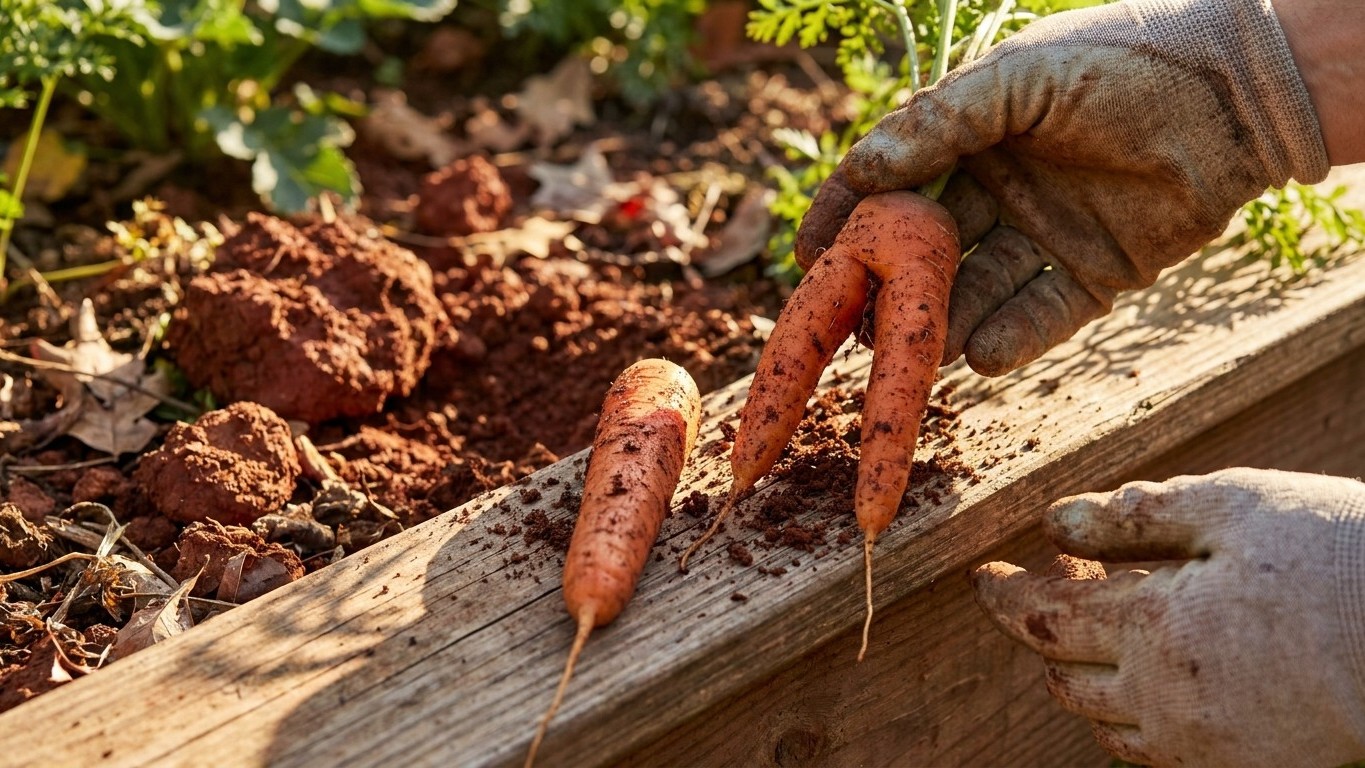

Georgia’s benchmark soil is sandy, not clay-heavy, so a straight, unforked carrot is a realistic goal in much of the state. The Tifton series, the soil USDA lists as representative for Georgia, runs 84 percent sand and only 6 percent clay, well drained and naturally acid. That texture works in a carrot’s favor. What still needs fixing is fertility: at roughly 0.8 percent organic matter, this ground needs compost before roots go in.
The short answer
The soil USDA names as representative for Georgia is the Tifton series, an Ultisol, one of those old, heavily weathered and leached soils that have sat under warm, wet conditions long enough to lose most of their natural fertility. USDA’s Soil Data Access records the surface horizon of the Tifton series’ major components at 84 percent sand, 6 percent clay and 9 percent silt, with a surface pH around 5.5, slightly acid, organic matter near 0.8 percent, and good, well-drained structure throughout.
That’s good news for anyone worried their carrots will come out of the ground looking like a wishbone. Utah State University Extension is blunt about what causes forking: heavy or rocky soil. Roots split and branch when they hit compacted clay, a buried stone, or a hardpan they can’t push through. Tifton’s 84 percent sand content means there’s little clay to compact and plenty of pore space for a taproot to grow straight down. On paper, this is closer to the loose, well-drained ground carrots actually want than a lot of Southern soils manage.
Sand alone doesn’t grow a carrot, though. The same USDA figures that clear Tifton of a forking problem also flag its weak point: organic matter sits at just 0.8 percent, and the surface runs acid. Utah State University Extension’s guidance calls for soil rich in organic matter alongside the sandy, well-drained texture, and Tifton is only halfway there. Left alone, a bed of this soil drains fast, dries fast, and starves a root crop of the steady moisture and nutrients it needs to size up evenly.
The fix isn’t a different variety or a change in planting date. It’s compost, worked in ahead of seeding, in enough volume to lift that organic matter well above its natural baseline. Gardeners on tighter, heavier pockets within the state, and there are plenty since Tifton represents one series among hundreds mapped across Georgia, get more out of double digging or building a raised bed filled with a loose, amended mix. Either approach solves the same problem: give the taproot a clear, soft path down before it ever meets an obstacle.
None of this replaces knowing your own dirt. The Tifton series is what USDA lists as representative of the state as a whole, not a survey of every backyard in it. River bottoms run heavier and wetter. Hill country and anything a builder has graded or filled can behave nothing like the mapped series. Treat these numbers as a starting point for what the region’s ground tends to do, then confirm it with a look at your own bed.
The test that settles it in your own garden
State soil surveys describe an average. Your raised bed, or the strip along the fence where the builder dumped fill dirt years back, is not an average. The only way to know if your soil will fork a carrot is to look at it yourself, before a single seed goes in the ground.
- Dig a hole where the row will go. Go down about a foot with a spade or trowel and set the soil aside in a pile so you can see the full profile, not just the surface inch that gets tilled every year.
- Check the depth and look for stones. Carrots need a clear run straight down. Anything that stops your spade, a rock, a slab of hardpan, a tangle of old roots, is exactly what will split a taproot in two.
- Feel the texture. Take a handful of moist soil and squeeze it. Sandy soil like Tifton falls apart loosely and won’t hold a shape. Clay-heavy soil rolls into a ribbon between your fingers and stays there. The more it ribbons, the more it needs loosening or replacing before you plant a root crop.
- Watch how water moves through it. Fill the hole with water and let it drain, then fill it again and time how long the second fill takes to disappear. Water that lingers for hours points to compacted or clay-heavy ground; carrots left sitting in that kind of soil are as prone to splitting and rot as to forking.
- Compare what you find to the state’s benchmark. If your soil feels close to loose and sandy with no obstructions, you’re working with something like the Tifton profile and forking risk is low. If it ribbons, holds water, or stops your spade cold, plan on compost, double digging, or a raised bed before seeding.
What goes wrong here
- Forking in heavy pockets. Not every Georgia garden sits on sandy, Tifton-type ground. Where clay content runs higher than the state benchmark, or where a hardpan sits a few inches down, roots hit resistance and split into two or three legs. Utah State University Extension’s answer is generous compost and double digging before sowing, breaking up the compacted layer so the taproot has nothing left to grow around.
- Poor germination during a hot stretch. Carrot seed is small and sits near the surface, and sandy soil like Tifton’s dries out fast once summer heat sets in. A crust can form on top before the seed ever cracks. Light, frequent watering, rather than one deep soak, keeps the seedbed workable long enough for germination to finish.
- Splitting from uneven watering. Well-drained, sandy soil sheds water quickly, which means a dry week followed by a heavy rain or a deep watering can swell a root faster than its skin can stretch, cracking it open. A steady watering schedule, rather than letting the bed dry out and then flooding it, keeps growth even and the skin intact.
- Low fertility stalling root size. At roughly 0.8 percent organic matter and a surface pH near 5.5, the state’s benchmark soil doesn’t hand a carrot much to work with on its own. Working compost into the bed ahead of planting addresses both problems at once, adding the organic matter Utah State University Extension calls for and softening some of that natural acidity.
Common questions
Does Georgia’s state soil mean my garden won’t have forking problems?
Not automatically. The Tifton series is what USDA lists as representative for Georgia, but it’s one soil series among hundreds mapped across the state. Your yard could sit on entirely different ground, especially near a river, on a hillside, or anywhere fill dirt was brought in during construction. Dig and check before assuming your soil matches the benchmark.
How many days do Georgia carrots take from seeding to harvest?
Utah State University Extension puts carrots at 70 to 100 days, counted from the day the seed goes into the ground. Carrots are sown directly where they’ll grow, so there’s no transplanting step to shift that timeline.
Should I add lime to correct Tifton’s acid pH?
The surface pH USDA records for the Tifton series runs around 5.5, slightly acid. That figure describes the mapped series, not necessarily your bed. A gardener wanting to adjust pH should test their own soil first rather than assume the state figure applies plot for plot.
Is a raised bed necessary if my soil is sandy like Tifton?
Not necessarily for texture. Sandy, well-drained soil close to the Tifton profile already gives a carrot the loose path it needs to grow straight, per Utah State University Extension’s guidance on what prevents forking. A raised bed still helps if you want to control fertility and moisture but it’s an option, not a requirement, on ground that already drains well and has few obstructions.