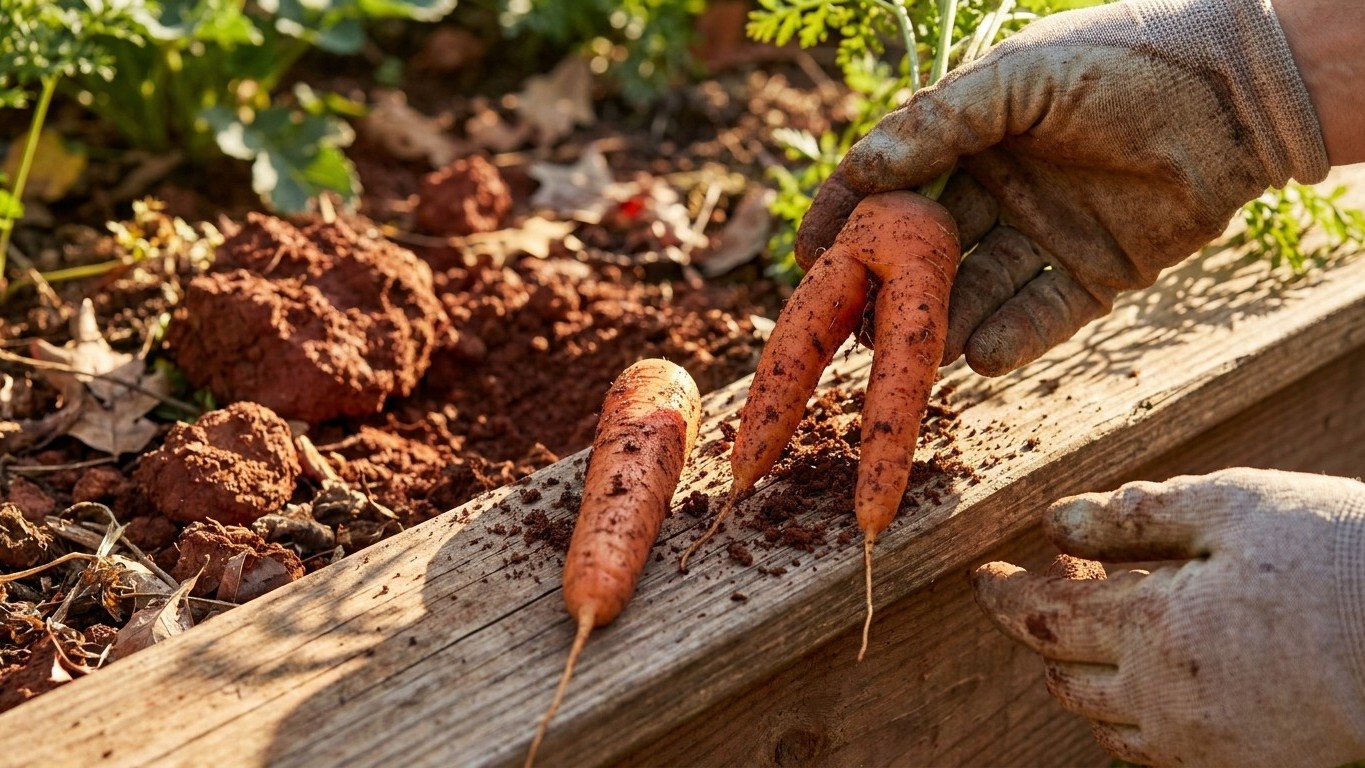

Idaho’s benchmark soil, the Threebear series, is a light volcanic-ash Andisol that holds water and phosphorus well and runs closer to silt loam than heavy clay. That texture makes forking less likely than in dense, rocky ground, but the surface layer’s strong acidity and only moderate drainage still call for compost, deep loosening, or a raised bed before you trust a carrot row to it.
The short answer
The soil USDA lists as representative of Idaho is called the Threebear series, an Andisol built from volcanic ash. That parentage matters more than the name suggests: ash-derived soils are naturally light and porous, and they hold onto both water and phosphorus in a way that heavier clay soils cannot match. The surface horizon runs 35 percent sand, 15 percent clay and 50 percent silt, which puts it in the silt loam family rather than the sticky clay loams that give carrots the most trouble. Drainage is rated moderately well drained, not the free-draining sandy loam a seed catalog would call ideal, but not the waterlogged, brick-hard ground that causes the worst forking either.
Surface pH on this series runs strongly acid, about 5.0. That is worth flagging on its own, since most root vegetables prefer a soil closer to neutral, and a pH that low can slow nutrient uptake even in soil with good texture. The organic matter figure recorded for this series is unusually high, around 75 percent at the surface. That number almost certainly reflects a natural organic layer, forest litter or a peat-like accumulation typical of an undisturbed ash-soil profile, not the crumbly, worked-in compost of a cultivated garden bed. A tilled vegetable plot will never carry organic matter anywhere near that level, so don’t read it as a promise that your dirt is already rich.
Put those pieces together and the honest answer is: a carrot planted in ground that matches the Threebear series is less prone to forking than one planted in dense clay, because the silt-loam texture and volcanic-ash porosity give roots room to push straight down. But moderate drainage plus strongly acid pH means it’s not a free pass either. According to Utah State University Extension, carrots want deep, sandy, well-drained soil rich in organic matter, and heavy or rocky soil is what makes the root fork. If a soil test on your own plot shows more clay than this series carries, or if water sits after a rain instead of moving through, the fix is the same one Extension recommends everywhere: work in plenty of compost and double dig the bed, loosening the ground a full spade’s depth so the taproot has nothing to deflect off. Raised beds filled with a sandy loam mix solve the problem outright for anyone whose native ground is heavier than the state’s representative series.
One caution belongs front and center. Idaho spans hundreds of mapped soil series, from ash-derived mountain ground to heavy river-bottom clay to whatever a builder scraped and filled before a subdivision went in. The Threebear series is the state’s representative soil in USDA’s records, not a diagnosis of your yard. It’s a starting point for understanding what the region’s ground tends to do, not a substitute for digging into your own dirt.
The test that settles it in your own garden
State-level data can only tell you what’s typical. Your garden is one plot, not a statistical average, and the fastest way to know if it will fork a carrot is to check it directly.
- Dig a hole at least 12 inches deep where you plan to sow. Carrots need that much clear depth to grow straight, so note right away if you hit a hardpan layer, buried rock, or dense clay before you reach 12 inches.
- Look at what comes out of the hole. Count visible stones and chunks of rock in the spoil pile. A handful of pebbles is normal; a shovel that keeps striking rock at 6 or 8 inches down is a sign roots will hit obstacles and split around them.
- Grab a moist handful of soil from the bottom of the hole and squeeze it. Soil that forms a slick, sticky ribbon between your fingers is clay-heavy and prone to forking. Soil that falls apart into loose crumbs the moment you open your hand is sandy and drains fast. Something in between, holding a loose shape but breaking apart with a light poke, is the loamy texture carrots prefer.
- Fill the hole back in loosely, then water it well and come back in an hour. If a puddle is still sitting on the surface, drainage is poor and roots will struggle for oxygen and tend to fork or rot. If the water has vanished into the ground, drainage is adequate.
- Repeat the dig-and-squeeze test in two or three spots around the bed. Garden soil is rarely uniform, and a low spot near a downspout can behave nothing like the raised corner ten feet away.
What goes wrong here
- Forking in heavy ground. Wherever the native soil runs heavier in clay than a silt loam, roots meet resistance and split rather than push straight down. Utah State University Extension is direct about the cause: heavy or rocky soil forks the root. Work in plenty of compost and double dig the bed a full spade’s depth before sowing, or switch to a raised bed filled with a lighter mix if the native ground won’t cooperate.
- Poor germination during a hot spell. Carrot seed is slow to sprout under the best conditions, and a stretch of hot, dry weather right after sowing can dry out the top inch of soil before the seed ever germinates. Keep the seedbed consistently moist with light, frequent watering until seedlings are up, rather than one heavy soak that lets the surface crust over between waterings.
- Splitting from uneven water. A root that grows through a dry stretch and then gets hit with a sudden heavy watering or a hard rain can crack along its length as the inner tissue swells faster than the outer skin. Even, steady moisture through the growing season, rather than a boom-and-bust watering schedule, keeps the root’s growth rate consistent enough that it doesn’t outrun itself.
- Stunted roots in acidic ground. Soil running strongly acid, in the range this state’s representative series carries, can limit how well roots take up nutrients even when the texture is otherwise fine. A basic soil test before planting will tell you if lime is worth working in, since guessing at pH from texture alone isn’t reliable.
Common questions
Do I need to till the whole bed or just the row where I’ll sow carrots?
Double digging works best across the full width of the bed, not just a narrow strip, since carrot roots spread laterally as they search for the path of least resistance. A single loosened furrow still leaves compacted soil on either side for the root to deflect off.
How long before I know if my carrots are going to fork?
You generally won’t see it until harvest, since forking happens underground as the root grows. Carrots sown in place typically reach maturity in 70 to 100 days from seeding, and that’s usually the first real look at whether the root grew straight or split.
Does adding sand to clay soil fix the forking problem?
Compost is the fix Extension names, not sand on its own. Working in organic matter improves structure and drainage together, while sand alone can create a layered soil that drains unevenly and doesn’t solve the underlying density problem.
Is a raised bed really necessary, or can I just amend the ground I have?
Either can work. Amending heavy native soil with compost and double digging is often enough if the ground isn’t extremely dense or rocky. A raised bed filled with a sandy loam mix is the more reliable route when the native soil is very heavy clay, very rocky, or drains so poorly that water still sits an hour after watering.