
Idaho’s representative state soil, the Threebear series, is a light volcanic-ash soil that drains well and holds moisture better than most, but it runs strongly acid and that acidity, not the texture, is what most often stands between a gardener and a straight carrot. Get the pH corrected and the ground stays loose enough for a clean root. That’s the short version. Your own yard may tell a different story entirely.
The short answer
The soil USDA lists as representative of Idaho is called the Threebear series, an Andisol, which is the technical name for a soil built from volcanic ash rather than the more common mix of weathered rock and river sediment. In its surface layer it runs about 35 percent sand, 15 percent clay and 50 percent silt, a texture closer to a fine loam than to anything heavy or gritty. Drainage is classed as moderately well drained, meaning water moves through it at a reasonable pace instead of pooling or racing straight past the roots. Surface pH sits around 5.0, which is strongly acid, well below the range most root vegetables prefer.
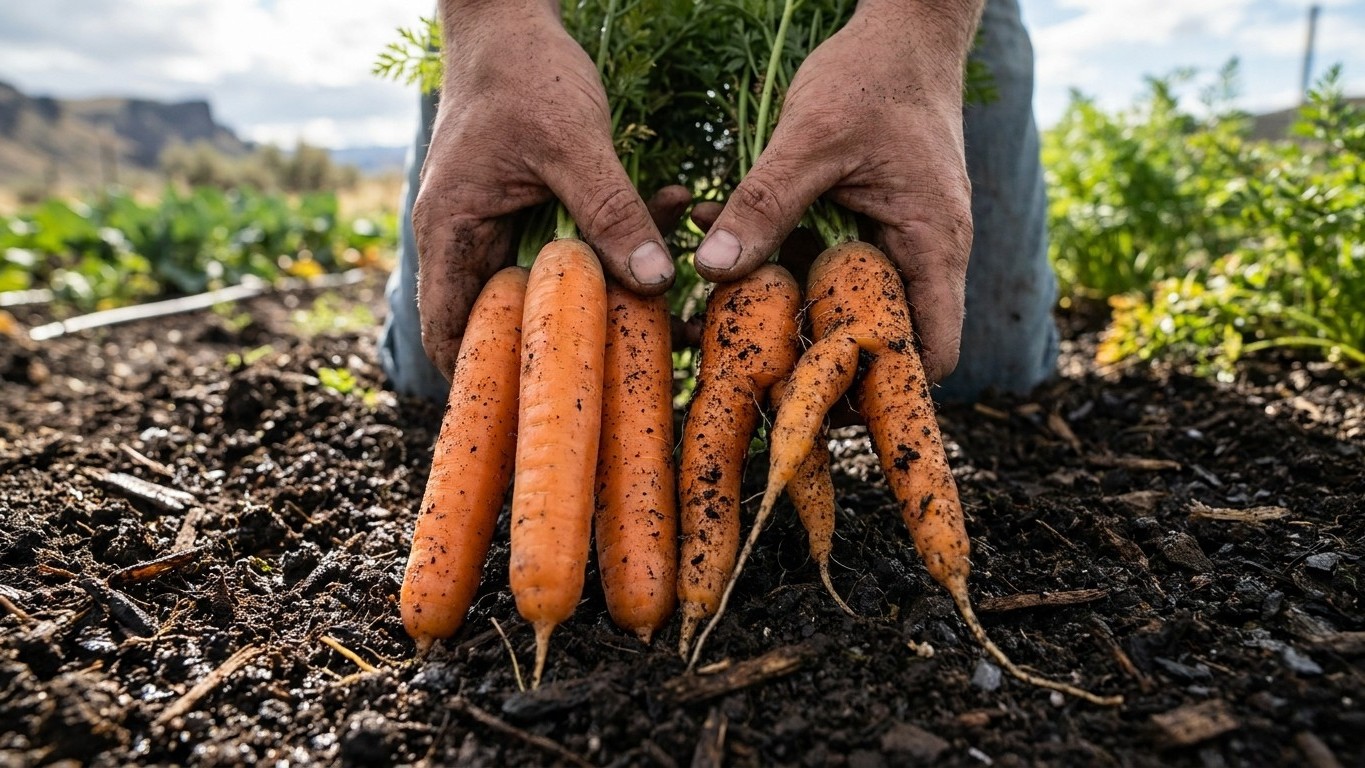
For a carrot grower, that combination is mixed news. Carrots want deep, sandy, well-drained soil rich in organic matter, according to Utah State University Extension, and heavy or rocky ground is what makes the taproot split into two or three forks as it searches for the path of least resistance. Threebear’s low clay share and moderate drainage put it on the friendlier side of that equation. Forking from sheer soil density is less likely here than in a compacted clay loam. The strong acidity is the bigger obstacle. It won’t bend a root the way a chunk of gravel will, but it can stunt growth and hold back the fine root hairs a carrot needs to size up evenly, and a soil test that comes back near 5.0 is worth correcting with lime before you invest in a full bed.
One figure needs a caveat before it goes anywhere near your garden plan. The organic matter reading tied to this series comes in at roughly 75 percent, a number that only makes sense for a natural surface horizon like forest litter or a volcanic-ash cap, not for a dug and amended vegetable bed. No cultivated soil holds anything close to that once it’s been turned, planted and harvested for a season or two. Treat it as a description of undisturbed ground, not a target to chase.
If your own patch turns out to be heavier than this reference profile, Utah State’s guidance still applies: work in plenty of compost and double dig the bed, loosening it a full spade’s depth beyond where you’d normally stop, or skip the argument with your native soil altogether and build a raised bed filled with a looser mix. Idaho, like every state, spans hundreds of mapped soil series, from ashy volcanic loam to heavy river-bottom clay to thin, stony hillside ground. Threebear is a starting point for thinking about the region, not a diagnosis of what’s under your own boots.
The test that settles it in your own garden
The state soil description tells you what the region tends toward. It says nothing about the ten-by-ten patch behind your house, which may sit on fill dirt, old lawn, or a soil series nobody has walked over with a state description in hand. A short, physical check answers the question the map can’t.
- Dig a hole at least a foot deep. Carrots need clear, loose ground for their full length, so look at how far down the soil stays workable before it turns to hardpan, rock, or dense clay you can’t easily break apart.
- Check for stones and buried debris. Pull out anything solid you find along the way. A root doesn’t stop for a pebble the way a shovel does; it forks around it instead.
- Feel the texture between your fingers. Wet a handful lightly and rub it. Gritty and loose means sand, smooth and sticky means clay, silky and slick usually means silt. Most garden soils are a blend, and knowing which side yours leans toward tells you how much amending it needs.
- Roll a moist handful into a ball. If it holds a tight shape and resists breaking, clay content is high and a heavy amendment plan is worth the effort before sowing. If it falls apart almost immediately, drainage is likely fast and forking from density is less of a concern.
- Watch how water drains after a hard rain or a deep watering. Standing water an hour later points to poor drainage and a case for raised beds. Water that disappears within a few minutes across the whole bed points to good drainage, sometimes fast enough that you’ll need to water more often once seeds are in.
None of these steps needs lab equipment, and none of them substitutes for a real soil test if you want an actual pH or nutrient number. But they’ll tell you, in an afternoon, whether your ground is closer to the loose ash-based profile described above or to something denser that calls for compost, double digging, or a raised bed before a single seed goes in.
When to sow here
Carrots go into the ground as seed, straight into their final spot. There’s no transplanting step to count from, no seedling tray to move outside on a warmer week. Every date below runs from the day the seed hits the soil.
- Start with the frost window. Around the Boise station tracked by NOAA’s National Centers for Environmental Information, the last spring freeze typically falls somewhere between April 23 and May 7, based on the 1991-2020 climate normals. That’s a range, not a fixed date, and it applies to a low valley station. Idaho’s higher ground, which covers most of the state, runs colder and later, sometimes by weeks.
- Sow two to three weeks before that window closes. Carrot seed tolerates cool soil and a light frost better than the seedlings of many other vegetables, so gardeners typically get it in the ground two to three weeks ahead of the last expected freeze rather than waiting for frost-free conditions.
- Check the soil temperature before you trust the calendar. Seed needs the ground to have warmed to at least 40 F to germinate at all. A calendar date means little if a cold snap has kept the soil colder than that; a simple soil thermometer pushed a couple of inches down settles the question faster than guessing.
- Aim for the range where germination actually performs best. Seed germinates most reliably between 55 and 65 F. Sowing at the 40 F minimum will eventually produce a stand, but slowly and unevenly; waiting until the soil sits in that 55-65 F band gives faster, more uniform sprouting.
- Count forward from seeding, not from a transplant, for harvest. Once you have a sowing date, everything downstream, thinning, watering schedule, expected root size, is measured from that day in the ground, since carrots have no earlier transplant stage to shift the clock.
What goes wrong here
- Forking in heavy or compacted ground. Even where the region’s reference soil runs loose, a builder-graded lot, an old driveway base, or a compacted clay pocket can still split a taproot into two or three legs as it hits resistance. The fix is the one Utah State University Extension gives for heavy soil generally: work in compost and double dig the bed, or sidestep the problem with a raised bed filled with looser material.
- Poor, patchy germination during a hot stretch. Carrot seed germinates best between 55 and 65 F, and a sudden warm spell can push soil past that range right when seeds are trying to sprout. A layer of mulch or a board laid over the row until seedlings emerge keeps the seedbed cooler and more even, and watering lightly but consistently prevents the surface from crusting over in the heat.
- Split roots from uneven watering. A root that grows steadily and then gets a sudden heavy soak after a dry stretch can crack along its length as it swells too fast. Keeping the watering schedule even, rather than letting the bed dry out hard between waterings, avoids the sudden growth spurt that causes the split.
- Slow, stunted growth in strongly acid soil. Ground closer to a pH of 5.0, the value recorded for the region’s reference series, sits below where root vegetables generally perform best. A soil test that confirms strong acidity in your own bed is worth correcting with lime well ahead of sowing, since amending soil chemistry takes time to take effect.
Checking this against your own county
Everything above describes one mapped soil series and one region’s frost data. Neither one is a substitute for what’s actually growing, or failing to grow, in your own county. University of Idaho Extension keeps county-level offices that can run a real soil test, confirm local frost dates than a single valley station, and flag pest or disease pressure specific to your area.
Reaching out before you commit a season’s work to a bed is a shorter path than troubleshooting forked or stunted carrots after the fact. Their office directory and current guidance are posted at the University of Idaho Extension.
Common questions
Does Idaho’s state soil mean my garden will be acidic too?
Not necessarily. The Threebear series represents one mapped profile among hundreds across the state, and its pH near 5.0 describes that specific series, not every yard in Idaho. A local soil test is the only way to know your own reading.
Can I sow carrot seed as soon as the soil thaws?
Soil needs to reach at least 40 F before carrot seed will germinate at all, and it germinates far better between 55 and 65 F. Thawed ground and warm-enough ground aren’t always the same thing, so checking soil temperature directly is more reliable than guessing from the calendar.
Will a raised bed fix forking on its own?
A raised bed filled with a loose, well-draining mix sidesteps a heavy or rocky native soil entirely, which handles the most common cause of forking. It won’t correct acidity or nutrient issues on its own, so a soil test of the fill material still matters.
How long after sowing should I expect to harvest?
Carrots typically need 70 to 100 days from seeding to reach harvest size, counted from the day seed goes into the ground since there’s no transplant stage to shift the timeline. Cooler soil, shade, or stress during growth can push that toward the longer end.