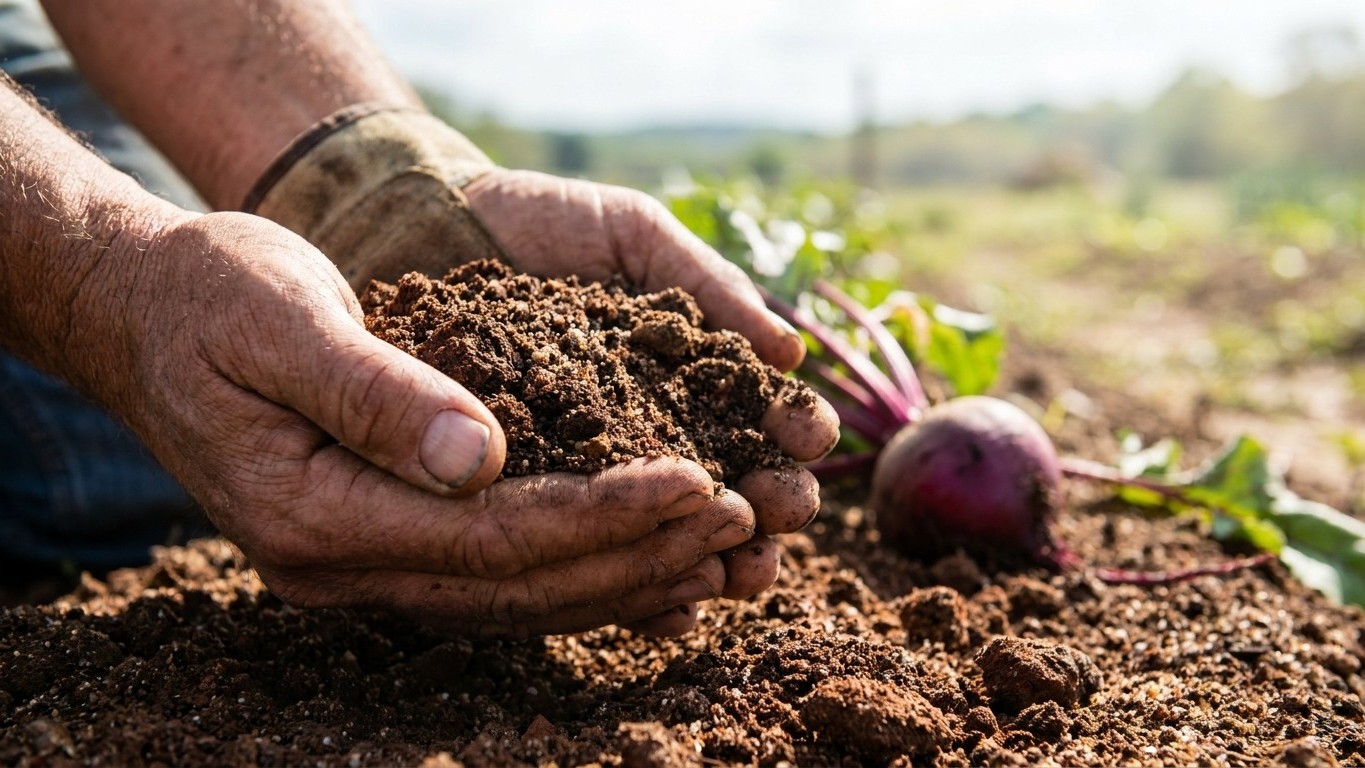

Illinois’ signature soil, the Drummer series, is a poorly drained, clay-heavy Mollisol built for corn and soybeans, not the deep, loose, sandy ground beets actually want. That mismatch is fixable with raised beds and modest organic matter, but timing matters just as much: sow 2 to 3 weeks before your local last frost, and know that your first six weeks in the ground will likely include both a cold snap and a dry spell before the season evens out.
The short answer
The Drummer series is Illinois’ official state soil, named by state law and tracked by USDA NRCS as the representative ground of the Corn Belt. It’s dark, deep and rich, with roughly 5.5 percent organic matter in the surface horizon, a surface pH near 6.7 (essentially neutral), and a texture that runs 8 percent sand, 31 percent clay and 61 percent silt. That’s a clay-dominant profile, and the series is classified as poorly drained.
None of that is what a beet is looking for. Utah State University Extension is blunt about it: beets want deep, sandy, well-drained soil rich in organic matter. Drummer gives you the organic matter, but the sand is missing and the drainage runs the wrong direction. In practice, that means water sits longer in a Drummer-type bed after rain than a beet root prefers, and heavy clay resists the kind of easy, unobstructed growth a straight, unforked beet needs. Raised beds, or at least loosened and amended rows, do most of the correction here. Utah State’s guidance caps the fix at no more than 1 inch of composted organic matter worked into the top of the bed per 100 square feet, since piling on more organic matter than that isn’t the goal, drainage and looseness are.
On the heat side, the published guidance is specific about the failure mode rather than a location’s yearly heat tally: temperatures above 85 F combined with water stress make the root woody. Illinois summers deliver stretches of weather in that range, sometimes long ones, but this page doesn’t have a verified count of how many days a year any Illinois location crosses 90 F, so that number isn’t published here. What is confirmed is the mechanism: heat alone isn’t the enemy, heat paired with a thirsty root is.
Keep the state soil in perspective. Illinois spans hundreds of mapped soil series, from sandy river-bottom ground to compacted urban fill where a building once stood. Drummer represents the state in the way a state bird represents a state, it’s the emblem, not a promise about your yard. The organic-matter and pH figures above describe the surface horizon of Drummer as mapped in its natural state, not a cultivated garden bed. A homeowner’s real starting point is a soil test, not this page. Use Drummer to understand the regional tendency toward heavy, slow-draining clay, then verify what’s actually under your own beet bed.
The six weeks that decide it here
Beets are direct-sown, never transplanted, and the standard advice is to get seed in the ground 2 to 3 weeks ahead of the last spring frost. Near Chicago O’Hare, the station NOAA NCEI uses for the 1991-2020 climate normals in this region, the last spring freeze at 32 F falls somewhere between April 11 and April 22 in most years, based on the 30 to 70 percent probability band. That puts an Illinois beet’s first six weeks, the window that determines whether it bolts or not, squarely in late March through May depending on how early or late a gardener plants relative to that window.
That stretch of the Illinois calendar is not a settled, predictable season. Spring in this part of the Midwest tends to swing rather than hold steady, cold snaps followed by warm surges, a soaked week followed by one dry enough to crack the surface of a clay-heavy bed. On Drummer-type ground, the poor drainage cuts both ways during this window: a wet spell can leave the root zone saturated and cold, slowing germination, while a dry spell right after can pull moisture out of a bed that was never built to drain evenly in the first place. Utah State’s guidance is precise about what a dry stretch does to a young beet: water stress in the first 6 weeks causes premature flowering, meaning the plant bolts to seed instead of building a root worth eating.
That’s the practical stakes of this six-week window in Illinois: it’s not really about surviving frost (beets tolerate cool soil reasonably well), it’s about keeping the root zone evenly moist while spring does its usual back-and-forth. A gardener who sows on schedule, 2 to 3 weeks before that April 11 to April 22 date, but then lets the bed dry out during one of the season’s typical dry pulses, is the classic setup for a bolted crop later in the year. This is also where the suburban-versus-airport gap matters: a garden outside the city, especially at any elevation or further from the urban heat island, will often see its own last frost run one to two weeks later than the O’Hare station date, and the first fall frost arrive one to two weeks earlier. That shifts the whole six-week window, so the airport date is a reference point, not a planting order for every county.
What goes wrong here
- Waterlogged, slow-draining beds after spring rain. Drummer-type clay holds water rather than shedding it, and a saturated root zone slows germination and invites rot. Build a raised bed or work the row deeply enough that excess water has somewhere to go, and avoid working the soil while it’s still wet enough to compact into clods.
- Bolting from an early dry spell. If the bed dries out anywhere in the first six weeks after sowing, the plant reads that as a signal to flower rather than bulk up its root. Water on a consistent schedule through that window rather than reacting only when the surface looks dry, since clay soils can look damp on top while the root zone below is already stressed.
- Woody roots from a late-season heat and thirst combination. Once temperatures climb past 85 F, a beet that’s also short on water toughens up rather than staying tender. This is a separate failure from bolting, it happens later in the season and it doesn’t stop the root from forming, it just ruins the texture. Mulch to buffer soil temperature and keep watering steady once summer heat sets in.
- Forked or misshapen roots in unamended clay. Heavy, compacted clay resists a straight taproot the same way it resists a shovel. Loosen the bed a full spade’s depth before sowing rather than relying on surface amendment alone.
- Over-amending with organic matter. More compost isn’t automatically better. Utah State’s own ceiling, no more than 1 inch of composted organic matter per 100 square feet, exists because piling on organic matter past that point can throw off the balance the bed needs rather than simply making it richer.
Common questions
Does Illinois’ state soil mean my garden is automatically bad for beets?
Not automatically. Drummer is the soil that represents Illinois at the state level, but the state contains hundreds of other soil series, and river-bottom ground, hill country, and any lot a builder has graded or filled will differ from Drummer entirely. Treat the state soil as a regional tendency toward heavy, slow-draining clay, and confirm your own bed’s texture and drainage with a soil test rather than assuming Drummer’s numbers apply to your yard.
How many days from sowing to harvest should I expect?
The commonly cited range runs 60 to 80 days, and that clock starts at seeding in the garden bed, not at any transplant date, since beets are always sown directly in place rather than started elsewhere and moved.
Is bolting the same problem as a woody root?
No, and treating them as one problem is the most common mistake. Bolting comes from water stress in the first six weeks after sowing and causes the plant to flower instead of building a proper root. Woodiness comes later, from heat above 85 F combined with water stress, and ruins the texture of a root that already formed. Different timing, different fix, both come back to keeping the bed consistently watered rather than watering only when it looks dry.
Should I add compost to a heavy clay bed before planting beets?
Some organic matter helps loosen a clay-dominant bed like Drummer-type soil, but Utah State University Extension caps it at no more than 1 inch of composted organic matter per 100 square feet. The goal is better structure and drainage, not maximum richness, and overshooting that amount doesn’t buy you anything extra.