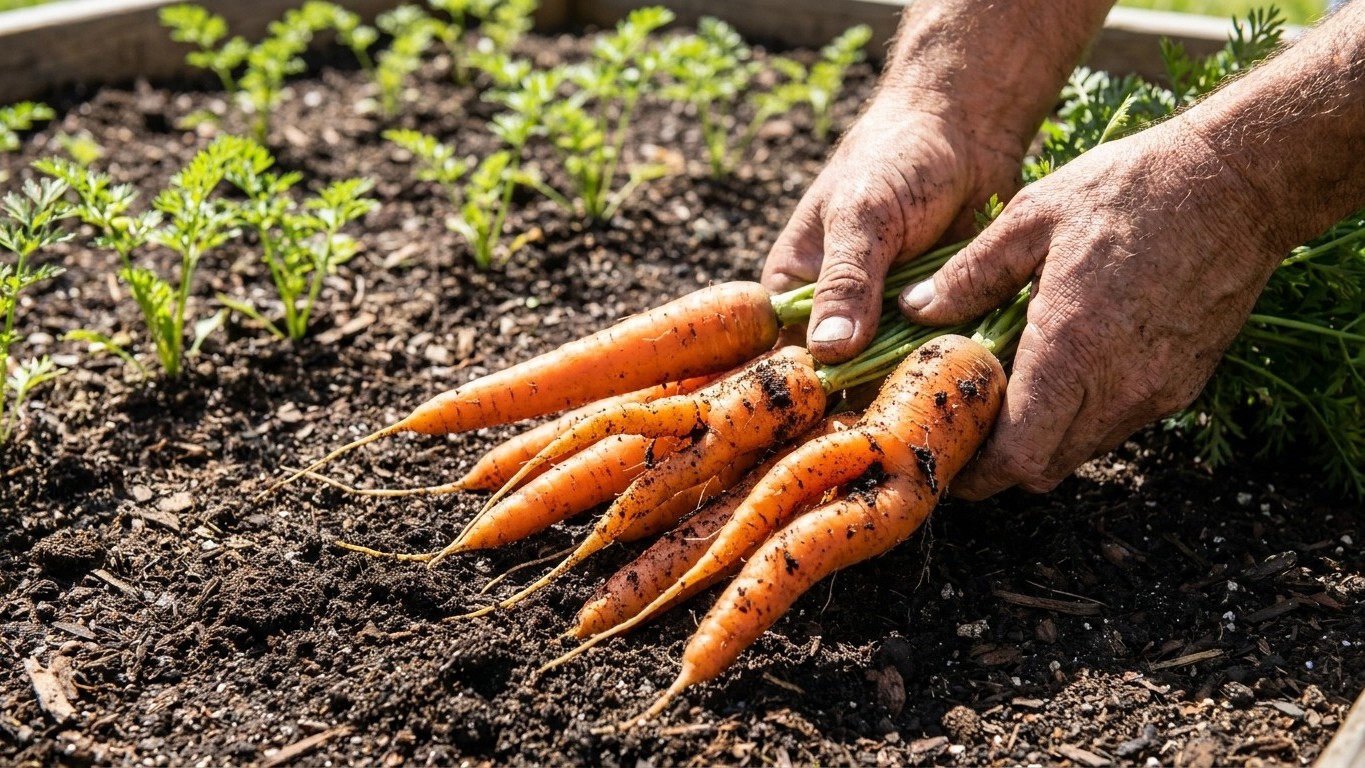

There’s no single fixed date, because carrots don’t wait for a frost-free calendar the way tomatoes do. Seed goes into the ground while the soil is still cool, in the weeks leading up to the average last spring frost rather than after it. In Illinois, though, the harder question isn’t really the calendar. It’s the ground itself. The state’s signature soil is heavy, silty clay, exactly the kind of dirt that can turn a straight carrot into a forked one.
The short answer
Illinois carries the Drummer series as its official state soil, a designation set by Illinois law in 2001 and tracked by the USDA NRCS State Soils program. Drummer is a Mollisol, the deep, dark, organic-rich prairie soil that built the Corn Belt and made the region one of the most productive farming landscapes on the continent. Sampled at the surface, USDA’s Soil Data Access records show it running about 8 percent sand, 31 percent clay and 61 percent silt, with organic matter around 5.5 percent and a surface pH near 6.7, close to neutral. It is also classified as poorly drained.
Put a carrot seed in ground shaped like that and the root has a rough time of it. Utah State University Extension is blunt about what carrots actually want: deep, sandy, well-drained soil rich in organic matter. Heavy or rocky soil makes the root fork, splitting into two or three legs instead of growing down as one clean taper. Drummer’s numbers, 61 percent silt and 31 percent clay against just 8 percent sand, sit almost exactly opposite that wish list. Add poor drainage and you get compacted, slow-draining ground that resists a thin taproot pushing straight down.
The fix Utah State lays out isn’t a different variety. It’s soil work: generous compost worked in, and double digging to loosen the profile well below where the root will travel. Where the native ground is simply too heavy to turn workable in a season, a raised bed filled with looser, amended soil sidesteps the problem entirely, since the carrot never has to fight the native clay at all.
None of this means every Illinois garden is Drummer soil. Illinois spans hundreds of mapped soil series, from sandy ground along the Illinois and Mississippi River terraces to shallow, rocky soils in the driftless hill country of the northwest. Drummer describes what made the state’s prairie ground famous, not what’s necessarily under any one backyard. Treat it as a starting point for what heavy Midwest clay tends to do to a carrot, then find out what’s actually in your own bed.
The test that settles it in your own garden
The state soil survey can tell you what the region tends toward. Only digging in your own yard tells you what your carrots will actually meet.
- Dig a test hole where you plan to sow. Go down as deep as you’d want a mature carrot root to reach, and keep going a bit further so you can see what lies beneath the topsoil.
- Look at what comes out. Note the depth of the darker topsoil before it changes color or texture, and check for stones, gravel or a dense, compacted layer. Rocks and a shallow topsoil layer are what push carrots to fork or grow stubby.
- Feel the texture. Take a handful of moist soil and squeeze it. Soil that ribbons out smooth and holds its shape is heavy in clay, closer to what the Drummer series represents. Soil that falls apart and feels gritty leans sandy, closer to what carrots actually prefer.
- Watch how it drains. After a rain, or after watering the test hole, come back and see how long standing water lingers. Water that disappears quickly points to loose, well-drained ground. Water that sits for a long stretch signals the same kind of poor drainage the state soil survey lists for Drummer.
- Compare what you found to the carrot’s wish list. Deep, loose, stone-free and quick-draining is the target. Wherever your test hole falls short, that’s the exact spot to add compost, double dig, or simply build up rather than dig down.
What goes wrong here
- Forked or twisted roots in heavy ground. This is the direct result of clay-heavy, poorly drained soil like the state’s Drummer series: a taproot meets resistance or a stone and splits rather than pushing straight through. Utah State University Extension’s remedy is straightforward: work in plenty of compost and double dig the bed before sowing, or grow the crop in a raised bed filled with looser soil so the root never has to fight native clay at all.
- Poor or patchy germination during a hot, dry stretch. Carrot seed is small and slow to sprout, and heavy silty-clay soil can crust hard on top as it dries after a rain, sealing in the moisture the seedling needs to break through. Keeping the seedbed lightly and consistently moist until seedlings appear, and avoiding a hard crust from forming, matters more with this type of soil than with a looser, sandier bed.
- Split or cracked roots from uneven watering. Clay-rich soil like Drummer swings between two extremes: it holds water and turns waterlogged after rain, then cracks and dries out hard once the surface bakes. A carrot root that’s stalled by drought and then hit with a sudden soak tends to split along its length. Watering on a steady, even schedule rather than in occasional heavy dumps evens out that swing and reduces splitting.
Common questions
Does the Drummer soil series mean my carrots will always fork?
No. Drummer is the state’s official soil and represents the deep, dark prairie ground that made Illinois farmland famous, but the state includes hundreds of other soil series. Your yard may be sandier, rockier, or better drained than Drummer. The soil survey is a starting point for understanding regional tendencies, not a diagnosis of your specific bed.
Should I use a raised bed instead of amending heavy clay?
Either approach can work, according to Utah State University Extension, which recommends generous compost and double digging for heavy soil, or a raised bed as an alternative. A raised bed is often the faster route if the native ground is compacted or full of stones, since it lets you fill with loose, amended soil from the start rather than reworking what’s already there.
Can I sow carrots directly into unimproved clay soil?
You can, but expect more forked and stunted roots. Carrots want deep, sandy, well-drained soil rich in organic matter, and unimproved clay runs opposite to nearly every part of that. Working compost into the bed and loosening the soil well below the expected root depth before sowing gives the seed a far better shot at a straight taproot.
How long from sowing to harvest once carrots are in the ground?
Carrots are sown directly in place, with no transplanting step, so every day counts from the moment the seed goes into the soil. Depending on the crop and conditions, that stretch from seeding to harvest typically runs somewhere between 70 and 100 days, which is worth keeping in mind when you’re counting backward from any target harvest window.