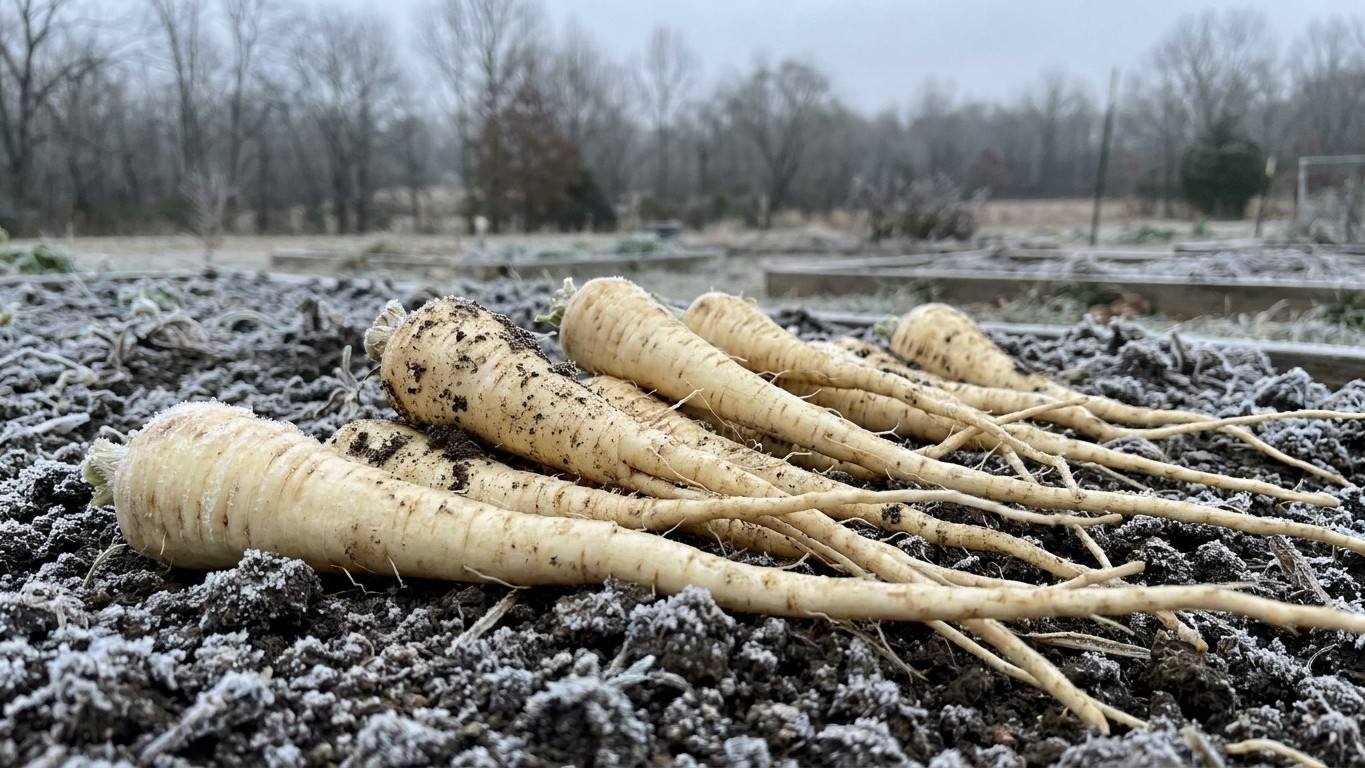

Minnesota parsnip growers get good news on one front and a scheduling puzzle on another. The cold here is real and reliable, more than enough to trigger the frost-driven sweetening parsnips are known for. The season length is the part worth checking before you commit a garden bed to a root that takes months to finish.
The short answer
Here’s the question that actually decides whether a Minnesota parsnip turns sweet: does this place deliver several weeks of hard, sustained frost before the roots come out of the ground? In the Twin Cities area, the mean daily minimum temperature during the coldest month sits at 8.8°F, based on NOAA NCEI Climate Normals from the Minneapolis reference station. That’s not a record low or a fluke cold snap. It’s the average low, night after night, across the coldest stretch of winter.
That number matters more than any hardiness zone label you’ll see on a seed packet or a nursery tag. Zone maps describe which perennial plants can survive winter in a given spot. They don’t tell you anything about how many frosty weeks a biennial root vegetable will sit through before harvest. Parsnips don’t need to survive winter as a living plant pushing new growth. They need cold exposure while dormant in the soil, cold enough and long enough to convert stored starch into sugar. An 8.8°F average minimum, repeated across weeks rather than days, is exactly the kind of sustained chill that does the job.
So the plain answer for Minnesota: yes, parsnips grown here will sweeten, not just grow. This isn’t a marginal case where a gardener has to hope for an unusually cold winter. The state’s winter climate normal already clears the bar with room to spare. Compare that to a milder climate where the coldest month might average in the 30s or low 40s, barely dipping below freezing on the worst nights. In that kind of place, a parsnip can reach full size and still taste flat and starchy, because the roots never experience the sustained cold that triggers the starch-to-sugar conversion. Minnesota doesn’t have that problem.
The tradeoff is that a climate cold enough to sweeten parsnips reliably is also a climate with a shorter growing season on the front end. The sweetening isn’t in question here. Whether the crop has enough calendar time to reach full size before that cold sets in is the part that needs actual arithmetic, which is exactly what the next section walks through.
Does the season fit?
Parsnips are sown directly in the garden bed, not started indoors and transplanted, and the standard guidance from Utah State University Extension calls for 100 to 120 days from seeding to maturity, with sowing timed 2 to 3 weeks before the last spring frost. Here’s how that lines up against Minnesota’s frost calendar.
- Start with the last spring frost. NOAA NCEI’s 1991-2020 climate normals put the last spring freeze for the Twin Cities reference station between April 17 and April 30, using the 30-70% probability band for a 32°F freeze.
- Back up 2 to 3 weeks for sowing. That puts a Twin Cities sowing date somewhere in the last week of March through the middle of April, depending on how the spring is running.
- Add germination time before anything visible happens. Parsnip seed is slow to sprout, typically taking 14 to 21 days. A gardener who sows in late March or early April won’t see rows emerge until mid to late April. This is the point where impatient gardeners assume the seed failed and till the bed back up. Don’t. Bare soil at three weeks is normal, not a crop failure.
- Count 100 to 120 days from the seeding date, not the emergence date. A sowing in the first week of April puts maturity somewhere in the middle of July to the beginning of August.
- Check that against the first fall frost. The Twin Cities first fall freeze runs between October 11 and October 23, per the same NOAA NCEI normals.
- Look at the gap. A crop that matures by late July or early August, with the first fall frost not arriving until mid-October, leaves roughly two and a half to three months of extra time in the ground. That’s not a tight fit. That’s a comfortable one, and the surplus time is useful: it means the roots can sit in place through the early frosts of October, absorbing exactly the cold exposure that makes them sweet, without any risk of the season running out first.
Northern Minnesota is a different calculation. Frost dates there run two to three weeks tighter on both ends, which shrinks the cushion but doesn’t erase it. A grower in the northern part of the state should sow at the earliest safe date within that 2-to-3-week window before the local last frost, rather than waiting for a comfortable, already-warm afternoon.
What goes wrong here
- Forked roots in heavy or stony ground. Parsnips grow a single long taproot, and anything solid in its path (compacted clay, rocks, old root chunks) splits it into two or three forked legs. Utah State University Extension recommends deep sandy soil, and where the native soil is heavy, double digging the bed to break up compaction before sowing. Minnesota’s clay-heavy soils in many counties make this the single most common cause of misshapen parsnips.
- Forked roots from overwatering. This is a separate cause from heavy soil, not the same problem restated. Consistently soggy soil encourages the taproot to branch rather than drive straight down. Water enough to keep the bed evenly moist during germination and early growth, but avoid the kind of daily soaking that keeps the root zone saturated for weeks.
- A season that runs out in the far north. Northern Minnesota’s tighter frost window leaves less slack than the Twin Cities calculation above. A late sowing, pushed back by a wet spring or a delayed start, can leave the crop short of its 100-to-120-day requirement when the first fall frost arrives. Sowing at the earliest safe date, rather than waiting for warmer soil, is the fix.
- Harvesting before the frost does its work. This one is specific to a state with plenty of cold: gardeners sometimes pull parsnips as soon as they look full-sized, without waiting through several weeks of hard frost first. The roots will be fine to eat, but they’ll taste like a starchy carrot instead of the sweet, nutty parsnip the wait is supposed to produce. Leave the roots in the ground through the early fall frosts and harvest later, not sooner.
North Carolina Extension Gardener Plant Toolbox puts it plainly: “All parts of this plant contain furocoumarins which can make skin sensitive to light causing burns so be sure to wear gloves, long sleeves and long pants when dealing with it.” That’s not limited to the leafy tops. It covers the whole plant, roots included, and it’s worth taking seriously precisely because most garden guides never mention it.
The mechanism is what makes this risk easy to miss. Furocoumarins in parsnip sap don’t burn skin on contact by themselves. The reaction needs sap on the skin and then sunlight on that same patch of skin. That combination is exactly what happens during harvest or when pulling and trimming the foliage on a bright day, hands and forearms brushing against wet, broken stems and leaves while standing in full sun. The burn doesn’t show up immediately either. It typically develops hours later, which is part of why people don’t connect it to the gardening they did that morning.
Because the reaction requires light, not just sap, washing your hands after the fact doesn’t undo exposure that already happened in sunlight. The real protection is preventing skin contact in the first place: gloves, long sleeves, and long pants when handling any part of the plant, harvest day included.
Checking this against your own county
The frost figures here come from a single reference station near Minneapolis, and Minnesota is a long state. A county near the Iowa border and a county near the Canadian border can differ by several weeks on both the last spring frost and the first fall frost, which shifts both your sowing window and how much cushion you have before the ground freezes hard.
University of Minnesota Extension is the source to check against your specific county before you finalize a sowing date. They maintain local frost data and planting guidance calibrated to Minnesota’s regions rather than a single statewide average, which matters more for a 100-to-120-day crop than for something you can rush through in six weeks.
Common questions
Can I sow parsnips in Minnesota in midsummer for a fall crop?
No. Parsnips need 100 to 120 days from seeding, and a midsummer sowing wouldn’t reach maturity before the first fall frost arrives in October. Spring sowing, timed 2 to 3 weeks before the last frost, is the only window that works here.
Should I mulch parsnips left in the ground over frost?
Mulching over the row keeps the ground workable so you can dig roots after the soil would otherwise start to freeze solid, letting you extend the harvest window through more of the frosty weeks that build sweetness.
Why hasn’t my parsnip seed sprouted after two weeks?
That’s normal. Germination runs 14 to 21 days, slower than most garden seed. Resist the urge to till the bed and re-sow before three weeks have passed.
Does the furocoumarin risk apply to store-bought parsnips too?
The warning from NC State Extension addresses the living plant, not the finished vegetable in your kitchen. The exposure risk is specifically tied to handling sap from a fresh-cut or fresh-pulled plant in sunlight, which is a garden-handling situation rather than a cooking one.