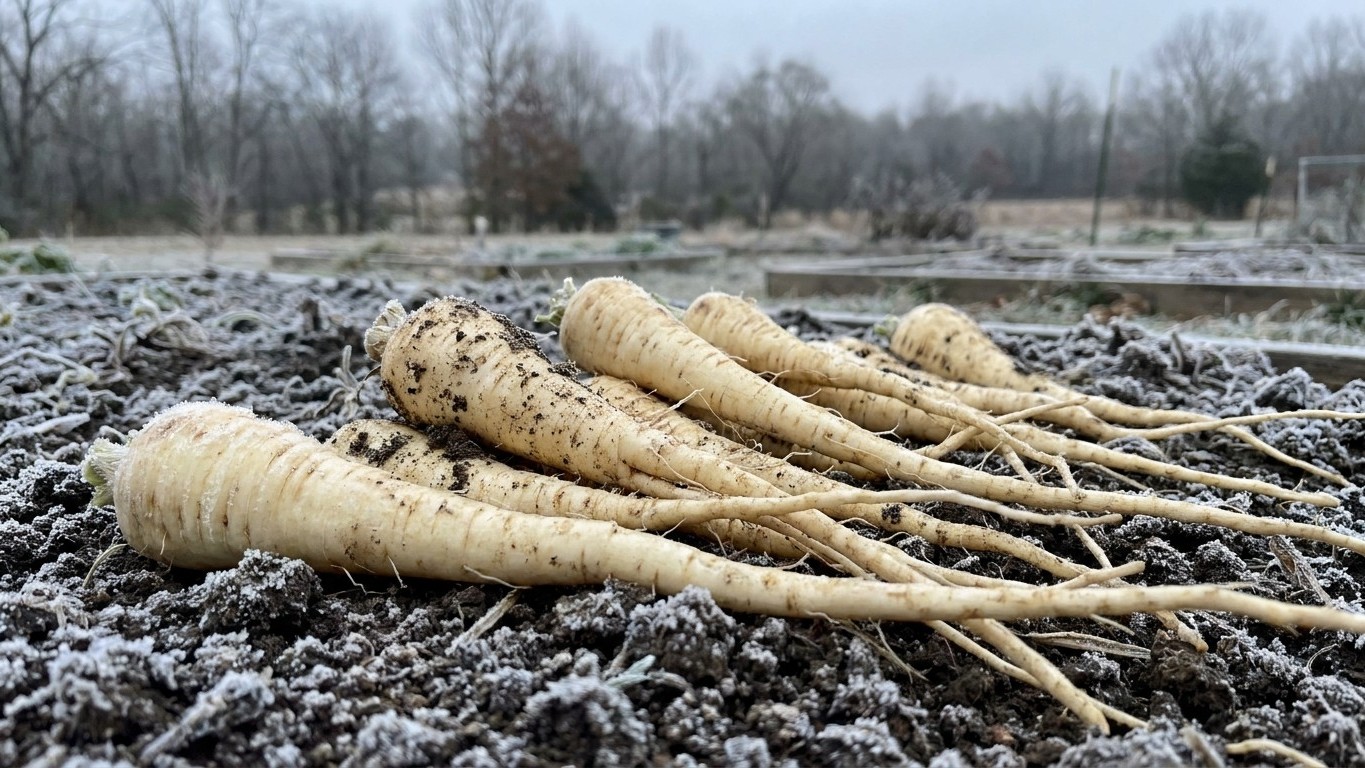

Vermont gardeners get a clear yes on both counts: the state’s frosty winters supply exactly the exposure parsnips need to turn their starch to sugar, and the growing season, even reckoned from the mild shores of Lake Champlain, leaves enough room to get a full-sized root before the ground locks up. The details change depending on where in the state you garden, but the fundamentals favor a sweet crop.
The short answer
The question that actually decides whether a Vermont parsnip turns sweet isn’t which hardiness zone shows up on a seed packet map. It’s whether the ground gets cold enough, for long enough, after the roots have already sized up in the soil. Hardiness zones describe whether a perennial plant survives winter where it’s planted. Parsnips don’t need to survive anything, they need to be exposed to cold while sitting in the ground, because that cold is what triggers the starch-to-sugar conversion that makes a parsnip worth eating instead of just growing.
Burlington’s climate record answers that directly. The coldest month there averages a daily minimum of 12.9°F, based on NOAA NCEI Climate Normals from the station covering 1991 to 2020. That’s not a record low from one unusually brutal night. It’s the average low across the coldest stretch of a typical winter, which means it happens reliably, year after year, not as a fluke.
A daily minimum sitting at 12.9°F for weeks on end is well below what a parsnip needs to trigger sweetening. Utah State University Extension notes the crop tastes best after several weeks of cool, frosty weather, and Vermont’s coldest month delivers far more than a handful of frosty nights. It delivers a sustained freeze cycle, night after night, which is the mechanism doing the actual work inside the root.
Compare that to a region where the coldest month barely dips below freezing on an average night. That’s a place where a parsnip can grow to full size and still taste flat, starchy, even faintly bitter, because the roots were pulled before real cold ever set in, or because the winter itself never got cold enough to finish the job. Vermont doesn’t have that problem. The risk here runs the other direction: harvesting too early, before the crop has had its full run of frosty weeks, and missing out on the sweetness the climate is already set up to deliver.
So the short answer holds: in Burlington and most of the Champlain Valley, parsnips left in the ground through a normal Vermont autumn and into the start of winter will sweeten. The remaining question is whether the growing season itself, from seed to a root worth leaving in the ground, actually fits.
Does the season fit?
Parsnips are sown directly into the garden bed, not started indoors and transplanted, which means every day of the countdown to maturity starts at the seed, not at a greenhouse. Here’s how the calendar plays out using Burlington’s published frost dates.
- Germination alone takes 14 to 21 days. That’s not part of the “100 to 120 days to maturity” figure most seed sources quote, it’s dead time before the countdown even starts, and gardeners who dig up the bed at day ten looking for sprouts are usually just impatient, not doing anything wrong.
- Seed goes in the ground 2 to 3 weeks before the last spring frost. In Burlington, that frost falls between April 30 and May 10, which puts a realistic sowing window in mid-to-late April.
- From sowing, the crop needs 100 to 120 days to reach full size. Counting forward from mid-to-late April lands maturity somewhere between early August and late August, well before any fall frost risk.
- The first fall frost in Burlington arrives between October 3 and October 13. That leaves roughly six to ten weeks after the crop is technically mature and before the ground freezes hard, time that isn’t wasted, because it becomes the frost-exposure window that sweetens the roots.
- Adding it up: from an April sowing to an October frost is somewhere around 165 to 185 days total. Against a 100-to-120-day requirement, that’s a comfortable margin, not a tight one.
- The caveat is real, though. Burlington sits on Lake Champlain, the mildest corner of Vermont. Gardeners in the Green Mountains or the Northeast Kingdom work with a shorter frost-free window, and that margin shrinks. A gardener in a colder pocket of the state should pull local frost dates rather than assume Burlington’s numbers apply, because a season that’s comfortable on the lakeshore can turn tight sixty miles inland.
What goes wrong here
- Forked roots in heavy or stony ground. Vermont’s glacial till soils run rocky and compacted in a lot of yards, and a parsnip taproot forks the moment it hits a rock or a dense clay layer instead of pushing straight down. Utah State University Extension recommends deep, sandy soil for straight roots, and where the ground doesn’t cooperate naturally, double digging the bed 12 to 18 inches down, and picking out stones as you go, gives the root a clear path.
- Forked roots from overwatering. This is a separate cause from soil texture, and it’s easy to mix the two up. Too much water encourages the root to split and branch even in decent soil. Keep the bed evenly moist rather than saturated, and let the top inch dry slightly between waterings once the seedlings are established.
- A season that runs out before maturity. This mostly threatens gardeners at higher elevation or in the Northeast Kingdom, where the frost-free window is shorter than Burlington’s. A late sowing, combined with a slow 14-to-21-day germination stretch, can push maturity dangerously close to the first fall frost. The fix is sowing at the earliest safe date for the local frost calendar rather than waiting for ideal weather.
- Harvesting before the sweetening has happened. Vermont’s winters are cold enough to sweeten parsnips reliably, but a root pulled the week it reaches full size, before several frosty weeks have passed, will still taste flat. Leave mature roots in the ground through repeated hard frosts rather than harvesting on the calendar date the seed packet suggests.
North Carolina Extension’s Gardener Plant Toolbox states it plainly: “All parts of this plant contain furocoumarins which can make skin sensitive to light causing burns so be sure to wear gloves, long sleeves and long pants when dealing with it.” That’s not limited to the leafy tops. It covers the whole plant, and it’s worth taking seriously before pulling a bed of parsnips on a sunny afternoon.
The mechanism is what makes this surprising. The burn isn’t caused by the sap on its own. It takes sap on the skin combined with sunlight hitting that same skin, a reaction called phytophotodermatitis. That’s why the injury shows up on a bright day spent harvesting or clearing tops, and why it doesn’t appear right away. The skin often looks fine at first, then reddens and blisters hours later, once the sunlight has had time to react with the compound already sitting on it.
It also explains why the protection is clothing, not a rinse afterward. Washing exposed skin after the fact doesn’t undo a reaction that’s already been triggered by sunlight. Gloves, long sleeves, and long pants, worn before handling the plant, are the actual defense, because they keep the sap off the skin in the first place rather than trying to manage the aftermath.
Checking this against your own county
Every figure here comes from a single reference station near Burlington, and Vermont’s terrain doesn’t hold to one climate from the Champlain Valley to the Northeast Kingdom. Elevation, distance from the lake, and local topography all shift frost dates, sometimes by two or three weeks in either direction. Before locking in a sowing date based on the numbers above, check them against local data.
The University of Vermont Extension is the state’s land-grant extension service, and it publishes county-level growing guidance, frost date charts, and soil testing resources built around Vermont’s actual regional variation rather than a single statewide average. Visit UVM Extension for guidance specific to your county before finalizing a planting date, especially if you’re gardening above the valley floor or well north of Burlington.
Common questions
Can parsnips overwinter in the ground in Vermont?
Many gardeners leave them in place through winter and dig as needed, since the cold soil keeps roots in good condition and continues the sweetening process. Mulching helps keep the ground workable enough to harvest during thaws.
Do parsnips need a different soil type than carrots?
They need the same basic conditions carrots do: deep, loose, stone-free soil. Utah State University Extension specifically calls for deep sandy soil, and where the native ground is heavier, it recommends double digging rather than planting into unamended clay.
Is it safe to eat parsnips after a hard freeze?
Yes. The freeze is what converts the stored starch to sugar, and that’s the point at which parsnips taste their best. There’s no food safety concern tied to leaving them in frozen ground.
Why did my parsnips split into two or three roots?
It comes from one of two separate causes: the taproot hit a rock, a hardpan layer, or dense clay and forked around it, or the bed was overwatered while the seedlings were establishing. Both produce the same forked shape, but the fixes are different, so it’s worth figuring out which one applies before the next planting.