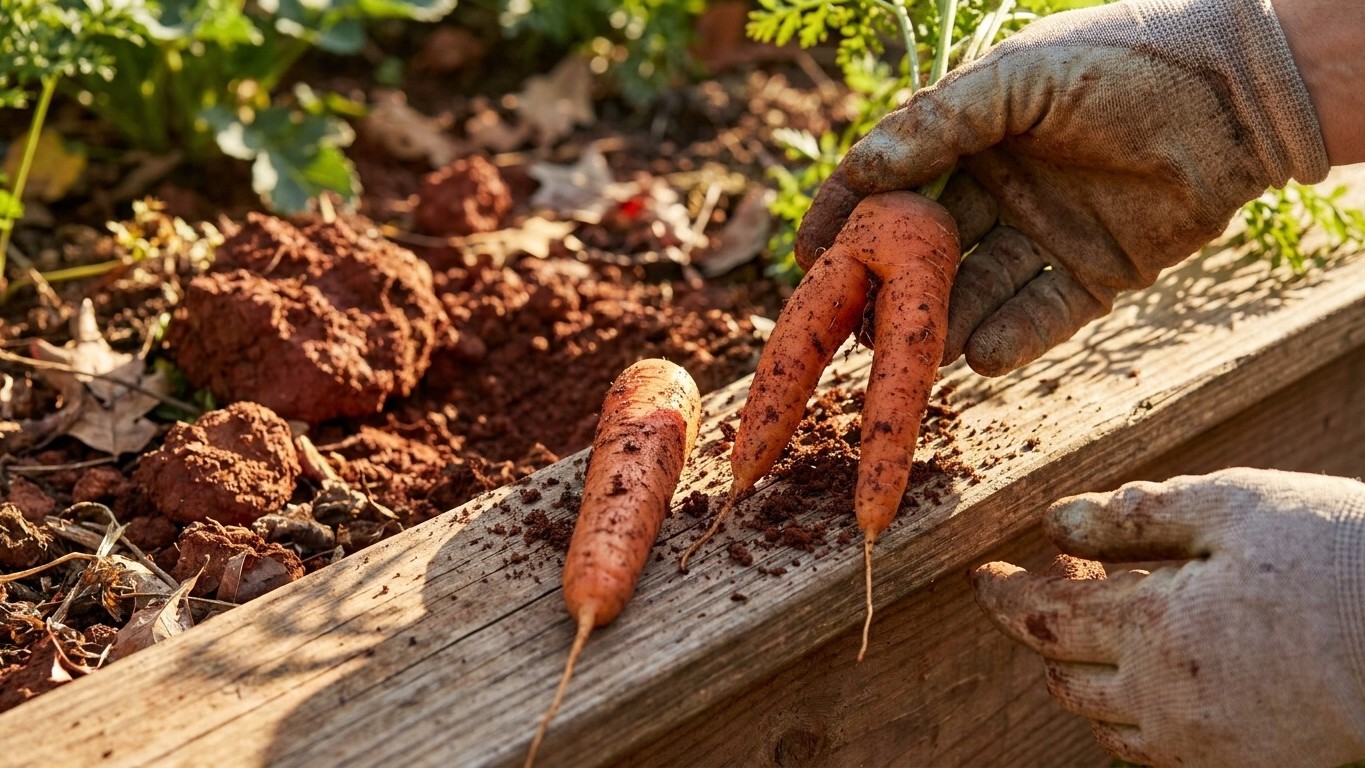

Massachusetts’s official state soil, the Paxton series, is sandy and well drained, exactly the texture Utah State University Extension says carrots need to grow straight instead of forked. That’s good news if your yard matches the profile. But soil texture changes block by block across the state, so the real answer depends on what’s under your own raised bed or row, not what a state law names as representative.
The short answer
Massachusetts adopted the Paxton series as its state soil, and the numbers behind that choice tell you a lot about what carrots face in typical New England ground. The Paxton series is classified as an Inceptisol, a young soil that hasn’t had time to develop the strong, distinct layers you’d find in older soil types. Its surface horizon runs about 61 percent sand, 7 percent clay and 32 percent silt, with organic matter around 5.5 percent and a surface pH close to 5.5, which is slightly acid. Drainage class: well drained.
Run that texture against what Utah State University Extension says a carrot actually wants, and the match is close. Their guidance is blunt: carrots need deep, sandy, well-drained soil rich in organic matter, and heavy or rocky soil is what makes the root fork. Paxton’s sand content (61 percent) and low clay (just 7 percent) land squarely in the category Utah State describes as favorable. On paper, a garden built on soil resembling this series shouldn’t produce the forked, stubby roots that heavy clay tends to hand you.
The organic matter figure, about 5.5 percent, is worth a second look before you get too comfortable. That number describes the natural surface horizon as mapped by soil surveyors, not a dug-and-amended garden bed. A worked bed with compost added over a few seasons can carry more organic matter than the raw series data shows, and a bed that’s been compacted by foot traffic or construction fill can carry a lot less. The pH reading, 5.5, also belongs to the mapped soil, not necessarily to the dirt under your tomatoes.
Here’s the caution that matters most: Massachusetts spans hundreds of distinct soil series, and Paxton is simply the one lawmakers picked to represent the state in 1990 through the USDA NRCS State Soils program. It is not a diagnosis of your yard. River bottoms tend to run heavier and wetter. Hill country can turn rocky fast. Any lot a builder graded, filled or scraped before your house went up can bear no resemblance to the native profile at all. If your garden sits on genuinely heavy or rocky ground, whatever the state soil says, the fix Utah State University Extension recommends stays the same: work in plenty of compost, double dig to break up the dense layer, or skip the fight altogether and grow carrots in a raised bed filled with loose, amended soil.
The test that settles it in your own garden
State soil data is a starting point, not a verdict. The only way to know what your carrots will hit six inches down is to check the ground yourself, and it takes fifteen minutes with a shovel.
- Dig a hole at least a foot deep where you plan to sow. Carrots need loose ground well past where most roots stop growing, so shallow digging won’t tell you enough.
- Look at what comes out. Note the depth before you hit a hardpan, a clay layer, gravel or ledge. Count and size any stones. A root pushing against a rock or a compacted layer is a root that forks.
- Feel the texture. Take a handful of moist soil and try to roll it into a ribbon between your fingers. Sandy soil falls apart. Clay-heavy soil holds a long, slick ribbon. Loam sits somewhere in between and crumbles into a shorter ribbon.
- Watch how water drains. Fill the hole with water and let it soak in, then fill it again and time how long it takes to disappear. Water that lingers for hours points to a drainage problem carrots won’t tolerate. Water that vanishes almost instantly suggests soil so sandy it may need more organic matter to hold moisture evenly.
Do this in two or three spots if your yard has any variation at all, near a downspout, next to a driveway, at the low end of a slope. Soil can shift character within a few feet, especially on lots that were partially filled or regraded. None of this replaces a lab soil test if you want exact numbers, but a shovel, your hands and a bucket of water will tell you within minutes whether you’re dealing with the loose, sandy profile carrots like or the dense, rocky ground that forces you toward compost, double digging or a raised bed.
What goes wrong here
- Forking in heavy ground. When a taproot meets compacted soil, a rock or a clay layer, it splits around the obstruction instead of pushing through. Utah State University Extension ties this directly to heavy or rocky soil conditions. The remedy is mechanical, not genetic: work in generous compost and double dig the bed to loosen soil well below where the root will travel, or build a raised bed filled with soil you control from the start.
- Poor germination during a hot, dry stretch. Carrot seed is small and sits close to the surface, so it dries out fast when the top inch of soil bakes. Keeping the seedbed consistently moist until seedlings emerge, and covering the row lightly to hold moisture, gives the fine roots a better shot at getting established before conditions turn harsh.
- Splitting from uneven watering. A root that grows steadily through a dry spell and then gets hit with a heavy soak can swell faster than its skin allows, causing it to crack along its length. A steady, even watering routine avoids the feast-or-famine pattern that triggers this.
- Stubby, short roots in shallow or rocky beds. Even without visible forking, a root that hits resistance early simply stops elongating. Since carrots are sown directly in place and never transplanted, there’s no second chance to fix a shallow bed once seed goes down. Loosen the full root zone before sowing, not after.
Common questions
Does the Paxton series mean my Massachusetts garden won’t have forked carrots?
Not automatically. Paxton is the soil the state adopted to represent it, but the state contains hundreds of soil series, and construction, fill and natural variation mean your own bed could differ completely. Use the texture and drainage test above to check your specific ground.
Is a pH of 5.5 a problem for growing carrots?
The 5.5 figure describes the Paxton series’ surface horizon as mapped, not a verified reading of your garden bed, and Utah State University Extension’s guidance on carrots addresses soil texture and organic matter, not a specific pH target. If you want your bed’s actual pH, a soil test is the way to get it.
How long do carrots take to mature after I plant them?
Carrots are sown directly in the garden and never transplanted, so maturity is counted from the seeding date, typically 70 to 100 days depending on the crop and conditions, not from any later planting-out step.
What’s the single best fix if my soil is heavy or rocky?
Utah State University Extension points to two options: work in plenty of compost and double dig the bed to loosen soil deep enough for a straight taproot, or sidestep the issue by growing carrots in a raised bed filled with soil you’ve built to be loose and well drained from the start.